
Calorie Deficit Calculator
Calculate exactly how many calories you need to lose weight. Understand your BMR, TDEE, and the perfect deficit for sustainable fat loss.
Calqulate.net calculates the daily deficit to reach your goal using proven energy-balance math with a safe-calorie floor. You get a clear target and the date you'll hit your goal.
3
Goal paces
Free
Price
No
Sign-up
Instant
Results
Private
In-browser
What Is a Calorie Deficit?
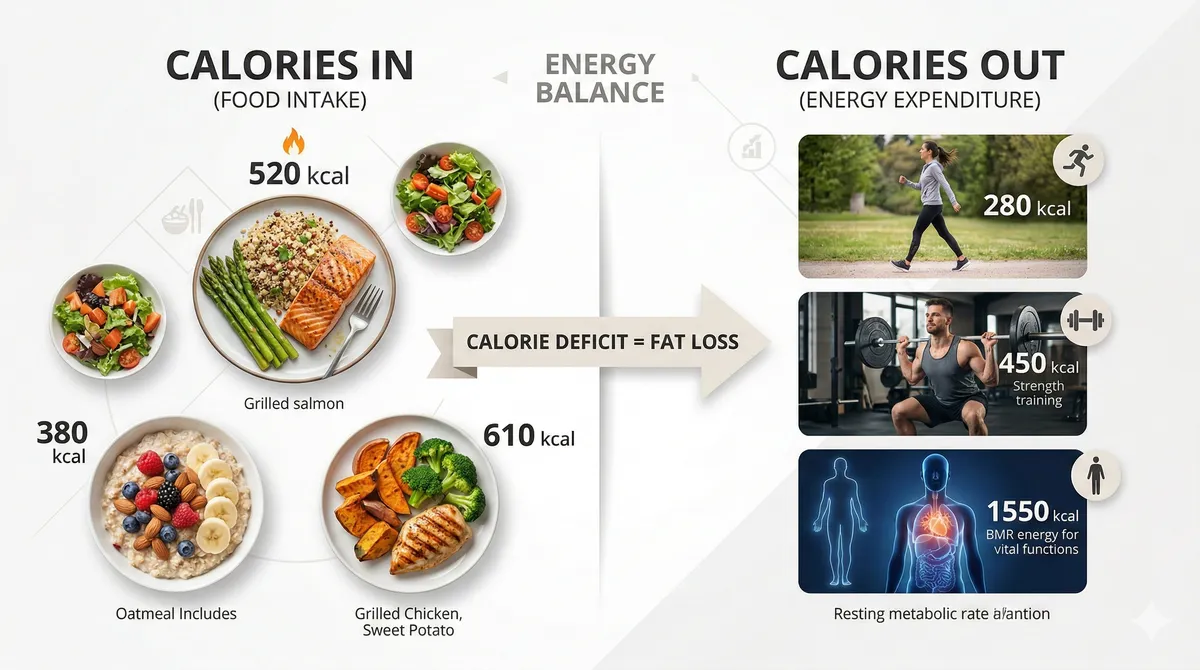
A calorie deficit happens when: Calories Burned > Calories Consumed. When this happens consistently, your body uses stored fat for energy, leading to weight loss.
Weight Loss Speed
Determined by the depth of your daily deficit.
Fat vs. Muscle
A proper deficit ensures you lose fat, not muscle mass.
Sustainability
Calculated deficits prevent extreme hunger and rebounding.
How to Calculate Calorie Deficit (Step-by-Step)
Calculate Your BMR (Basal Metabolic Rate)
We use the Mifflin-St Jeor Formula, the most accurate for adults:
Women: (10 × wt kg) + (6.25 × ht cm) − (5 × age) − 161
Calculate Your TDEE (Total Daily Energy Expenditure)
Multiply your BMR by your activity level multiplier:
| Activity Level | Multiplier |
|---|---|
| Sedentary | 1.2 |
| Light Exercise | 1.375 |
| Moderate Exercise | 1.55 |
| Very Active | 1.725 |
Apply the Calorie Deficit Formula
Calorie Deficit = Maintenance Calories (TDEE) − Target Intake
Safe Fat Loss Deficit Targets
| Daily Deficit | Expected Weekly Loss | Effort Level |
|---|---|---|
| 300 kcal | ~0.25 kg | Easy/Slow |
| 500 kcal | ~0.5 kg | Sustainable |
| 750 kcal | ~0.7 kg | Moderate |
| 1000 kcal | ~1 kg | Aggressive |
How Many Calories Deficit to Lose 1kg? 1 kg of fat ≈ 7,700 calories. To lose 1kg in a week, you'd need an 1,100 calorie daily deficit, which is aggressive and not ideal for most.
Lose Fat, Not Muscle
- Keep deficit moderate (300-500)
- Eat 1.6–2.2g of protein per kg
- Prioritize strength training
- Avoid crash dieting
Common Mistakes
- Eating too little: Leads to metabolic adaptation.
- Untracked oils/sauces: Hidden calories remove your deficit.
- Weekend overeating: Canceling out the weekday deficit.
- Overestimating exercise: Gym sessions burn less than you think.
Managing Weight Loss Plateaus
Most calculators don’t mention metabolic adaptation — but it matters. If you stop losing weight:
Realistic Expectations
A healthy fat loss rate is 0.5–1% of body weight per week. For an 80kg person, losing 0.4–0.8 kg per week is realistic and sustainable. Faster loss increases the risk of a weight rebound.
The "Free Calorie Deficit Calculator" Quality Standard:
An accurate tool must use the Mifflin-St Jeor formula, adjust for activity, allow for goal-based selection, and warn against cutting calories below your BMR.
Final Takeaway
Weight loss is not about starving. It’s about creating a controlled, sustainable calorie deficit. The best results happen when the deficit is moderate, protein is adequate, and progress is tracked weekly.
Curious about your hydration?
When dieting, water intake becomes even more critical for metabolic health.
Is Your Deficit Too Aggressive?
It is tempting to pick the biggest deficit and rush the process, but a deficit that is too deep usually backfires. If your daily deficit runs past roughly 1,000 kcal, or you are losing much faster than about 1% of your body weight per week, the calculator flags it for a reason. Very fast loss tends to strip away muscle alongside fat, leaves you tired and foggy, and nudges your metabolism to slow down as your body adapts. A slower, steadier pace is usually the one you can actually stick with.
This is also where some people ask about GLP-1 medications like semaglutide and tirzepatide. These drugs work mainly by reducing appetite, which can make a moderate deficit feel less like a fight. They are not a shortcut around the basics. You still lose weight because you eat fewer calories, you still need enough protein and strength training to hold onto muscle, and the same aggressive pace warnings still apply. GLP-1 medicines are prescription treatments with real side effects and eligibility criteria, so whether they make sense for you is a conversation to have with your own doctor, not something a calculator can decide.
If you want to compare what a medically supervised pace might look like, or you are already on a GLP-1 and want to plan realistic milestones, the tools below can help. Just keep the same mindset: moderate deficit, adequate protein, and progress you track over weeks rather than days. Pair this with your TDEE and BMR numbers so the deficit you choose stays grounded in your real maintenance level.
Curious how a GLP-1 pace compares?
Estimate realistic, steady weight-loss milestones and see how they line up with a moderate deficit.
A deficit that is too big costs you muscle
A deficit sets how fast the weight comes off. It does not decide how much of it is fat. Calqulate Vitals keeps your weight, protein and meals on one timeline, so a fast week shows up as something to look at rather than something to celebrate blindly.
- Log a weight or meal in seconds
- Protein check on your meals
- Everything you log on one timeline
- Fat vs muscle trend (Premium)
Related Nutrition & Weight Calculators
Explore the rest of our nutrition & weight tools — each one adds a different piece of the picture.
Frequently Asked Questions
Common questions and answers about this calculator.
How to calculate calorie deficit to lose weight?
First, calculate your maintenance calories (TDEE). Then, subtract a safe amount, typically 300–700 calories, to create your target daily intake.
How much calorie deficit is needed for weight loss?
A deficit of 500 calories per day is the gold standard, as it leads to approximately 0.5 kg of weight loss per week, which is sustainable and safe.
How much calorie deficit to lose fat (not muscle)?
A moderate deficit of 300–500 kcal combined with high protein intake (1.6–2.2g/kg) and strength training helps preserve muscle while losing fat.
How to find your calorie deficit manually?
It is your Maintenance Calories (TDEE) minus your daily caloric intake. If your TDEE is 2500 and you eat 2000, your deficit is 500.
Is it the same as a calorie deficiency calculator?
Yes, people often use these terms interchangeably. However, in nutrition, a 'deficit' is intentional for weight loss, while 'deficiency' usually refers to a lack of specific nutrients.
Tool Information
August 2026
Dr. Jaydeep Sanghani
Meet Akabari

Dr. Jaydeep Sanghani
MBBS, MD, DNB(Anaesth.), PDCC(CCM), DrNB(CCM)
AIIMS Bhubaneswar · AIIMS Rishikesh
Critical care specialist and anesthesiologist with advanced training from AIIMS. Reviews health calculators at Calqulate to ensure medical accuracy and evidence-based standards.
About the authors