
Framingham Risk Calculator: Predict Your 10-Year Heart Health
Is your heart older than you are? Cardiovascular disease remains the leading cause of mortality globally, but it is also one of the most preventable. For over 70 years, the Framingham Risk Calculator has served as the gold standard for predicting heart health.
Calqulate.net predicts your 10-year cardiovascular risk built on the landmark Framingham study data. You get an accurate percentage, a heart-age and the biggest factor to change.
10-yr
Risk
Free
Price
No
Sign-up
Instant
Results
Private
In-browser
What is the Framingham Risk Score Calculator?
The framingham risk score calculator is a clinically validated evidence-based tool used to estimate an individual’s 10-year risk of developing "hard" coronary heart disease (CHD), including myocardial infarction (heart attack) or fatal heart disease.
Developed from the landmark Framingham Heart Study, which began in 1948 in Massachusetts, this study helped identify the major cardiovascular risk factors we recognize today: high blood pressure, high cholesterol, and smoking.
- 1948: The study begins with 5,209 adult subjects.
- 1960s: Cigarette smoking found to increase heart disease risk.
- 1970s: High blood pressure and cholesterol linked to stroke.
- 2008: The "General CVD" risk score is released for primary care use.
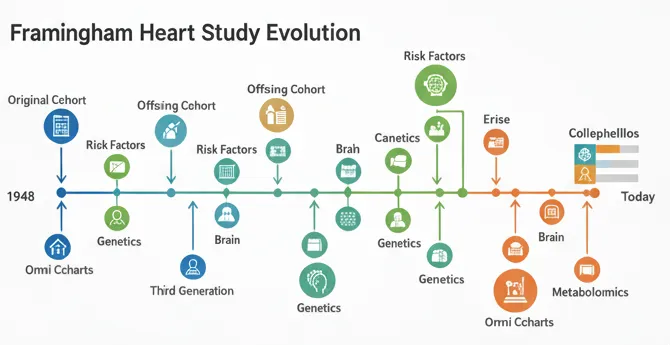
70+ years of data drive our framingham study risk calculator accuracy.
How the Framingham Dashboard Works
The framingham calculator takes into consideration how your lifestyle and biology interact. You need a few key pieces of information to get an accurate reading:
Age & Gender
Risk increases sharply between ages 30-79. Formulas differ significantly for men and women.
Cholesterol Ratios
The tool compares your Total Cholesterol to your "Good" HDL cholesterol levels.
Blood Pressure
Systolic (top number) pressure is a primary predictor of vascular stress.
Lifestyle Factors
Smoking status and Diabetes significantly raise your 10-year risk profile.
Note for UK, UAE, and Malaysia Users
This framingham heart risk calculator uses mg/dL for cholesterol. In the UK and Malaysia, results are often in mmol/L. To get an accurate score, convert your units (mmol/L × 38.67 = mg/dL) before inputting your data.
| Risk Level | 10-Year CHD Risk (%) | Recommended Action |
|---|---|---|
| Low Risk | < 10% | Maintain healthy lifestyle; periodic re-screening. |
| Intermediate Risk | 10% – 20% | Lifestyle changes + discussion about statin therapy with a doctor. |
| High Risk | > 20% | Intensive medical intervention and lifestyle overhaul. |
*According to Framingham data, a 50-year-old smoker with high blood pressure often carries a 10-15% risk, compared to an optimal peer at only 6%.
The Science: The Math Behind the Framingham Risk Calculator
For researchers and clinicians using the framingham risk calculator, the tool utilizes a complex multivariable regression model.
// Men Constant (L_Men): -172.300168
// Women Constant (L_Women): -146.5933061
Risk Probability Formula: P = 1 - S ^ exp(L)
Where S is the baseline survival rate (0.9402 for men and 0.98767 for women).
This level of mathematical precision is why the framingham heart risk calculatorremains a trusted global tool in clinical settings across the USA and the Middle East.
Ethnicity & Regional Considerations
While the framingham heart study risk calculator is a global benchmark, it was originally developed using a specific demographic in the USA.
- South Asian / Malay Descent: Often experience heart events 10 years earlier than other groups.
- Middle Eastern Residents: Higher prevalence of metabolic factors may require more aggressive prevention.
What to do with your Framingham Score?
FRS (2008) vs. ASCVD (2018): Which Should You Use?
In 2018, the American College of Cardiology (ACC) and the American Heart Association (AHA) recommended the use of the 2018 ASCVD 10-year Risk Calculator.
While the framingham heart study risk calculator is the foundation, the newer ASCVD model (Pooled Cohort Equations) includes Race as a factor and focuses on a broader range of events, including stroke. However, the Framingham model remains the most historically significant tool for primary care globally.
Pro Tip: The Family History Factor
The framingham study risk calculator doesn't account for genetics. If you have a first-degree relative with premature heart disease, many clinicians suggest doubling your FRS score for a truer picture of your risk.
3 Steps to Lower Your Framingham Risk Score
1. Manage Blood Pressure
Dropping your systolic pressure by just 10mmHg can significantly reduce your 10-year risk percentage.
2. Smoking Cessation
Within one year of quitting, your excess risk of CHD is reduced by half in the framingham risk calculator algorithm.
3. Optimize HDL
Focus on "good" fats found in olive oil and fish, staples in the healthy diets of the UAE and Mediterranean.
Conclusion: Take Control of Your Heart Health
The Framingham Risk Calculator is more than just a math equation; it is a legacy of 70 years of life-saving research. By understanding your 10 year ascvd risk calculator framingham score, you are empowered to make informed decisions with your physician.
Don't wait for symptoms. Use our framingham heart risk calculatortoday, and start your journey toward a healthier, longer life.
Scientific References & Guidelines:
- D'Agostino RB, et al. (2008). General Cardiovascular Risk Profile for Use in Primary Care. Circulation.
- Arnett DK, et al. (2019). ACC/AHA Guideline on the Primary Prevention of Cardiovascular Disease.
- WHO Cardiovascular Disease Risk Charts for Malaysia and UAE regions.
Medical Disclaimer: This 10 year ascvd risk calculator framingham tool is for educational purposes only and is not a substitute for professional medical advice, diagnosis, or treatment.
Related Disease Risk Calculators
Explore the rest of our disease risk tools — each one adds a different piece of the picture.
Frequently Asked Questions
Common questions and answers about this calculator.
Is the Framingham Risk Calculator accurate for everyone?
The original Framingham Heart Study was conducted on a primarily Caucasian population. While it is highly accurate for many, some ethnic groups in Malaysia, the UAE, or South Asia may find that 'Pooled Cohort Equations' (ASCVD) provide a more nuanced result for their specific demographic.
How often should I use the framingham risk score calculator?
If you are over age 30, it is clinically recommended to check your risk every 4–6 years. However, if you have existing risk factors like hypertension or high cholesterol, checking it annually with your healthcare provider is advised to track the effectiveness of your lifestyle changes.
Does the calculator include stroke risk?
The 2008 Framingham 'General CVD' version includes stroke, transient ischemic attack (TIA), and heart failure. However, the 'Hard CHD' version of the framingham heart risk calculator focuses specifically on the probability of a heart attack or fatal coronary heart disease.
What is the difference between FRS and the 10 year ascvd risk calculator framingham?
FRS (Framingham Risk Score) is the traditional model focusing on coronary heart disease. The 10-year ASCVD (Atherosclerotic Cardiovascular Disease) calculator is an updated model recommended by the AHA/ACC since 2013/2018 that includes stroke risk and accounts for race as a factor.
Can I use mmol/L instead of mg/dL for cholesterol?
Most Framingham models use mg/dL. If you are in the UK or Malaysia, you should convert your mmol/L results to mg/dL (multiply by 38.67 for total cholesterol) before entering them into the framingham study risk calculator for the most accurate results.
Does diabetes affect my Framingham score?
Yes, diabetes is considered a 'risk equivalent.' Having diabetes significantly increases the weighting in the framingham heart study risk calculator, as it drastically raises the probability of a vascular event over a 10-year period.
Should I double my score if I have a family history of heart disease?
While the standard formula doesn't ask for family history, clinical guidelines often suggest that if a first-degree relative had premature heart disease, your actual risk may be twice what the calculator shows. Always discuss this 'multiplier' with your doctor.
Tool Information
August 2026
Dr. Jaydeep Sanghani
Meet Akabari

Dr. Jaydeep Sanghani
MBBS, MD, DNB(Anaesth.), PDCC(CCM), DrNB(CCM)
AIIMS Bhubaneswar · AIIMS Rishikesh
Critical care specialist and anesthesiologist with advanced training from AIIMS. Reviews health calculators at Calqulate to ensure medical accuracy and evidence-based standards.
About the authors