
Quick answer
For a singleton pregnancy, recommended total weight gain depends mainly on BMI before pregnancy. At a pre-pregnancy BMI of 18.5–24.9, the commonly used range is 11.5–16 kg (25–35 lb).
How the Pregnancy Weight Gain Calculator Works
The calculation starts with your pre-pregnancy BMI, not BMI after pregnancy has begun.
Formula
BMI = weight (kg) ÷ height² (m)
Why the result is a range
Pregnancy weight gain is not perfectly linear. The guidance uses ranges because fluid shifts, nausea, appetite, fetal growth, and other factors vary between pregnancies.
What changes the estimate
Pre-pregnancy BMI, pregnancy week, current weight, and whether the pregnancy is singleton or multiple can change how a result is interpreted.
One weigh-in is not a diagnosis
Trends interpreted during prenatal care are more useful than a single scale reading.
Pregnancy Weight Gain Recommendations by Pre-Pregnancy BMI
The table below follows the 2009 Institute of Medicine/National Research Council recommendations that ACOG continues to reference. Weekly rates apply mainly to the second and third trimesters.
| Pre-pregnancy BMI | Category | Total gain | 2nd/3rd trimester rate |
|---|---|---|---|
| < 18.5 | Underweight | 12.5–18 kg (28–40 lb) | 0.44–0.58 kg/wk (1.0–1.3 lb/wk) |
| 18.5–24.9 | Healthy weight | 11.5–16 kg (25–35 lb) | 0.35–0.50 kg/wk (0.8–1.0 lb/wk) |
| 25.0–29.9 | Overweight | 7–11.5 kg (15–25 lb) | 0.23–0.33 kg/wk (0.5–0.7 lb/wk) |
| ≥ 30 | Obesity | 5–9 kg (11–20 lb) | 0.17–0.27 kg/wk (0.4–0.6 lb/wk) |
Pregnancy Weight Gain Chart by Week (kg and lb)
There is no single healthy number for every pregnancy week. A better week-by-week estimate combines the first-trimester allowance with the BMI-specific weekly rate used later in pregnancy.
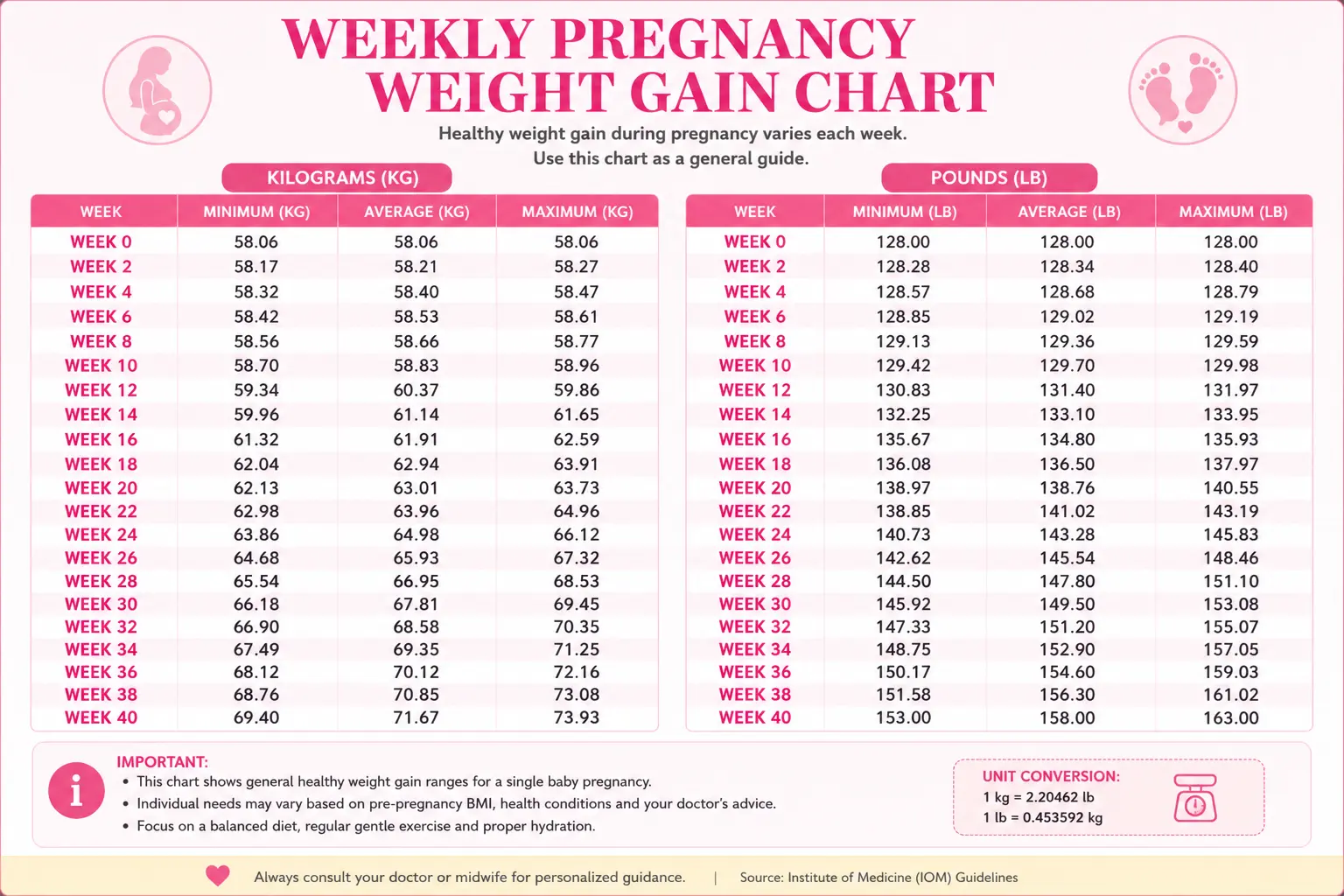
Pregnancy weight gain chart by week in kg
At a healthy pre-pregnancy BMI, the established second- and third-trimester rate is approximately 0.35–0.50 kg per week.
Pregnancy weight gain chart by week in lb
In pounds, the equivalent rate at a healthy pre-pregnancy BMI is approximately 0.8–1.0 lb per week in the second and third trimesters.
Pregnancy Weight Gain by Trimester
First trimester: weeks 1–13
The National Academies guidance assumes about 0.5–2 kg (1.1–4.4 lb) of total first-trimester gain. ACOG notes some people may gain only a small amount or no weight during the first 12 weeks.
What if morning sickness causes weight loss?
Nausea can affect early weight. If you cannot keep food or fluids down, are losing noticeable weight, feel dehydrated, or are worried, contact your maternity clinician.
Second trimester: weeks 14–27
The BMI-specific weekly rate becomes more useful here. The recommended pace differs by starting BMI.
Third trimester: weeks 28–40
The same BMI-specific weekly ranges are used as a general guide, while your maternity team considers fetal growth, fluid changes, symptoms, and other clinical factors.
Pregnancy Weight Gain Calculator for Twins
Twin pregnancies generally use higher total weight-gain ranges than singleton pregnancies.
| Pre-pregnancy BMI | Category | Twin total gain |
|---|---|---|
| < 18.5 | Underweight | 23–28 kg (50–62 lb) |
| 18.5–24.9 | Healthy weight | 17–25 kg (37–54 lb) |
| 25.0–29.9 | Overweight | 14–23 kg (31–50 lb) |
| ≥ 30 | Obesity | 11–19 kg (25–42 lb) |
Triplet and higher-order multiple pregnancies need individualized guidance because a single standard calculator range is not well established.
Pregnancy Weight Gain Calculator in India
You can use this calculator in India in kilograms and centimeters, but the reference ranges on this page come from the IOM/National Academies framework rather than a separate India-specific national target.
Why that distinction matters
Indian obstetric practice may be individualized according to maternal health, nutrition, fetal growth, local protocols, and your clinician's judgment. This page does not silently replace the source BMI categories with a different regional BMI system.
Where Does Pregnancy Weight Gain Go?
Pregnancy weight gain is not simply body fat. It includes the fetus, placenta, amniotic fluid, increased blood and fluid volume, breast and uterine tissue, and maternal energy stores.
Illustrative breakdowns from major medical sources are useful for understanding the biology, but they should not be used to estimate your personal fat gain from the scale.
What If I Am Above or Below the Pregnancy Weight Gain Range?
Being outside an estimated range does not automatically mean something is wrong. Your clinician interprets weight together with fetal growth, blood pressure, nutrition, symptoms, medical conditions, and other findings.
If you are gaining less than expected
Inadequate gestational gain has been associated with outcomes such as lower birth weight and preterm birth, but the right response is clinical assessment rather than self-directed force-feeding or calorie restriction.
If you are gaining more than expected
Excess gestational gain has been associated with larger birth weight and postpartum weight retention. Your maternity team can decide whether any nutrition or activity change is appropriate.
Do not diet based on the calculator
Do not start a restrictive weight-loss plan during pregnancy because one calculator result is above a range.
When Pregnancy Weight Gain Needs Prompt Medical Attention
Sudden weight gain with other symptoms needs attention
Contact your maternity team promptly if sudden weight gain or swelling occurs with a severe or persistent headache, vision changes, upper-abdominal pain, swelling of the face or hands, nausea or vomiting later in pregnancy, or difficulty breathing. These can be warning signs of preeclampsia.
A calculator cannot diagnose preeclampsia. Blood pressure measurement, urine testing, clinical assessment, and sometimes blood tests or ultrasound are used by healthcare professionals.
How Accurate Is a Pregnancy Weight Gain Calculator?
The BMI calculation and published reference ranges can be applied accurately, but the personal result is still a population-based estimate.
What the calculator can estimate
It can calculate pre-pregnancy BMI and match it to established total and weekly gain ranges.
What it cannot measure
It cannot assess fetal growth, distinguish fat from fluid, diagnose gestational diabetes or preeclampsia, or evaluate your full nutrition and medical history.
Your maternity team has the clinical context
Prenatal care can incorporate blood pressure, symptoms, ultrasound, lab findings, medications, and previous pregnancy history.
Pregnancy Weight Gain Calculator Methodology
Calqulate uses pre-pregnancy weight and height to calculate BMI, assigns the matching IOM/National Academies BMI category, and applies the corresponding total and later-pregnancy weekly ranges.
How the week-by-week estimate is built
The National Academies table assumes approximately 0.5–2 kg (1.1–4.4 lb) in the first trimester, followed by BMI-specific weekly rates. Any week-by-week curve is therefore an interpolation of population guidance, not an exact required path.
Singleton and twin calculations are different
Twin recommendations use separate total ranges and should not be inferred from singleton targets.
No hidden country-specific formula
This page identifies the framework it uses instead of mixing unrelated national rules into one result.
Medical Sources and References
Frequently Asked Questions
Frequently Asked Questions
Common questions and answers about this calculator.
How much weight should I gain during pregnancy?
For a singleton pregnancy, total recommended gain depends on pre-pregnancy BMI: 12.5–18 kg (28–40 lb) for BMI below 18.5; 11.5–16 kg (25–35 lb) for BMI 18.5–24.9; 7–11.5 kg (15–25 lb) for BMI 25–29.9; and 5–9 kg (11–20 lb) for BMI 30 or higher.
How is pregnancy weight gain calculated by week?
The calculator determines pre-pregnancy BMI, then applies the recommended total range and the BMI-specific weekly gain used mainly in the second and third trimesters. Week-by-week values are estimates, not exact targets.
How much weight should I gain in the first trimester?
The National Academies guidance assumes about 0.5–2 kg (1.1–4.4 lb) of total gain in the first trimester. ACOG notes some people may gain only a small amount or no weight during the first 12 weeks.
Can I use this pregnancy weight gain calculator in India?
Yes as a general estimate, but this tool uses IOM/National Academies BMI-based ranges rather than a separate India-specific national target. Your obstetrician may individualize goals.
How much weight should I gain with twins?
Common IOM-based twin ranges are about 23–28 kg (50–62 lb) for underweight, 17–25 kg (37–54 lb) for healthy BMI, 14–23 kg (31–50 lb) for overweight, and 11–19 kg (25–42 lb) for obesity.
Is it normal to lose weight in early pregnancy?
Some people gain little or no weight early in pregnancy, often because of nausea. Noticeable weight loss, dehydration, or inability to keep food or fluids down should be discussed with your maternity team.
Is sudden pregnancy weight gain a sign of preeclampsia?
Sudden weight gain can occur with fluid retention and may be concerning when it occurs with sudden swelling, severe headache, vision changes, upper-abdominal pain, or breathing difficulty. Contact your maternity team promptly if these symptoms occur.
Should I diet if I am gaining above the chart?
Do not start a restrictive weight-loss diet during pregnancy based only on a calculator. Your clinician should interpret weight together with fetal growth, nutrition, symptoms, and medical conditions.
Medical disclaimer
We build the Calqulate Pregnancy Weight Gain Calculator from established gestational-weight-gain guidance and aim to present the calculation as clearly as possible. Even a well-built calculator cannot evaluate fetal growth, fluid changes, medical conditions, medications, nutrition, symptoms, or your pregnancy history. Use the result as a general reference and discuss concerns about your weight or symptoms with your obstetrician, midwife, or other qualified maternity professional.
Calculate Your Pregnancy Weight Gain Range
Enter your pre-pregnancy measurements and pregnancy week to see your estimated range in kg or lb.
Calculate My RangeTool Information
August 2026
Dr. Jaydeep Sanghani
Meet Akabari

Dr. Jaydeep Sanghani
MBBS, MD, DNB(Anaesth.), PDCC(CCM), DrNB(CCM)
AIIMS Bhubaneswar · AIIMS Rishikesh
Critical care specialist and anesthesiologist with advanced training from AIIMS. Reviews health calculators at Calqulate to ensure medical accuracy and evidence-based standards.
Related Women's Health Calculators
Explore the rest of our women's health tools — each one adds a different piece of the picture.
About the authors