
Quick answer
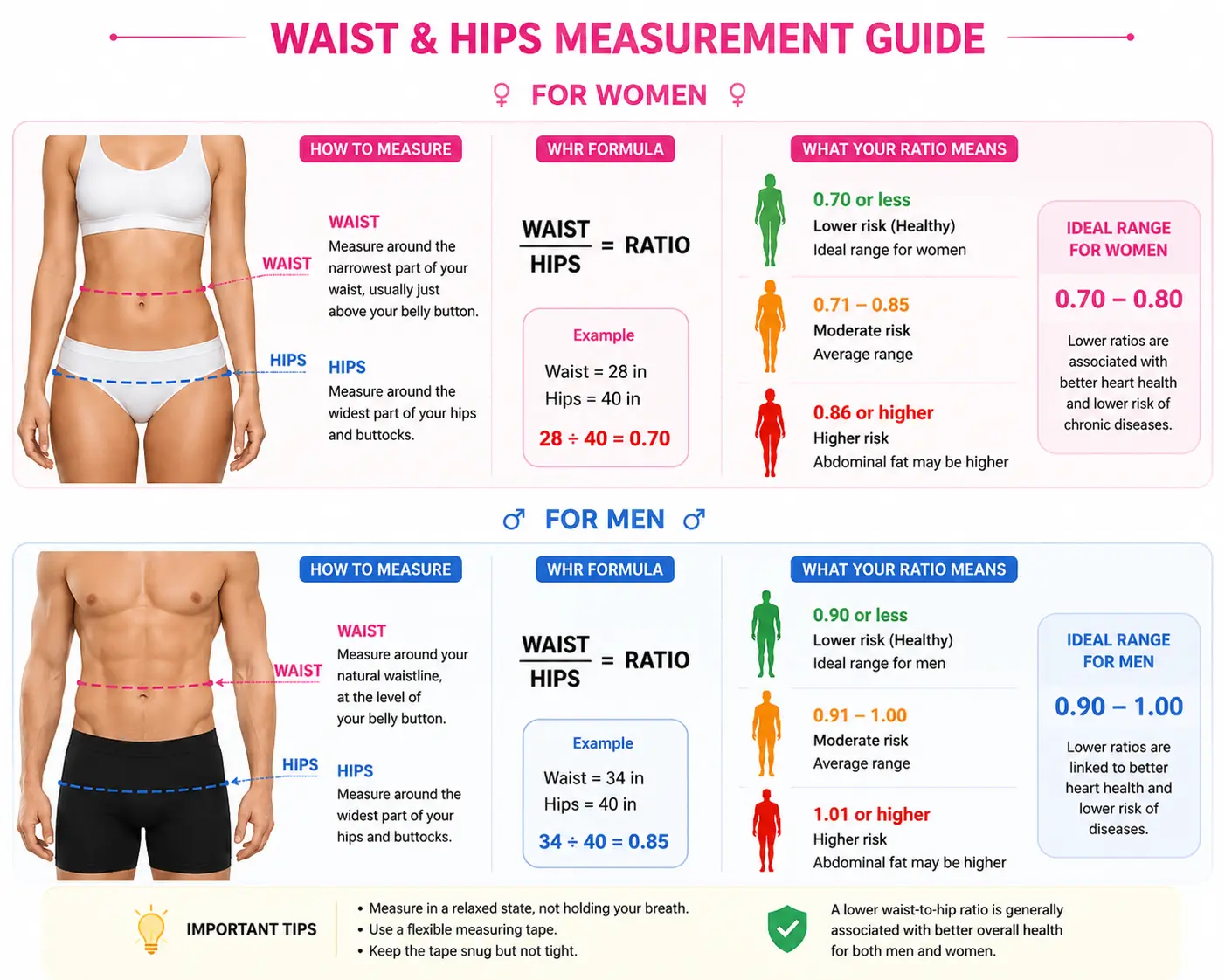
Waist-to-hip ratio is calculated by dividing your waist circumference by your hip circumference. For example, a 32-inch waist and 40-inch hips gives 32 ÷ 40 = 0.80.
How to Calculate Waist to Hip Ratio
Calculating your waist-to-hip ratio requires only two measurements: your waist circumference and your hip circumference. Divide your waist measurement by your hip measurement.
Waist to Hip Ratio Formula
WHR = Waist Circumference ÷ Hip Circumference
Waist to Hip Ratio Calculation Example
If your waist is 32 inches and your hips are 40 inches, the calculation is:
32 ÷ 40 = 0.80
Your waist-to-hip ratio is 0.80. You can use centimeters instead; the result stays comparable as long as both measurements use the same unit.
How to Measure Your Waist and Hips Correctly
Measurement technique matters because moving the tape even slightly can change your result. Use a flexible body-measuring tape and keep it horizontal around your body.
How to Measure Your Waist
How to Measure Your Hips
Measure both circumferences using the same unit. Do not pull the tape excessively tight or deliberately suck in your stomach.
Can I Calculate Waist-to-Hip Ratio in Inches?
Yes. Inches and centimeters both work. For example, 32 in ÷ 40 in = 0.80. There is no need to convert your measurements before using the calculator.
Waist-to-Hip Ratio Chart
There is no single perfect WHR for every person. Commonly used WHO-related thresholds identify a WHR above approximately 0.85 for women and 0.90 for men as elevated. These values are screening thresholds, not diagnoses.
Waist-to-Hip Ratio for Women
For women, a WHR above approximately 0.85 is commonly used as a threshold indicating greater central fat distribution. A result below that threshold should still be considered alongside other health information.
Waist-to-Hip Ratio for Men
For men, a WHR above approximately 0.90 is commonly used as an elevated threshold. WHR alone does not determine your overall cardiovascular or metabolic risk.
What Is a Good Waist-to-Hip Ratio?
There is no universally ideal waist-to-hip ratio that everyone should try to reach. For health screening, the more useful question is whether your waist is large relative to your hips and whether your result falls above commonly used reference thresholds.
Is 0.7 a Good Waist-to-Hip Ratio?
A WHR of 0.70 means your waist circumference is 70% of your hip circumference. For example, a 28-inch waist divided by 40-inch hips equals 0.70.
A value of 0.70 is below commonly used elevated WHR thresholds for both women and men, but it should not be treated as a universal ideal body target.
What Does a High Waist-to-Hip Ratio Mean?
A higher ratio means your waist circumference is larger relative to your hips. Higher abdominal fat distribution has been associated with greater cardiometabolic risk, but WHR is only one screening measure.
What Does a Low Waist-to-Hip Ratio Mean?
A lower ratio means your waist is smaller relative to your hips. A low WHR by itself does not diagnose health, nutritional status, or body composition.
Ideal Waist-to-Hip Ratio vs Normal Range
Searches for an “ideal waist-to-hip ratio” and a “normal WHR range” often ask the same question: whether a result is generally below or above a commonly used risk threshold.
It is more accurate to use WHR as a screening measurement than to call one number such as 0.70 or 0.80 a perfect target for everyone. Sex, age, ethnicity, overall waist size and other health factors can affect interpretation.
Waist-to-Hip Ratio and Body Shape
WHR can describe one aspect of body proportion because it compares the circumference of your waist with your hips. A lower ratio means the waist is smaller relative to the hips; a higher ratio means the two measurements are closer together.
WHR alone cannot determine your complete body shape because body-shape classification may also consider bust, shoulders, hips and other proportions.
Use the Body Shape CalculatorWaist-to-Hip Ratio vs BMI
WHR and BMI measure different things. BMI compares weight with height, while WHR compares your waist with your hips. WHR can add information about fat distribution that BMI does not directly show.
| Measurement | Uses | Main purpose |
|---|---|---|
| WHR | Waist + hips | Fat distribution / body proportions |
| BMI | Weight + height | Weight relative to height |
| Waist circumference | Waist | Abdominal size |
| Waist-to-height ratio | Waist + height | Waist relative to height |
Waist-to-Hip Ratio vs Waist-to-Height Ratio
These two ratios are easy to confuse, but they answer different questions.
Waist-to-Hip Ratio
Waist-to-Height Ratio
Waist-to-Hip Ratio Calculator Examples
These examples show how the calculation changes as waist size changes relative to hip size.
| Waist | Hips | WHR |
|---|---|---|
| 26 in | 36 in | 0.72 |
| 28 in | 40 in | 0.70 |
| 30 in | 40 in | 0.75 |
| 32 in | 40 in | 0.80 |
| 34 in | 40 in | 0.85 |
| 36 in | 40 in | 0.90 |
| 38 in | 40 in | 0.95 |
| 40 in | 40 in | 1.00 |
These examples explain the formula only and are not personalized health assessments.
How Calqulate Calculates Your WHR
The calculator uses the standard WHR formula: waist circumference divided by hip circumference. Inches and centimeters are both supported as long as both measurements use the same unit.
The result is shown as a ratio and compared with commonly used reference thresholds. WHR is a screening measurement, not a diagnosis, and should be considered alongside other health information when used for health interpretation.
Sources and References
Frequently Asked Questions
Frequently Asked Questions
Common questions and answers about this calculator.
How do I calculate my waist-to-hip ratio?
Divide your waist circumference by your hip circumference. For example, a 30-inch waist and 40-inch hips gives 30 ÷ 40 = 0.75.
What is a good waist-to-hip ratio?
There is no single perfect ratio for everyone. Commonly used WHO-related thresholds flag a waist-to-hip ratio above about 0.90 for men and 0.85 for women as elevated, but interpretation can vary by population and health context.
What does a 0.7 waist-to-hip ratio mean?
A WHR of 0.70 means your waist circumference is 70% of your hip circumference. For example, a 28-inch waist divided by 40-inch hips equals 0.70.
What is the waist-to-hip ratio formula?
Waist-to-hip ratio = waist circumference ÷ hip circumference. Use the same unit for both measurements.
Can I calculate waist-to-hip ratio in inches?
Yes. You can use inches or centimeters. Because one circumference is divided by the other, the result is the same as long as both measurements use the same unit.
What is the waist-to-hip ratio for women?
A WHR above approximately 0.85 is commonly used as an elevated threshold for women. WHR is a screening measurement and should not be used as a diagnosis by itself.
What is the waist-to-hip ratio for men?
A WHR above approximately 0.90 is commonly used as an elevated threshold for men. Overall health risk depends on more than one body measurement.
Where should I measure my waist for WHR?
WHO measurement protocols commonly place the waist measurement at the midpoint between the lowest palpable rib and the top of the iliac crest. Keep the tape horizontal and snug without compressing the skin.
Where should I measure my hips?
Measure around the widest part of the buttocks while keeping the tape horizontal and your feet together.
Is waist-to-hip ratio better than BMI?
They provide different information. BMI relates weight to height, while WHR describes how waist circumference compares with hip circumference. Neither number alone gives a complete health assessment.
Calculate Your Waist-to-Hip Ratio
Enter your waist and hip measurements to calculate your WHR instantly.
Calculate My WHRTool Information
August 2026
Dr. Jaydeep Sanghani
Meet Akabari

Dr. Jaydeep Sanghani
MBBS, MD, DNB(Anaesth.), PDCC(CCM), DrNB(CCM)
AIIMS Bhubaneswar · AIIMS Rishikesh
Critical care specialist and anesthesiologist with advanced training from AIIMS. Reviews health calculators at Calqulate to ensure medical accuracy and evidence-based standards.
Related Body Composition Calculators
Explore the rest of our body composition tools — each one adds a different piece of the picture.
About the authors