
Quick answer
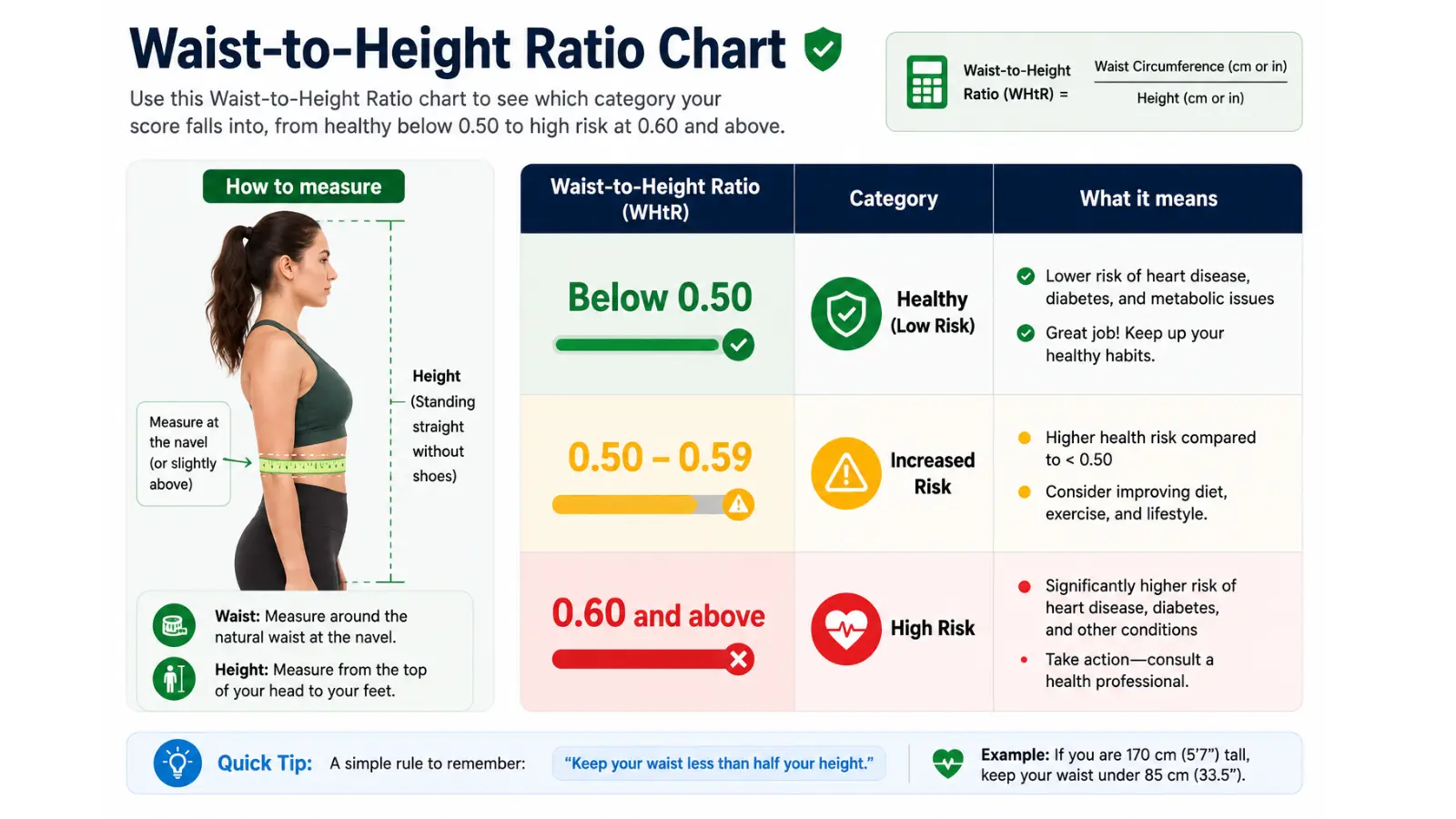
Waist-to-height ratio = waist ÷ height. NICE classifies 0.40–0.49 as healthy central adiposity, 0.50–0.59 as increased central adiposity, and 0.60 or more as high central adiposity for people with a BMI under 35 kg/m². A simple rule is to keep your waist to less than half your height.
How to Calculate Waist-to-Height Ratio
Use the same unit for your waist and height, then divide your waist circumference by your height.
Waist-to-Height Ratio Formula
WHtR = Waist Circumference ÷ Height
Waist-to-height ratio calculation example
If your waist is 80 cm and your height is 170 cm:
80 ÷ 170 = 0.47
A result of 0.47 falls within NICE's 0.40–0.49 healthy central-adiposity classification, assuming the guidance is appropriate for you.
Inches work the same way. For example, 32 inches ÷ 68 inches = 0.47.
Waist-to-Height Ratio Chart
The chart below uses NICE's adult waist-to-height ratio classifications. These classifications are intended for people with a BMI under 35 kg/m² and are the same for both sexes and all ethnicities.
| WHtR | NICE classification | Interpretation |
|---|---|---|
| 0.40–0.49 | Healthy central adiposity | No increased health risk in the NICE classification |
| 0.50–0.59 | Increased central adiposity | Associated with increased health risk |
| 0.60 or more | High central adiposity | Associated with further increased health risk |
What Is a Good Waist-to-Height Ratio?
For adults covered by NICE guidance, a ratio from 0.40 to 0.49 is classified as healthy central adiposity. The memorable public-health message is to keep your waist measurement below half your height.
What does a ratio of 0.50 mean?
A WHtR of 0.50 means your waist is exactly 50% of your height. NICE classifies 0.50 to 0.59 as increased central adiposity.
What does a 0.39 waist-to-height ratio mean?
A ratio of 0.39 means your waist is 39% of your height. It falls below NICE's 0.40–0.49 healthy central-adiposity classification, but that does not automatically mean you are underweight or unhealthy. WHtR is not a substitute for BMI, weight history, nutritional assessment or clinical evaluation.
Waist-to-Height Ratio for Women and Men
Unlike some waist-circumference and waist-to-hip ratio thresholds, NICE uses the same adult WHtR classifications for women and men: 0.40–0.49 healthy central adiposity, 0.50–0.59 increased central adiposity, and 0.60 or more high central adiposity.
Waist-to-height ratio for women
Waist-to-height ratio for men
Waist-to-Height Ratio by Age
For adults, NICE does not publish a different WHtR threshold for every age group. The same adult central-adiposity classifications are used, although age, medical conditions, body composition and other clinical factors still matter when interpreting health risk.
The NHS waist-to-height calculator has additional rules for younger users and advises that anyone aged 17 or under use it with a parent or carer. This page is primarily written for adults.
What Should My Waist Size Be for My Height?
The easiest way to convert the 0.50 rule into a waist measurement is to divide your height by two. Your waist would need to be below that number to remain under a WHtR of 0.50.
| Height | Waist below 0.50 WHtR |
|---|---|
| 150 cm (4 ft 11 in) | Under 75 cm (29.5 in) |
| 160 cm (5 ft 3 in) | Under 80 cm (31.5 in) |
| 170 cm (5 ft 7 in) | Under 85 cm (33.5 in) |
| 180 cm (5 ft 11 in) | Under 90 cm (35.4 in) |
| 190 cm (6 ft 3 in) | Under 95 cm (37.4 in) |
These values are mathematical examples of the less-than-half-your-height rule, not individualized medical targets.
How to Measure Your Waist for WHtR
A consistent waist measurement matters because even a small change in tape placement can alter your ratio.
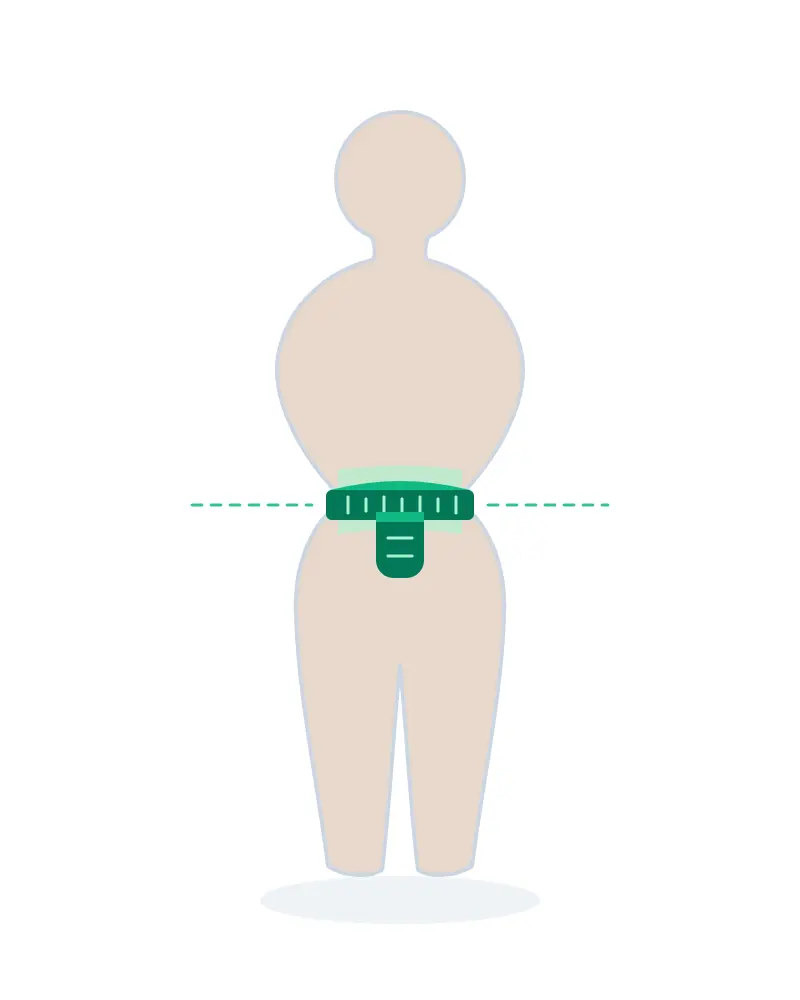
1. Stand upright and relaxed.
2. Wrap a flexible tape horizontally around your waist using a consistent anatomical measurement point.
3. Keep the tape snug without compressing the skin.
4. Record the measurement without deliberately pulling your stomach in.
Waist-to-Height Ratio vs Waist-to-Hip Ratio
These calculators sound similar but use different measurements. WHtR divides your waist by your height, while WHR divides your waist by your hips.
Waist-to-Height Ratio (WHtR)
Waist-to-Hip Ratio (WHR)
Waist-to-Height Ratio vs BMI
BMI and WHtR answer different questions. BMI relates body weight to height, while WHtR uses waist circumference to provide information about central adiposity.
Evidence reviews have found WHtR useful for identifying cardiometabolic risk, but it is more accurate to treat WHtR as a complementary screening measure rather than claim it simply replaces BMI. NICE recommends waist-to-height ratio classification for adults with a BMI under 35 kg/m².
Check your BMIU.S. Army Waist-to-Height Ratio Calculator
In July 2026, the U.S. Army announced that WHtR replaced its previous height-and-weight tables and circumference-based body-fat assessment as the Army's body composition screening method.
Current Army guidance states that the standard is a WHtR below, but not equal to, 0.55, recorded to three decimal places. That Army compliance standard is different from the general NICE 0.50 public-health boundary used elsewhere on this page.
What This Calculator Can and Cannot Tell You
WHtR is a simple screening measurement. It can describe how your waist size compares with your height, but it cannot diagnose diabetes, cardiovascular disease, hypertension, obesity or any other medical condition.
NICE's adult classifications are intended for people with a BMI under 35 kg/m². The NHS also advises against using its WHtR calculator in pregnancy, for children under 5, for people with an eating disorder or suspected eating disorder, or for people with a growth disorder or another condition affecting height.
How Calqulate Calculates Your WHtR
Calqulate divides the waist circumference you enter by your height. The calculator supports centimeters and inches as long as the same unit is used for both values.
Adult interpretation on this page follows the NICE central-adiposity classifications of 0.40–0.49, 0.50–0.59 and 0.60 or more, together with the public-health message to keep your waist below half your height.
Sources and References
Frequently Asked Questions
Frequently Asked Questions
Common questions and answers about this calculator.
How do I calculate waist-to-height ratio?
Divide your waist circumference by your height using the same unit for both measurements. For example, an 80 cm waist divided by a 170 cm height equals 0.47.
What is a good waist-to-height ratio?
NICE classifies 0.40 to 0.49 as healthy central adiposity for people with a BMI under 35 kg/m². NICE also advises keeping your waist to less than half your height, which means a ratio under 0.50.
What does a waist-to-height ratio of 0.5 mean?
A ratio of 0.50 means your waist circumference is exactly half your height. NICE classifies 0.50 to 0.59 as increased central adiposity and advises keeping the ratio below 0.50.
What does a 0.39 waist-to-height ratio mean?
A ratio of 0.39 means your waist is 39% of your height. It is below NICE's 0.40 to 0.49 healthy central-adiposity classification, but WHtR alone cannot tell whether someone is underweight or diagnose a health problem.
Is waist-to-height ratio the same for women and men?
For the NICE adult central-adiposity classification, the same WHtR ranges are used for both sexes. A ratio of 0.40 to 0.49 is classed as healthy, 0.50 to 0.59 as increased, and 0.60 or more as high central adiposity for people with a BMI under 35 kg/m².
Does waist-to-height ratio change by age?
For adults, NICE uses the same central-adiposity ranges rather than separate cutoffs for each age. Interpretation still depends on overall health and clinical context.
Is waist-to-height ratio better than BMI?
They measure different things. BMI relates weight to height, while WHtR adds information about central adiposity by including waist circumference. NICE recommends WHtR alongside BMI in appropriate adults rather than treating either measure as a complete health assessment.
Can I use inches for a waist-to-height ratio calculator?
Yes. You can use inches or centimeters as long as both waist and height use the same unit. The units cancel when one measurement is divided by the other.
Where should I measure my waist?
Use a flexible tape around your waist, keeping it horizontal and snug without compressing the skin. Follow one measurement method consistently so repeat readings are comparable.
What is the U.S. Army waist-to-height ratio standard?
As of 2026, the U.S. Army uses waist-to-height ratio as its official body-composition screening method. Army guidance states that the standard is less than, but not equal to, 0.55 and records the result to three decimal places. Use official Army guidance for compliance decisions.
A note about medical accuracy
We design the Calqulate Waist-to-Height Ratio Calculator to make the formula and published reference ranges as clear and reliable as possible. Even so, an online calculator cannot evaluate your full medical history, body composition or individual risk. If a measurement concerns you, or you have symptoms or an existing health condition, discuss it with a qualified healthcare professional.
Calculate Your Waist-to-Height Ratio
Enter your waist and height to calculate your WHtR and compare the result with the reference ranges above.
Calculate My WHtRTool Information
August 2026
Dr. Jaydeep Sanghani
Meet Akabari

Dr. Jaydeep Sanghani
MBBS, MD, DNB(Anaesth.), PDCC(CCM), DrNB(CCM)
AIIMS Bhubaneswar · AIIMS Rishikesh
Critical care specialist and anesthesiologist with advanced training from AIIMS. Reviews health calculators at Calqulate to ensure medical accuracy and evidence-based standards.
Related Body Composition Calculators
Explore the rest of our body composition tools — each one adds a different piece of the picture.
About the authors