Body Shape Calculator for Men: How to Measure Your Body Shape
Find your male body shape in two minutes. A 3D tool that morphs to your measurements, the five men's body types explained, how to measure, and a free body shape calculator.
5
Male Shapes
4
Measurements
2 min
Time Needed
Free
3D Tool
Why Your Body Shape Decides How Clothes Fit
The Problem
Most men shop by a single label — medium or large — and hope for the best. A size only describes volume, not how your frame carries it. Two men can both wear a large and look completely different in the same jacket, because one has broad shoulders and a narrow waist while the other runs straight up and down.
The Solution
Your body shape is the ratio between four measurements: shoulders, chest, waist, and hips. Get those ratios right and you can predict which cuts will fit, which need a tailor, and which to skip. The same ratios tell you which training balances your frame.
Below you can spin a 3D figure that morphs to your numbers, learn to measure in two minutes, and read what each of the five shapes means for clothing and the gym. When you want a saved result, the body shape calculator stores it for you.
See Your Shape in 3D
Switch to Male, enter your four measurements, and watch a neutral 3D body morph into your real silhouette. Rotate it, zoom in, and read your shape and waist-to-hip ratio below.
Your measurements
Private. Nothing is uploaded or saved.
Enter your measurements to see your body morph into its detected shape.
How to Measure Your Body Shape (4 Steps)
You need a soft tape, a mirror, and a relaxed stance. Keep the tape level with the floor, snug but not tight, and do not flex. Measure each spot twice and take the average.
Shoulders
Wrap the tape around the widest point of your shoulders and upper arms, keeping it level with the floor.
Chest
Measure the fullest part of your chest, with the tape sitting just under your armpits. Breathe normally, do not puff out.
Waist
Measure your natural waist at navel level, not where your jeans sit. Keep the tape snug, not tight.
Hips
Stand with your feet together and measure around the widest part of your hips and glutes.
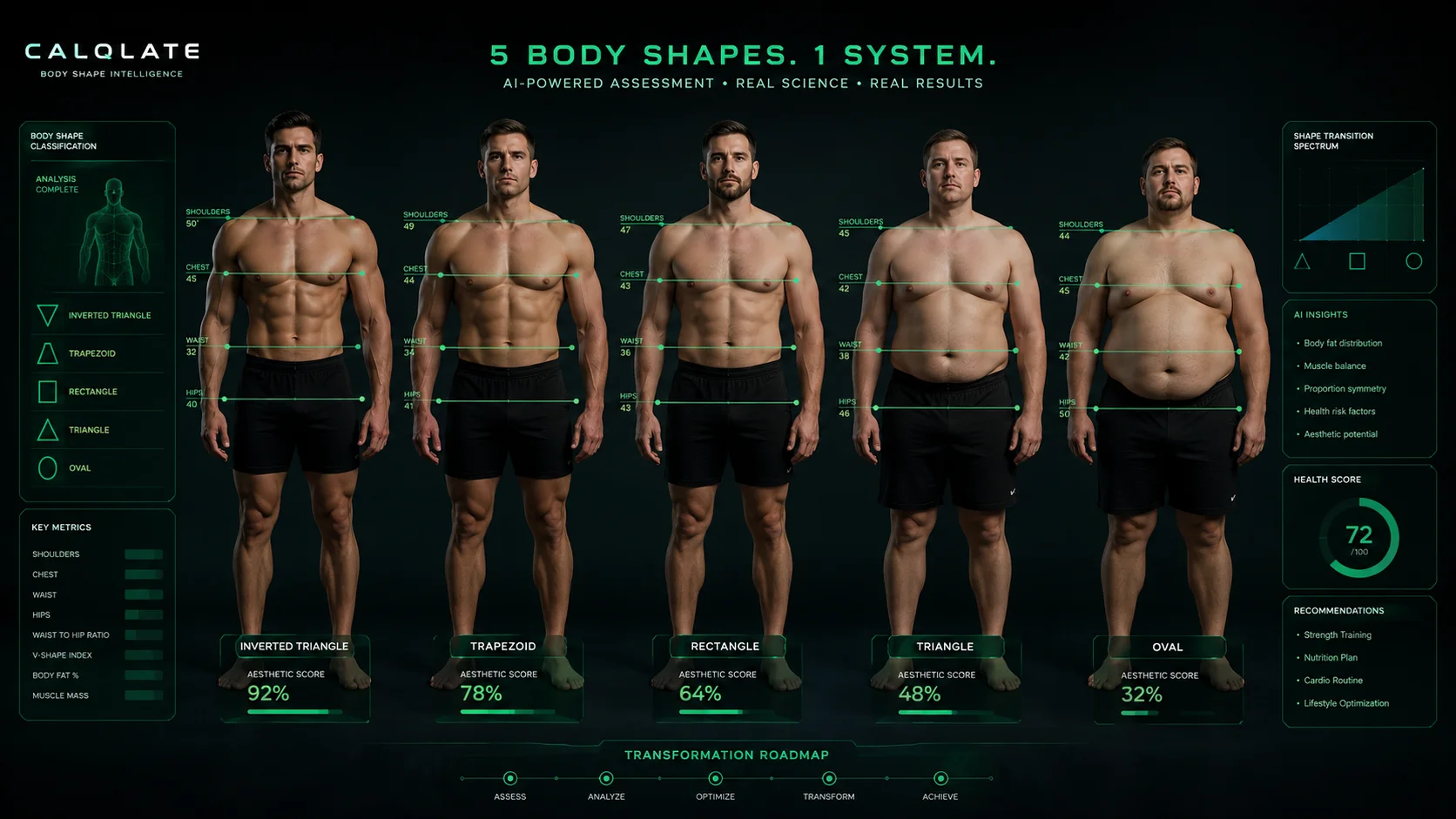
The Five Male Body Shapes
Every man lands in one of these five, set by how his shoulders compare to his waist and hips. Here is how to spot each one and what to do with it.
Inverted Triangle
The athletic V-taperBroad shoulders and chest taper sharply to a narrow waist and hips. Common in swimmers, lifters, and naturally wide-framed men. Shirts that fit the shoulders tend to balloon at the waist.
How to spot it
Shoulders much wider than the waist (ratio about 1.4 or higher), hips narrow.
Dress it
- ✓Slim-fit shirts with stretch, or have shirts taken in at the waist
- ✓Avoid heavy shoulder padding, your frame already has width up top
- ✓Straight or slim trousers add a little visual weight to the lower half
Train it
- •Keep training the legs so the lower body keeps pace with the upper
- •Add mobility work to offset tight chest and shoulders
Trapezoid
The balanced athletic buildShoulders and chest are broader than the waist, with a gentle taper. This is the build most off-the-rack clothing is cut for, so standard sizes usually fit well. Often called the ideal male proportion.
How to spot it
Shoulders moderately wider than the waist (ratio about 1.25 to 1.4), hips slightly narrower than shoulders.
Dress it
- ✓Most standard cuts work, so buy for fit and fabric
- ✓Slim and tailored fits show the natural taper
- ✓Layering works without bulking you out
Train it
- •Balanced training keeps the proportions, no single area needs chasing
- •Mix resistance, conditioning, and mobility
Rectangle
Straight up and downShoulders, chest, waist, and hips sit at roughly the same width, so the torso reads straight. Lean men often land here. The goal with clothing and training is to build the appearance of an upper-body taper.
How to spot it
Shoulders, waist, and hips are close to the same width (shoulder-to-waist under about 1.25).
Dress it
- ✓Structured jackets with light shoulder padding widen the upper line
- ✓Tapered trousers narrow the lower half for contrast
- ✓Horizontal detail on top, like chest pockets, adds width where you want it
Train it
- •Prioritize shoulders, upper back, and chest to build a V-taper
- •Bench press, pull-ups, and lateral raises help most
Triangle
Wider through the hipsHips and waist are wider than the shoulders and chest, so the lower body dominates. This shape often shows up with age or after a long stretch of low activity. Clothing and training both aim to widen the top.
How to spot it
Hips wider than the shoulders, weight carried in the lower body.
Dress it
- ✓Structured blazers with a strong shoulder line widen the upper body
- ✓Avoid raglan sleeves, which narrow the shoulders
- ✓Darker trousers and lighter tops draw the eye upward
Train it
- •Build shoulders, chest, and arms to balance the frame
- •Overhead press and rows are high-value lifts here
Oval
Fullness through the middleMost of the visual weight sits in the midsection, with the waist wider than the shoulders and hips. The aim is a longer, leaner line through clothing and a focus on core and overall conditioning in training.
How to spot it
Waist is the widest measurement, wider than both chest and hips.
Dress it
- ✓Monochrome outfits and vertical lines lengthen the silhouette
- ✓Avoid clingy knits and boxy oversized fits, both add bulk
- ✓An open jacket or layer creates a vertical frame down the center
Train it
- •Combine steady cardio with full-body strength work
- •Core stability and posture work make the biggest visual difference
The Shoulder-to-Waist Spectrum
One ratio separates the five shapes. The higher it is, the stronger the V-taper. A value near 1.0 means a straight or hip-led frame.
Typical values for each shape. Yours will sit somewhere on this line. Ratios are based on the measurement ranges in Calqulate's male body type chart.
Want a saved, shareable result?
You just measured your shape in 3D above. Open the full Body Shape Calculator to compare shapes, download a report, and see your GLP-1 fat-vs-muscle context.
Body Shape Is Not the Same as Body Type
People mix these up all the time. Here is the difference at a glance.
Body Shape
Your silhouette
Describes your proportions from four measurements — shoulders, chest, waist, hips. Inverted triangle, trapezoid, rectangle, triangle, or oval. For clothing and training focus, shape is the number that helps.
Somatotype
Your body's response
The ectomorph, mesomorph, and endomorph framework describes how your body responds to food and training — how easily you gain muscle or store fat. For nutrition and building speed, somatotype is the lens that helps.
A Note on Reading Your Result
A body shape result is a styling and training guide, not a health verdict. It reads your ratios, so it does not see your height, posture, or limb length, all of which change how clothes hang. Where you store fat can carry health signals, but for that, a waist-to-hip ratio or a doctor's input matters more than a shape label. Use this as a starting point and adjust from your own mirror.
Take the guide with you
Download a free, printable men's body shape guide. The five shapes, how to measure, and the style and training notes in one PDF.
Frequently Asked Questions
How do I find my body shape as a man?+
Measure four things with a soft tape: shoulders, chest, waist, and hips, all level with the floor. Compare the numbers. If your shoulders are much wider than your waist you are an inverted triangle, if they are moderately wider you are a trapezoid, if everything is even you are a rectangle, if your hips are widest you are a triangle, and if your waist is widest you are an oval. The body shape calculator does this in one click.
What are the five male body shapes?+
Inverted triangle (broad shoulders, narrow waist), trapezoid (a moderate shoulder-to-waist taper and the most common athletic build), rectangle (shoulders, waist, and hips about even), triangle (hips wider than shoulders), and oval (the waist is the widest point). They are based on the ratios between your measurements, not your weight.
What is the most common male body shape?+
The trapezoid and the rectangle are the two most common. The trapezoid has a gentle taper from broad shoulders to a narrower waist, which is also the build most clothing is cut for. The rectangle runs straight up and down with little taper.
What measurements do I need for a male body type calculator?+
Four: shoulders, chest, waist, and hips. Inches or centimetres both work, since the result comes from the ratios between them, not the raw size. Measure twice and take the average for a cleaner read.
Is body shape the same as body type or somatotype?+
Not quite. Body shape describes your silhouette from your measurements (inverted triangle, rectangle, and so on). Somatotype, the ectomorph, mesomorph, and endomorph idea, describes how easily you build muscle or store fat. You can be a lean rectangle or a muscular rectangle. Shape is about proportions, somatotype is about how your body responds to training and food.
Can I change my body shape?+
You can shift it, within limits. Your bone structure is fixed, but training changes how the frame looks. A rectangle who builds shoulders and back can read closer to a trapezoid, and an oval who loses midsection fat moves toward a rectangle. The shape categories are a starting point, not a life sentence.
How accurate is an online body shape calculator?+
The math is exact, since it just compares your ratios. Accuracy comes down to your measuring. Use a soft tape, keep it level, do not flex, and measure each spot twice. Get that right and the result is reliable. It does not account for height, posture, or limb length, so treat it as a styling and training guide, not a medical reading.
The Bottom Line
Four measurements tell you your body shape, and your shape tells you how to dress and where to train. Measure carefully, find your spot on the spectrum, and use it as a practical guide rather than a label. When you want your exact result saved, run the free calculator.
Open the Body Shape Calculator →