
Free GLP-1 Safety Tool
GLP-1 Unit Converter
Convert mg ↔ units ↔ mL for compounded semaglutide and tirzepatide using your vial's concentration.
- mg → Units
- Units → mg
- Semaglutide
- Tirzepatide
- U-100 Syringe
- Instant
- Free forever
- Educational only
- Browser only
- No sign-up required
Ready when you are
5 quick questions · instant answer · nothing stored
Your data is private. We do not store your answers or any personal information.
The label always wins. Every number on this page depends on the concentration printed on your vial. If a result here disagrees with what your prescriber or pharmacist told you to draw, do not inject. Call them.
Understanding your conversion
Every conversion on this page is one worked example: a prescribed dose in milligrams, your vial's concentration, and the number of units that lands on the syringe. Here is what a typical result looks like.
- Your prescribed dose
- 0.5 mg
- Your concentration
- 2.5 mg/mL
- Volume to draw
- 0.20 mL
- Draw
- 20 units
- Recommended syringe
- 30-unit syringe
Before you inject, check three things
Almost every conversion error comes down to one of these three numbers being wrong. Confirm all three against the label in your hand before you draw.
Check your concentration
Read the mg/mL printed on your vial and make sure it matches what you entered. This one number decides every unit you draw.
Check your medication
Confirm the drug and that it is a compounded vial, not a pre-filled pen. Pens measure the dose for you and are never drawn into a syringe.
Check your syringe
Use a U-100 insulin syringe, where 100 units equals 1 mL, and pick the smallest barrel your dose fits so the markings are easy to read.
How many units is my GLP-1 dose?
A GLP-1 dose has no single unit value. It depends entirely on your vial's concentration. For example, 0.5 mg equals 20 units at 2.5 mg/mL but only 10 units at 5 mg/mL. Find your dose below, then read the column that matches the concentration on your label.
- 1 mg/mL
- 25 units
- 2.5 mg/mL
- 10 units
- 5 mg/mL
- 5 units
- 1 mg/mL
- 50 units
- 2.5 mg/mL
- 20 units
- 5 mg/mL
- 10 units
- 1 mg/mL
- 100 units
- 2.5 mg/mL
- 40 units
- 5 mg/mL
- 20 units
- 2.5 mg/mL
- 68 units
- 5 mg/mL
- 34 units
- 2.5 mg/mL
- 96 units
- 5 mg/mL
- 48 units
- 5 mg/mL
- 100 units
- 10 mg/mL
- 50 units
- 20 mg/mL
- 25 units
mg ↔ Units conversion chart
Read the row for your dose or your units, then the column that matches your concentration. Every value assumes a U-100 insulin syringe, where 100 units equals 1 mL.
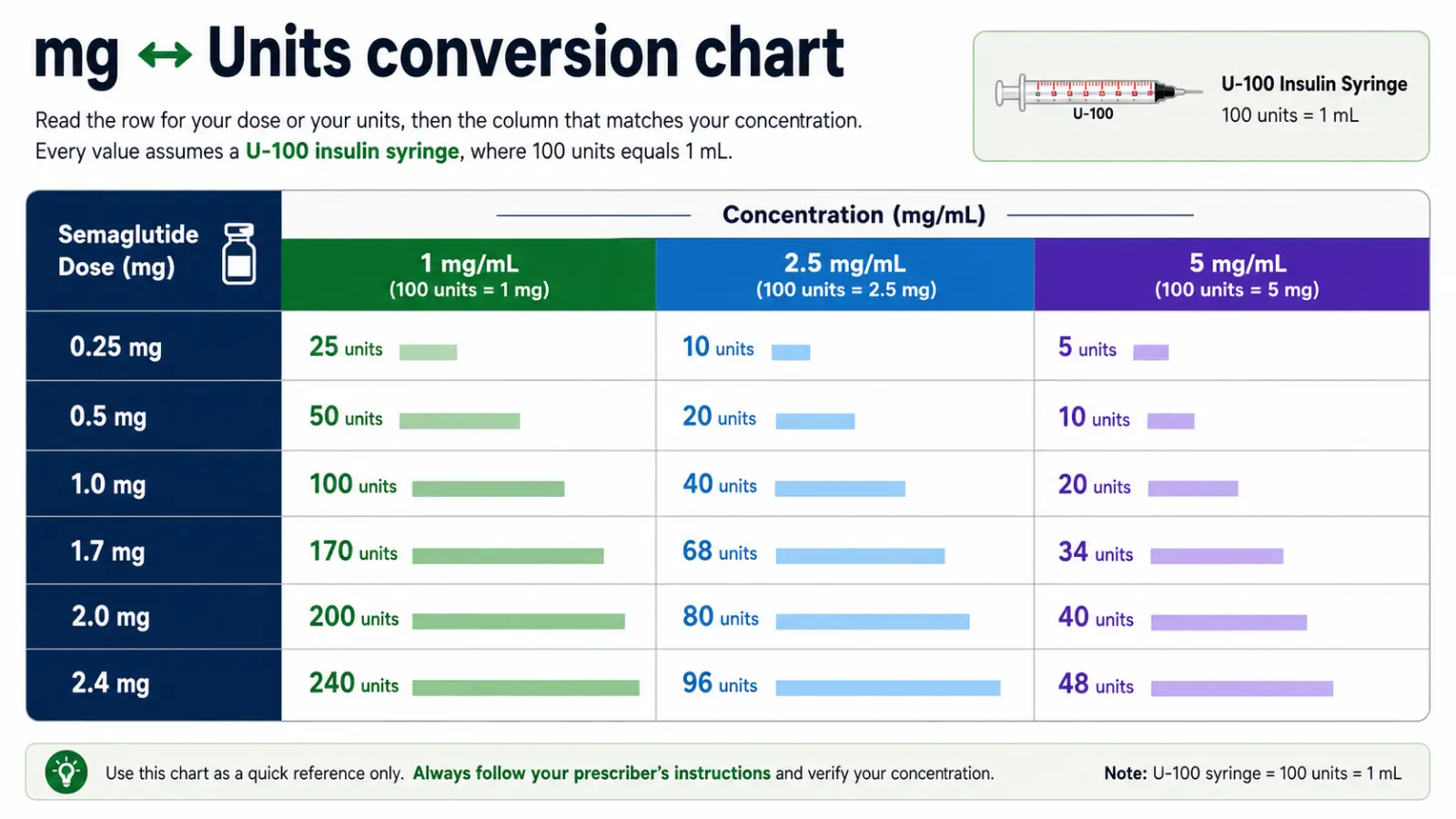
| Dose | At 1 mg/mL | At 2.5 mg/mL | At 5 mg/mL |
|---|---|---|---|
| 0.25 mg | 25 units | 10 units | 5 units |
| 0.5 mg | 50 units | 20 units | 10 units |
| 1 mg | 100 units | 40 units | 20 units |
| 1.7 mg | 170 units (2 syringes) | 68 units | 34 units |
| 2.4 mg | 240 units (3 syringes) | 96 units | 48 units |
| 5 mg (tirzepatide) | Not applicable | 200 units | 100 units |
| Units | At 2.5 mg/mL | At 5 mg/mL | At 10 mg/mL |
|---|---|---|---|
| 10 units | 0.25 mg | 0.5 mg | 1 mg |
| 20 units | 0.5 mg | 1 mg | 2 mg |
| 30 units | 0.75 mg | 1.5 mg | 3 mg |
| 50 units | 1.25 mg | 2.5 mg | 5 mg |
| 100 units | 2.5 mg | 5 mg | 10 mg |
Why concentration matters
The same dose can equal completely different syringe units because pharmacies prepare compounded GLP-1 vials at different strengths.
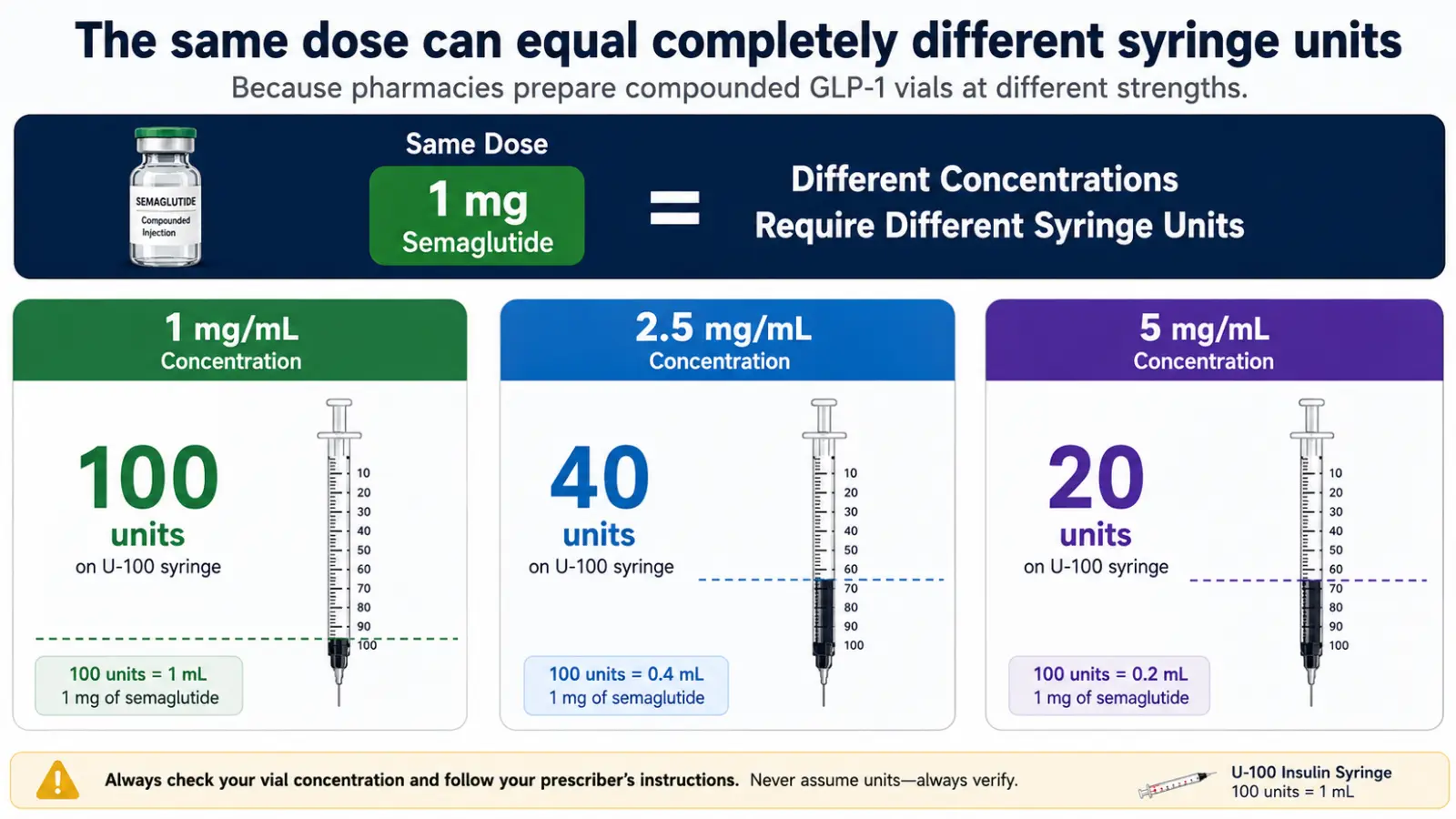
1 mg at 1 mg/mL
100 units
1 mg at 5 mg/mL
20 units
Brand pens vs compounded vials
Only compounded multi-dose vials need converting. Brand pens such as Ozempic, Wegovy, Mounjaro and Zepbound measure the dose for you in milligrams, so you never count units.
- Ozempic No need
- Wegovy No need
- Mounjaro No need
- Zepbound No need
- Compounded semaglutide Convert
- Compounded tirzepatide Convert
Choosing the right syringe
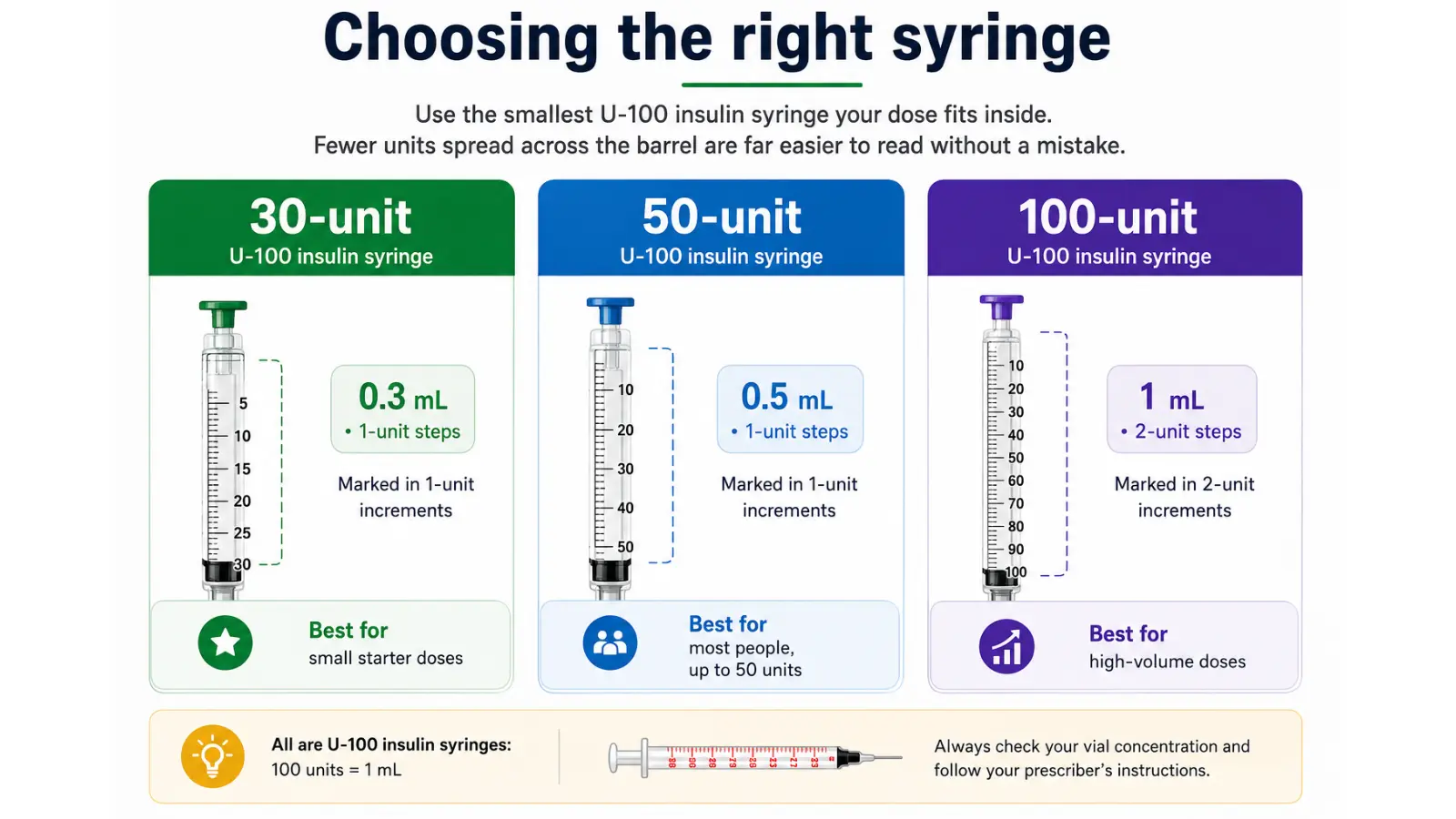
Use the smallest U-100 insulin syringe your dose fits inside. Fewer units spread across the barrel are far easier to read without a mistake.
30-unit
0.3 mL · 1-unit steps
Best for small starter doses
50-unit
0.5 mL · 1-unit steps
Best for most people, up to 50 units
100-unit
1 mL · 2-unit steps
Best for high-volume doses
Common conversion mistakes
Most GLP-1 dosing errors are not maths errors. They are the wrong concentration, a reused units figure, or the wrong syringe. Here are the mistakes worth catching before you draw.
Reusing a units number from an old vial
A new vial can be a different strength. Always read the concentration on the new label and redo the conversion.
Copying a units figure from a forum or a friend
A units number is meaningless without the concentration it came from. Their vial is almost certainly not yours.
Assuming the wrong concentration
Believing your vial is 2.5 mg/mL when it is really 5 mg/mL doubles every dose you draw. Confirm mg/mL first, every time.
Rounding a dose that lands between two markings
If your dose does not sit on a whole line, do not estimate. It usually means the concentration and the syringe are mismatched.
Drawing a pen into an insulin syringe
Ozempic, Wegovy, Mounjaro and Zepbound are measured in milligrams by the device. They are never counted in units.
What to do if your numbers don't match
If the units here disagree with what your prescriber or pharmacist told you to draw, do not inject. The label always wins. Work through these steps before you go any further.
- 1Re-read the concentration on your vial and confirm it matches the mg/mL you entered here.
- 2Convert in the other direction: take the units you plan to draw, convert them back to milligrams, and check it equals your prescribed dose.
- 3Confirm the medication is a compounded vial, not a pre-filled pen that measures the dose for you.
- 4If the two answers still disagree, call the pharmacy that dispensed it before you inject. They will resolve it in a minute.
If you believe you have already injected the wrong amount, contact your prescriber or a poison information service straight away.
Why you can trust this calculator
This converter uses the same arithmetic your pharmacist uses, with your own vial concentration and the U-100 insulin syringe standard, and it checks the answer in both directions.
Uses your vial concentration
Nothing is assumed. Every result is built from the mg/mL you read off your own label.
U-100 insulin syringe standard
All units assume 100 units per 1 mL, the standard for insulin syringes worldwide.
Double-direction verification
You can convert mg to units and units back to mg to confirm both answers agree before you draw.
Browser-only calculations
Every number is worked out on your device. Nothing you type is stored or sent anywhere.
Educational safety checks
The tool flags doses that don't fit, land between markings, or exceed approved maximums so you can stop and confirm.
Dose ranges and product information are drawn from FDA prescribing information and manufacturer labels for semaglutide (Novo Nordisk) and tirzepatide (Eli Lilly). See the sources below.
Sources and references
This page is built from public clinical guidance and peer-reviewed research. Always confirm decisions with a licensed clinician.
- 1.FDA: Medications containing semaglutide, including compounding information
- 2.FDA: Compounded tirzepatide, information for patients and providers
- 3.Ozempic (semaglutide) Prescribing Information (Novo Nordisk / FDA)
- 4.Wegovy (semaglutide) Prescribing Information (Novo Nordisk / FDA)
- 5.Mounjaro (tirzepatide) Prescribing Information (Eli Lilly / FDA)
- 6.Zepbound (tirzepatide) Prescribing Information (Eli Lilly / FDA)
Common GLP-1 conversion questions
Direct answers to the exact questions people type into search. Every one depends on your concentration, so read your label first.
mg to Units
- How many units is 0.25 mg?
- At 2.5 mg/mL, 0.25 mg is 10 units. At 5 mg/mL it is 5 units, and at 1 mg/mL it is 25 units. A 5-unit dose is very small to measure, so a 30-unit syringe is far safer than a 100-unit one here.
- How many units is 0.5 mg?
- At 2.5 mg/mL, 0.5 mg is 20 units. At 5 mg/mL it is 10 units, and at 1 mg/mL it is 50 units. This is why 0.5 mg equals 20 units only sometimes, and why the answer is worthless without a concentration attached.
- How many units is 1 mg?
- At 2.5 mg/mL, 1 mg is 40 units. At 5 mg/mL it is 20 units, and at 1 mg/mL it fills an entire 100-unit syringe. Same prescription, three different numbers on the barrel.
- How many units is 1.7 mg?
- At 2.5 mg/mL, 1.7 mg is 68 units, and at 5 mg/mL it is 34 units. At 1 mg/mL it would be 170 units, which does not fit in a single syringe, so a more concentrated vial is the correct answer rather than two injections.
- How many units is 2.4 mg?
- At 2.5 mg/mL, 2.4 mg is 96 units, which only just fits a 100-unit syringe. At 5 mg/mL it is 48 units, which is far more comfortable to draw. At the maintenance dose, concentration stops being a detail and starts deciding whether the dose fits at all.
- How many units is 5 mg of tirzepatide?
- At 5 mg/mL, 5 mg is 100 units, a full syringe. At 10 mg/mL it is 50 units, and at 20 mg/mL it is 25 units. Compounded tirzepatide is usually supplied concentrated for exactly this reason.
Units to mg
- 10 units equals how many mg?
- 0.25 mg at 2.5 mg/mL, 0.5 mg at 5 mg/mL, or 1 mg at 10 mg/mL. Ten units is a tenth of a millilitre, and how much medication sits in that tenth is entirely down to your vial.
- 20 units equals how many mg?
- 0.5 mg at 2.5 mg/mL, 1 mg at 5 mg/mL, or 2 mg at 10 mg/mL. If someone tells you 20 units is a standard dose, they are telling you about their vial, not yours.
- 30 units equals how many mg?
- 0.75 mg at 2.5 mg/mL, 1.5 mg at 5 mg/mL, or 3 mg at 10 mg/mL. Thirty units is 0.3 mL, which fills a 30-unit syringe exactly.
- 50 units equals how many mg?
- 1.25 mg at 2.5 mg/mL, 2.5 mg at 5 mg/mL, or 5 mg at 10 mg/mL. Note that 2.5 mg of semaglutide would be above the maximum approved weekly dose of 2.4 mg, which is the kind of mismatch worth catching before you inject.
- 100 units equals how many mg?
- 2.5 mg at 2.5 mg/mL, 5 mg at 5 mg/mL, or 10 mg at 10 mg/mL. One hundred units is a full millilitre, the entire barrel of a 100-unit syringe.
Concentration
- Why does concentration matter so much?
- Because it is the only thing standing between your dose in milligrams and the number on your syringe. Get it wrong and every unit you draw is wrong by the same factor. Assuming 2.5 mg/mL when the vial is 5 mg/mL doubles your dose.
- Why do pharmacies use different strengths?
- Compounding pharmacies formulate independently, so vial strength varies by pharmacy, batch and the dose range they expect you to need. Higher concentrations keep the injection volume small at maintenance doses. It is normal, and it is why you must re-check every new vial.
- What concentration is compounded semaglutide?
- Commonly 1, 2, 2.5 or 5 mg/mL, but there is no single standard and your pharmacy may use another. The only reliable source is the label on your own vial, never a chart, a forum or this page.
- What concentration is compounded tirzepatide?
- Often 5, 10 or 20 mg/mL, because tirzepatide doses run much higher than semaglutide and a dilute vial would make the injection volume impractical. As always, your label is the authority.
- What does mg/mL actually mean?
- How many milligrams of medication are dissolved in each millilitre of liquid. A 5 mg/mL vial holds 5 mg in every millilitre, so half a millilitre holds 2.5 mg. It describes the strength of the liquid, not the size of your dose.
Syringes
- What is a 30-unit syringe?
- A 0.3 mL insulin syringe, usually marked in 1-unit steps. It is the easiest to read for small GLP-1 doses because those few units are spread across the full length of the barrel.
- What is a 50-unit syringe?
- A 0.5 mL insulin syringe, typically marked in 1-unit steps. A comfortable middle ground for doses up to 50 units.
- What is a 100-unit syringe?
- A 1 mL insulin syringe, usually marked in 2-unit steps. It holds the most liquid but is the hardest to read precisely, so it is a poor choice for a 5 or 10-unit dose.
- How do I read an insulin syringe?
- The numbers on the barrel are units, not millilitres, and on a U-100 syringe 100 units equals 1 mL. Draw until the top of the plunger seal sits exactly on your line, at eye level, with no air bubble.
- Why did my pharmacy change my syringe?
- Usually because your dose or your concentration changed and the old barrel no longer fits it well. A dose that outgrows a 30-unit syringe needs a 50 or 100-unit one, and a smaller dose is safer to measure on a smaller barrel.
Injection Safety
- Can I inject too much?
- Yes, most often by using the wrong concentration in the conversion. Believing your vial is 2.5 mg/mL when it is 5 mg/mL doubles every dose you draw. Check the label before every new vial, and confirm your first draw with your pharmacist.
- What if I used the wrong concentration?
- Work out what you actually injected: units divided by 100, multiplied by the true concentration. If that is more than your prescribed dose, contact your prescriber or a poison information service now. Expect nausea and vomiting, watch for dehydration, and do not take your next dose until you have spoken to them.
- What if my dose lands between two markings?
- Do not estimate and do not round up. A dose that does not land on a line usually means the concentration and the syringe are mismatched, and the fix is a different vial or a different barrel. Ask your pharmacist.
- How do I double check my prescription?
- Convert in both directions. Take the units you plan to draw, convert them back to milligrams at your concentration, and confirm the result equals the dose your prescriber wrote. If the two disagree, do not inject.
- What should the pharmacy label tell me?
- The drug, the concentration in mg/mL, the total volume in the vial, your prescribed dose and how it is to be measured. If the concentration is missing from the label, call the pharmacy and ask for it before you inject.
By Medication
- How do I convert Ozempic to units?
- You do not. Ozempic is a pre-filled pen: you dial the dose in milligrams and the pen measures it. Never draw a pen into an insulin syringe. Unit conversion applies only to multi-dose vials.
- How do I convert Wegovy to units?
- There is nothing to convert. Wegovy comes as a single-dose pen that delivers its full fixed dose, so there is no measurement step and no units to count.
- How do I convert Mounjaro to units?
- Mounjaro single-dose pens and vials each contain one full dose, so a partial measurement is not part of the approved instructions. If you have been given a multi-dose compounded vial instead, convert using the concentration on that vial's label.
- How do I convert Zepbound to units?
- The same as Mounjaro: single-dose pens and vials deliver one full dose and need no conversion. Only compounded multi-dose vials require you to measure units yourself.
- How do I convert compounded medication?
- Divide your dose in mg by the concentration on your vial to get millilitres, then multiply by 100 for units on a U-100 syringe. This is the only category where you truly need this page.
Common Questions
- Why doesn't everyone use the same units?
- Because units measure liquid, not medication. The number of units you draw depends on how concentrated your vial is, and compounding pharmacies use different concentrations. There is no universal units figure for any GLP-1 dose.
- Can two people use different units for the same dose?
- Yes, and this is completely normal. One person drawing 40 units at 2.5 mg/mL and another drawing 20 units at 5 mg/mL are injecting the identical 1 mg dose.
- Why is my vial different from last time?
- Pharmacies change formulations, and a new prescription may be filled at a different strength. Never assume the new vial matches the old one. Read the concentration and redo the conversion before your first injection from it.
- Is 0.5 mg equal to 20 units?
- Only at 2.5 mg/mL. At 5 mg/mL, 0.5 mg is 10 units, and at 1 mg/mL it is 50 units. This exact question is the reason unit conversion errors happen, because the answer people remember was true for someone else's vial.
Save your setup, then track every injection
This conversion solves the syringe in your hand today. Calqulate Vitals remembers your concentration and syringe, logs every injection you draw, charts your drug level between doses, and turns those weekly numbers into a picture of whether your treatment is actually working.
- Your concentration and syringe, saved
- Every injection on one timeline
- See how much medication is still working today
- Fat vs muscle trend and plateau risk (Premium)
Where this fits in your GLP-1 journey
Each Calqulate tool answers one urgent question. Together they are a single operating system for your treatment.
Related calculators and trackers
Related in your GLP-1 journey
Full GLP-1 hub →Related GLP-1 Calculators
Explore the rest of our glp-1 tools — each one adds a different piece of the picture.
Medical Disclaimer: Calqulate Vitals provides educational information only. This converter performs arithmetic on numbers you enter and cannot see your vial, your syringe or your prescription. It is not medical advice, is not a dosing instruction, and does not replace your prescriber or pharmacist. Always confirm your concentration and your dose against the label and with the person who dispensed it. Never change your prescribed dose. If you believe you have injected the wrong amount, contact your prescriber or a poison information service immediately.
Tool Information
August 2026
Dr. Jaydeep Sanghani
Meet Akabari

Dr. Jaydeep Sanghani
MBBS, MD, DNB(Anaesth.), PDCC(CCM), DrNB(CCM)
AIIMS Bhubaneswar · AIIMS Rishikesh
Critical care specialist and anesthesiologist with advanced training from AIIMS. Reviews health calculators at Calqulate to ensure medical accuracy and evidence-based standards.
About the authors