
The Mathematics of Beauty: Calculate Your Facial Harmony
See the math behind facial harmony: the golden ratio, facial thirds, and the six key angles that shape a balanced face. Includes a free facial harmony calculator with photo upload, manual input, and saved-result tracking.
6
Measurements
2
Input Methods
Yes
Saved History
Free
Price
Beauty Has a Measurable Side
People have argued about what makes a face attractive for as long as they’ve made art. Culture shifts, taste is personal, and two people rarely agree on everything. Underneath all of that, though, surgeons, orthodontists, and the engineers who build beauty filters work with something far more concrete. They work with angles, distances, and ratios.
Plastic surgeons plan a chin or nose around specific degrees. Orthodontists read jaw angles off an X-ray before they move a single tooth. The face apps that smooth and reshape your selfie are running the same measurements in the background. The shared idea behind all of it is facial harmony, which is how well your features sit in proportion with each other.
This guide breaks down the six measurements that matter most, shows the simple math behind each one, and gives you a free facial harmony calculator that does the trigonometry for you. You can upload a photo and tap the points, or type in numbers you measured yourself. Either way you get a harmony score, a breakdown of each feature, and the option to save your result and compare it later.
Plastic Surgery
Plans procedures around precise degree measurements
Orthodontics
Reads jaw angles off X-rays before moving teeth
Beauty Filters
Runs the same measurements to reshape selfies
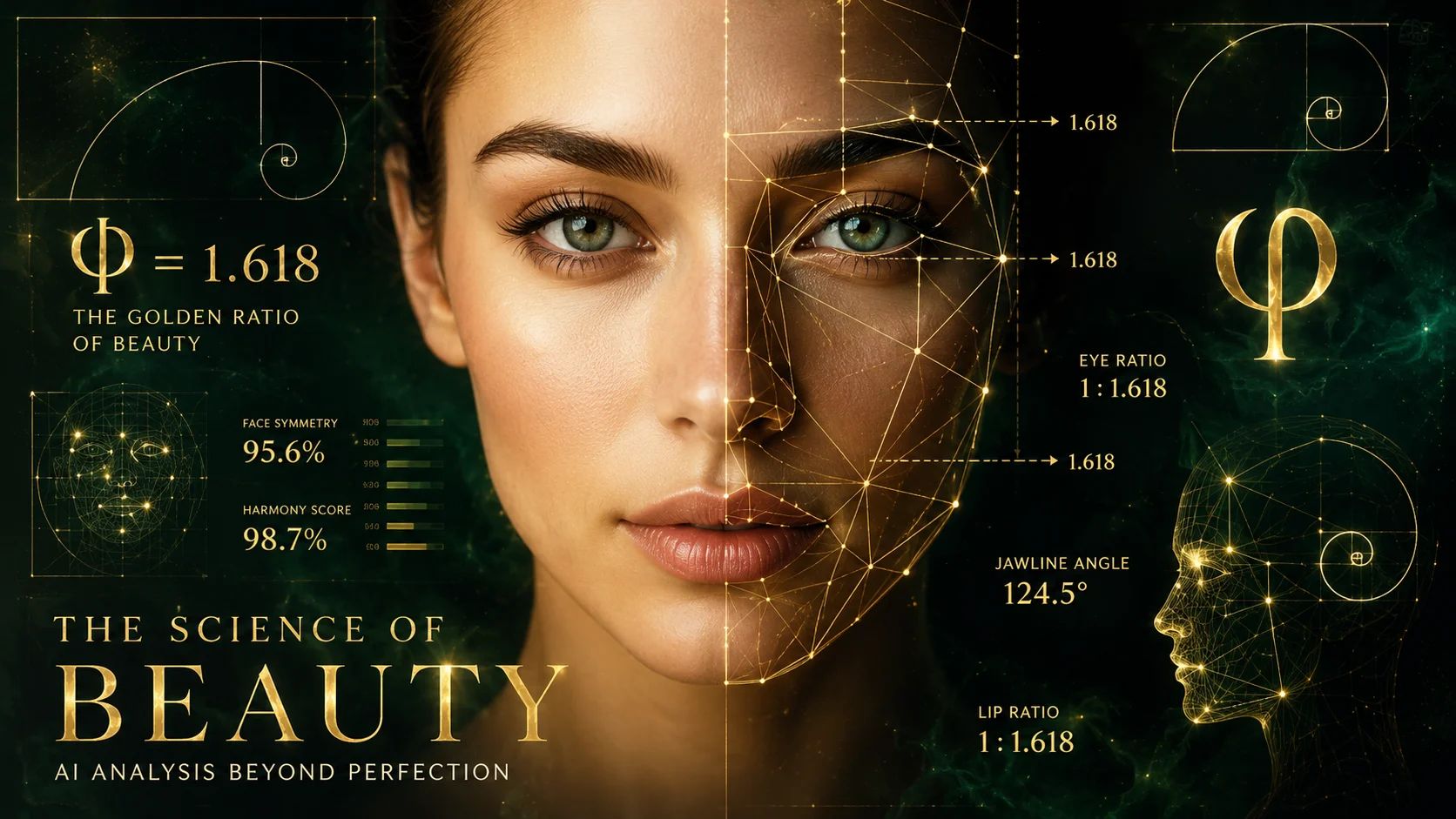
The Golden Ratio, Phi 1.618
The Greeks found a proportion they called Phi, roughly 1.618, and it keeps turning up in nature, from the spiral of a shell to the branching of a plant. When a face sits close to this ratio, most people read it as balanced. The link is not magic. We see well-proportioned faces as a sign of health, and the brain tends to prefer what it can process easily.
In a face that fits the ratio well, two relationships stand out:
- 1The length of the face is about 1.618 times its width.
- 2The distance from the base of the nose to the chin is roughly 1.618 times the distance from the bottom of the lips to the chin.
Treat the ratio as a guide, not a grade. Plenty of faces people love sit a little outside it, and that is the point we keep coming back to in this article.
1.618
Phi — The Golden Ratio
Closer to full bar = closer to Phi
The Rule of Thirds and Fifths
Before measuring any angle, surgeons map the face onto a simple grid. It tells them at a glance whether the features are spaced evenly.
- ⅢVertical thirds. A balanced face splits into three roughly equal bands: hairline to brow, brow to base of the nose, and base of the nose to the bottom of the chin.
- ⅤHorizontal fifths. Across the face, the width should fit about five eye-widths. The gap between the eyes is close to one eye-width.
These zones explain why a face can look slightly off even when each feature is fine on its own. If one third runs long, or the eyes sit wide, the proportion shifts and the eye notices.
Facial Grid — Vertical Thirds
→ brow
nose base
→ chin
Three equal vertical bands
The Six Measurements That Decide Facial Harmony
View a face from the side, or plot a few points on a front photo, and a handful of angles do most of the work. Here is what each one measures and the range aesthetic experts treat as balanced.
Jawline
Gonial Angle
Nose to lip
Nasolabial Angle
Eye angle
Canthal Tilt
Forehead to nose
Nasofrontal Angle
Lip to chin
Mentolabial Angle
Length to width
Golden Ratio
How an angle is calculated from three points
angle at B = arccos ( (BA · BC) / (|BA| × |BC|) )
Three points A, B, C. The angle sits at the middle point B.
That is the same formula the calculator runs when you tap the points on your photo. For the eye tilt it measures the slope of the line between your inner and outer eye corner. For the golden ratio it divides face length by face width. The math is exact. Your accuracy depends only on how carefully you place the points.
Balanced angle ranges at a glance
Each bar is the range that surgeons and orthodontists treat as balanced, in degrees. Wider bars give you more room before a feature reads off-balance.
Gonial Angle
Jawline
The angle of the lower jaw measured at the corner below the ear. Lower reads sharper and more square, higher reads softer and rounder.
Nasolabial Angle
Nose to lip
The angle between the base of the nose and the upper lip. A slight upward tilt usually reads more feminine and youthful.
Canthal Tilt
Eye angle
The slope of the eye from the inner corner to the outer corner. A small positive tilt lifts the eye and reads alert; a negative tilt can read tired.
Nasofrontal Angle
Forehead to nose
The transition where the forehead meets the bridge of the nose, viewed from the side. It sets how deep or shallow the brow-to-nose curve looks.
Mentolabial Angle
Lip to chin
The fold between the lower lip and the chin. It controls whether the chin looks balanced, recessed, or over-projected.
Golden Ratio
Length to width
Face length divided by face width. Faces close to Phi (about 1.618) tend to read as balanced.
Calculate Your Facial Harmony
Upload a photo and tap the landmark points, or type your angles by hand. Get a harmony score, a per-feature breakdown, and the option to save and compare. Your photo never leaves your device.
Harmony score
Add a measurement
0 of 6 measured
balanced 115° to 130°
balanced 95° to 110°
balanced 2° to 8°
balanced 115° to 130°
balanced 110° to 130°
balanced 1.5 to 1.7
Everything you enter stays in this browser. Nothing is uploaded. This tool is for general interest, not a medical or cosmetic assessment.
Track Your Results and Compare Over Time
Most face-angle tools give you a number and forget it the moment you close the tab. This one keeps a private history on your device, so a measurement you take today still means something months from now.
Save every reading
Each result is stored with its date and your harmony score. Nothing is sent to a server. It all stays in your browser.
Compare two dates side by side
Tick any two saved results and the tool lays them out together, with the change in each angle marked up or down.
See the trend after a change
Braces, a fitness change, or a procedure can shift these angles. Re-measure under the same conditions and watch the numbers move.
How to Get an Accurate Reading
The math is only as good as the photo you feed it. These habits keep your numbers honest and repeatable.
Stand back, then zoom in
Shoot from at least five feet away and zoom, instead of a close selfie. Close lenses stretch the nose and flatten the jaw, which throws every angle off.
Use a true side profile for jaw and nose angles
Gonial, nasofrontal, nasolabial, and mentolabial angles are read from the side. Turn a full 90 degrees and keep your head level, eyes forward.
Use a straight front shot for eyes and ratios
Canthal tilt and the golden ratio need a face-on photo. Keep the camera at eye height so your features are not tilted up or down.
Relax your face
No smiling, no clenching. A tense jaw or a grin changes the lip and chin angles and gives you a reading that won't repeat next time.
Flat, even light
Hard shadows hide the exact landmark points. Face a window or use soft, even light so the inner eye corner, jaw corner, and chin tip are easy to mark.
Keep conditions the same to compare later
If you want to track changes over time, repeat the same distance, angle, and lighting. Consistent photos make your saved results comparable.
What Helps and What Hurts Your Accuracy
A few small habits make the difference between a number you can trust and one that changes every time you measure.
Marking the deepest point of a fold, not the surface
Nasion and the mentolabial sulcus are the deepest dips. Mark those, not the skin around them.
Zooming the photo before placing points
Bigger landmarks mean smaller click errors. A few pixels off can shift an angle by two or three degrees.
Taking the same shot twice and averaging
Two careful reads that agree give you confidence the number is real, not a fluke of one click.
Using a close-up selfie
Lens distortion near the face inflates the nose and warps the jaw line. Your angles will be wrong.
Tilting the head up or down
A tilted head changes the apparent jaw and nose angles. Keep the chin level and eyes forward.
Reading one number as a verdict
A single degree outside a range means little. Look at the full picture across all measurements.
A Note on What These Numbers Mean
Mathematically average faces can look flat or synthetic, while a distinct nose or an uneven smile often adds the character people remember. These angles give you a blueprint of balance, nothing more. They do not measure expression, health, or worth. If you are weighing a cosmetic or orthodontic change, talk to a qualified professional who can assess your face in person. This tool is built for general interest, not medical advice.
Frequently Asked Questions
How does a facial harmony calculator work?+
It uses basic trigonometry. You mark a few landmark points on your photo, like the corner of your jaw or the inner and outer corners of your eye. The tool then measures the angle between those points and compares it to the ranges that surgeons and orthodontists treat as balanced. The math is exact. The only thing that affects the result is how carefully you place the points.
What is the most attractive gonial angle?+
Most aesthetic studies put the balanced gonial angle between 115 and 130 degrees. An angle near 120 gives a defined, structured jaw. Above about 140 degrees the jaw can look soft or sloping, while a very low angle reads as square and strong. There is no single correct number, since a stronger or softer jaw suits different faces.
What does a positive canthal tilt mean?+
It means the outer corner of your eye sits slightly higher than the inner corner. A tilt of roughly +2 to +8 degrees is the range people tend to find alert and youthful. A negative tilt, where the outer corner drops below the inner corner, can give a tired or downturned look.
Is the golden ratio really linked to beauty?+
Partly. Faces with a length-to-width ratio near 1.618 often read as balanced, and the proportion shows up across many faces people rate highly. But it is one signal among many. Symmetry, skin, expression, and proportion between features matter just as much. Treat the ratio as a guide, not a grade.
Do the ideal angles differ for men and women?+
For most angles, no. The jaw, eye, forehead, and chin angles use the same balanced ranges. The clear exception is the nasolabial angle. Men tend to look balanced around 90 to 105 degrees, while women often look balanced with a slight upward tilt around 100 to 115 degrees. The calculator adjusts that range when you set your sex.
Will I get the same result every time?+
You will if your photo and your point placement stay consistent. Different lighting, camera distance, or head tilt will move the numbers. That is why the tool lets you save each result with the date. When you repeat the measurement under the same conditions, you can compare the readings and trust the trend.
Are average or mathematically perfect faces the most attractive?+
Not always. Faces built to be perfectly average can look flat or synthetic. Small departures from the ideal, like a distinct nose or an uneven smile, often add character that people find more appealing. The math gives you a blueprint of balance. It does not measure charm, expression, or the things that make a face memorable.
The Bottom Line
Math gives you a fair, repeatable way to read facial proportion, and it explains why some faces strike us as balanced. It is only half the story. The angles set the structure. Expression, symmetry, and the small things that make a face distinct bring it to life. Measure for curiosity, save your result, and let the number be one input among many.