Find Your Face Shape Online Free
A free face shape detector, quiz, and complete styling guide — find your face shape in under a minute, then pick glasses, hairstyles, haircuts, and beard styles that actually suit you.
Finding your face shape sounds simple, but it can be surprisingly confusing. One selfie makes your face look round, another makes it look longer, and your hairstyle or camera angle can completely hide your real facial proportions. That is why so many people search for a way to find your face shape online free before choosing glasses, hairstyles, haircuts, or makeup.
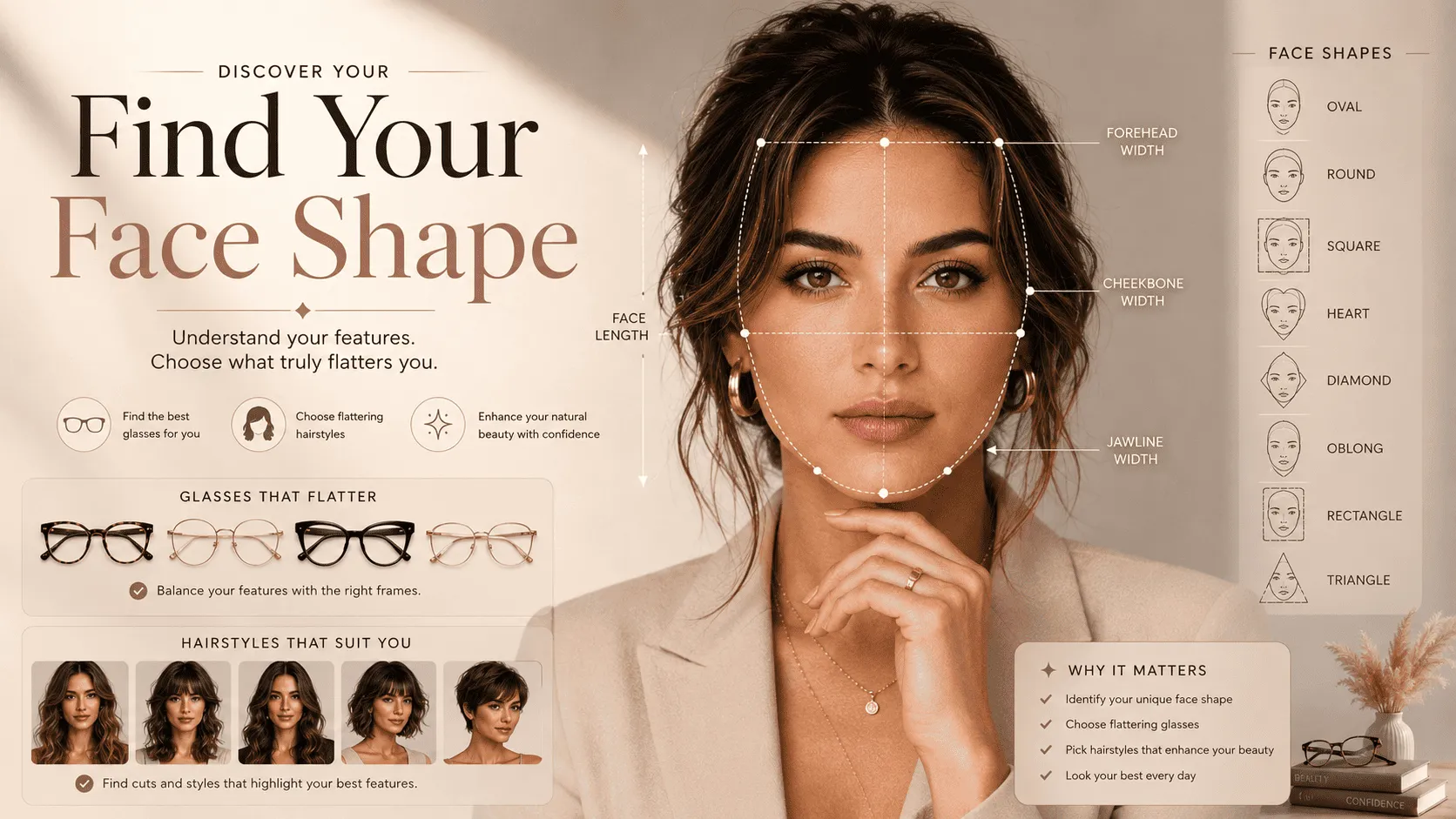
Our free face shape calculator helps you figure out your likely face shape using simple clues — face length, cheekbone width, forehead width, jawline, and chin shape. Whether you want a quick face shape detector, a 5-question quiz, or a guide to find my face shape for glasses, this page walks you through it step by step.
Knowing your face shape helps with choosing glasses, hairstyles, haircuts, beard styles, makeup, contouring, filters, and fashion choices — it's the single most useful piece of styling information you can have about yourself.
Find Your Face Shape Online Free
Answer five quick questions or enter your face measurements. We'll match you to one of eight face shapes and recommend glasses, hairstyles, and beard styles.
Compared to its width, how long does your face look?
Tie your hair back, look in a mirror, and compare top of forehead to chin.
Your result is a helpful styling guide, not a strict rule. Many people have a mix of two face shapes — use this as a starting point, then try a few hairstyles or frames to see what works best for you.
What Is a Face Shape?
A face shape is the overall outline of your face when viewed from the front — the way your forehead, cheekbones, jawline, and chin combine to form a recognizable silhouette. Most people fit into one of eight common face shapes:
Your face shape depends on five things: forehead width, cheekbone width, jawline width, face length, and chin shape. When you know how those measurements compare, your shape becomes obvious — and that's exactly what the calculator above checks for you.
How to Find Your Face Shape
There are two reliable ways to figure out your face shape. Use whichever feels easier — both lead to the same answer.
Method 1: How to Find Your Face Shape Without Measurements
You can find your face shape without a measuring tape. Tie your hair back, stand in front of a mirror in good lighting, and ask yourself four questions:
- 1
Which part is widest?
Look at your forehead, cheekbones, and jawline. The widest one tells you a lot — forehead-widest is usually heart-shaped, cheek-widest is often diamond or oval, jaw-widest is triangle or square.
- 2
Is your face longer or balanced?
Compare top of forehead to chin against ear-to-ear width. If they're similar, you're in the round/square family. If length is much greater, you're in the oval/oblong/rectangle family.
- 3
Is your jawline sharp or soft?
Sharp, angular jaw → square or rectangle. Soft, rounded jaw → round, oval, or oblong. Narrow or pointed → heart or diamond.
- 4
What does your chin look like?
Rounded chin = round or oval. Pointed chin = heart or diamond. Squared chin = square, rectangle, or triangle.
Method 2: How to Find Your Face Shape With Measurements
For a more accurate answer, use a soft measuring tape and write down four numbers (cm or inches — it doesn't matter, we're comparing ratios):
- 1
Forehead width
Across the widest part of your forehead, temple to temple.
- 2
Cheekbone width
The outer edge of one cheekbone to the other, just under the eyes.
- 3
Jawline width
Just below the ears, around the curve to the chin.
- 4
Face length
Center of the hairline straight down to the bottom of your chin.
Compare the numbers:
- Oval face: Face length is longer than width; cheekbones are the widest point; jaw is softly rounded.
- Round face: Length and width are similar; soft jawline; full cheeks.
- Square face: Forehead, cheekbones, and jaw are similar in width; strong, angular jaw.
- Heart face: Wider forehead, narrower chin.
- Diamond face: Cheekbones are widest, narrow forehead and jaw.
- Oblong face shape: Face is noticeably longer than wide, with similar widths across.
- Rectangle face: Long face with a stronger, straighter jawline.
- Triangle face: Jawline is wider than forehead.
Face Shape Detector vs Face Shape Quiz vs Face Shape App
People search for all three — and they're not the same. Here's how to choose:
Face shape detector
A tool that analyzes your facial proportions — either from measurements or from answers about your features. Our calculator above is a face shape detector.
Face shape quiz
A guided 5-question quiz that asks about your forehead, cheekbones, jawline, chin, and face length. Best for users who don't want to measure anything.
Face shape app
A downloadable app that often uses AR filters or camera AI. Convenient, but accuracy depends on lighting and angle. Many users prefer a no-download tool.
Our online face shape detector and quiz can be a faster, more reliable option than downloading a find your face shape app — there's nothing to install, no permissions required, and it works in any browser.
Why It Is Hard to Find Your Face Shape
If you've ever looked in the mirror and thought "I see three different face shapes," you're not alone. Several real problems get in the way:
- Selfies distort proportions — phone cameras use wide-angle lenses that make the forehead look bigger and the chin look smaller.
- Camera angles change your face length — a slightly tilted phone can turn an oblong into an oval.
- Hairstyles hide the forehead and jaw, making it almost impossible to see your true outline.
- Weight changes affect facial fullness, especially in the cheeks and jaw.
- Many people have a mix of two face shapes (oval-square, heart-diamond) and don't fit a single label cleanly.
- Lighting and shadow can make a soft jaw look sharper, or a sharp jaw look soft.
- AR filters and beauty apps change facial proportions automatically — so what you see isn't what you have.
How Our Face Shape Calculator Solves This Problem
Instead of guessing from a single selfie, our face shape detector uses multiple signals — the shape of your jaw, the widths of your face, the relationship between length and width, and the look of your chin. It gives you a structured answer instead of a vague impression.
Saves time
A face shape result in under 30 seconds — no app to download, no account to create.
Works online
Open it on your phone, tablet, or laptop. Anywhere with a browser.
Free forever
No paywall, no email gate, no premium tier. Just use it.
Beginner-friendly
The quiz uses plain language — no measurements required if you don't want them.
Actionable result
Every result includes glasses, hairstyle, and beard recommendations you can use today.
No download needed
A genuine alternative to a find your face shape app — the same answer, faster.
Find My Face Shape for Glasses
The right glasses balance your face. The rule is simple: pick frames that contrast with your natural lines. Sharp jaw? Go soft. Soft round face? Go angular. Here's a face-by-face breakdown:
| Face Shape | Best Frame Styles |
|---|---|
| Oval | Almost every frame style works • Square or geometric frames add a little structure |
| Round | Angular or rectangular frames add definition • Square wayfarers and browline frames work well |
| Square | Round or oval frames soften sharp angles • Rimless or thin-frame styles work well |
| Heart | Lightweight, rimless, or thin-frame styles • Bottom-heavy frames balance the wider forehead |
| Diamond | Oval frames soften the angular cheekbones • Cat-eye frames highlight the cheek structure |
| Oblong | Oversized or tall frames add width visually • Decorative side temples break the length |
| Rectangle | Round and oval frames soften the structure • Wider frames break up the face length |
| Triangle | Browline frames add width at the top • Cat-eye frames balance the jaw |
Find Your Face Shape and Hairstyle
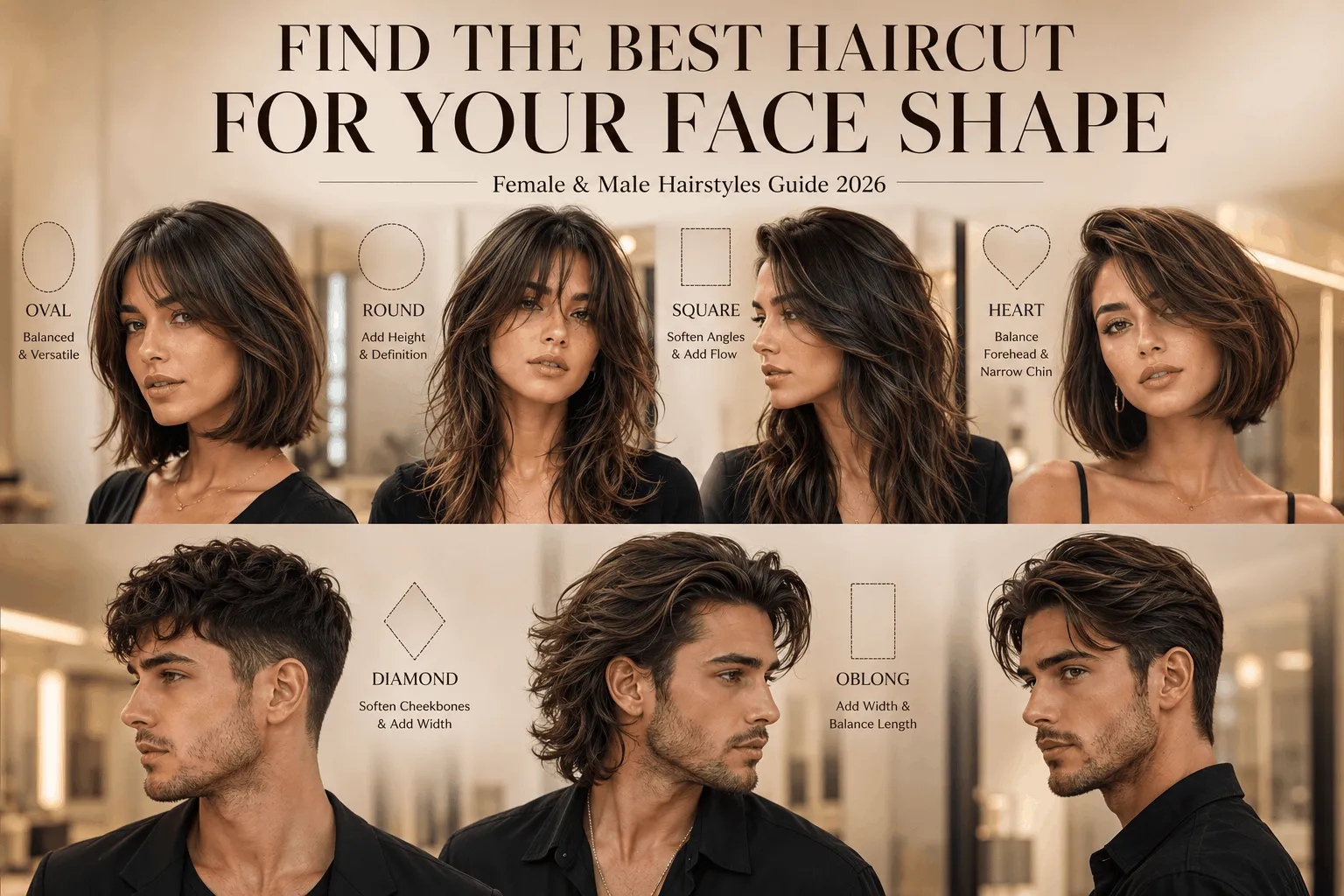
Your face shape is the strongest predictor of which haircuts will suit you. Whether you're trying to find your face shape for a haircut as a man or a woman, the principle is the same: balance length with width.
| Face Shape | Hairstyle Ideas |
|---|---|
| Oval | Long layers, bobs, and lobs • Side parts, middle parts — both work |
| Round | Volume at the crown adds length • Layers and long side-swept bangs |
| Square | Soft layers and waves • Side-swept styles to break the jaw line |
| Heart | Chin-length cuts add width near the jaw • Side-swept or curtain bangs soften the forehead |
| Diamond | Side parts and chin-length bobs • Layered cuts that add width at the forehead |
| Oblong | Bangs (blunt, curtain, or wispy) shorten the face • Waves and curls add width at the sides |
| Rectangle | Layered hairstyles with waves add softness • Bangs visually shorten the face |
| Triangle | Volume near the temples and crown • Side-swept bangs widen the forehead |
For men, the same logic applies to beard styles. A square face benefits from a softly rounded beard. A round face benefits from a goatee that adds vertical length. A heart face benefits from a fuller beard that adds weight to a narrower chin.
Face Shape Types Explained
Below is a detailed guide for every face shape — how to identify it, common features, the best glasses and hairstyles, and the most common mistake people make.

Oval Face Shape
A balanced face that is a bit longer than it is wide, with a softly rounded jaw and slightly wider cheekbones than forehead and chin.
How to identify:
Your face length is about 1.5× your face width. Your forehead is slightly wider than your jaw, and your jawline is softly rounded — not sharp or pointed.
Common features:
- Face length is longer than width
- Softly rounded jawline
- Forehead slightly wider than chin
- Cheekbones are the widest part
✓ Best glasses
- • Almost every frame style works
- • Square or geometric frames add a little structure
- • Aviators and wayfarers look balanced
✓ Best hairstyles
- • Long layers, bobs, and lobs
- • Side parts, middle parts — both work
- • Curtain bangs or no bangs at all
Common mistake
Choosing very oversized frames or heavy hairstyles that hide your naturally balanced proportions.
Stylist tip
Oval is considered the most versatile face shape — feel free to experiment with trends since most styles work in your favor.

Round Face Shape
A face where length and width are about equal, with soft curves at the cheeks, jawline, and chin.
How to identify:
Your face length and width are nearly the same. Your jaw is soft and curved (not sharp), and your cheeks are full. There are no strong angles.
Common features:
- Face length and width are similar
- Soft, rounded jawline
- Full cheeks
- Wider, soft forehead
✓ Best glasses
- • Angular or rectangular frames add definition
- • Square wayfarers and browline frames work well
- • Cat-eye frames lift the cheekbones
✓ Best hairstyles
- • Volume at the crown adds length
- • Layers and long side-swept bangs
- • Long bobs and styles that fall past the jaw
Common mistake
Choosing round glasses, chin-length blunt bobs, or styles with extra volume at the sides — all add more roundness.
Stylist tip
Always add a vertical line: a center part, taller hairstyle, longer earrings, or V-neck tops will visually slim a round face.

Square Face Shape
A strong, angular face where the forehead, cheekbones, and jawline are roughly the same width.
How to identify:
Your face length and width are similar. Your jaw is strong, defined, and forms a clear angle. The forehead is usually flat or straight.
Common features:
- Forehead, cheekbones, and jaw are similar in width
- Strong, angular jawline
- Flat or straight forehead
- Face length close to face width
✓ Best glasses
- • Round or oval frames soften sharp angles
- • Rimless or thin-frame styles work well
- • Cat-eye frames lift the strong jawline
✓ Best hairstyles
- • Soft layers and waves
- • Side-swept styles to break the jaw line
- • Long, layered hair frames the face beautifully
Common mistake
Choosing sharp, boxy frames or blunt cuts that exaggerate an already strong, angular jaw.
Stylist tip
Soften, don't sharpen. Curves balance a square face — round frames, soft waves, and rounded jewelry all work.

Heart Face Shape
A face with a wider forehead, prominent cheekbones, and a narrow, often pointed chin.
How to identify:
Your forehead is the widest part of your face. Your chin is narrow and sometimes pointed. Cheekbones are usually prominent.
Common features:
- Wider forehead
- Narrow, sometimes pointed chin
- Defined cheekbones
- Face tapers from forehead to chin
✓ Best glasses
- • Lightweight, rimless, or thin-frame styles
- • Bottom-heavy frames balance the wider forehead
- • Aviators and oval frames
✓ Best hairstyles
- • Chin-length cuts add width near the jaw
- • Side-swept or curtain bangs soften the forehead
- • Long layers ending below the chin
Common mistake
Slicked-back hairstyles or short pixie cuts that expose the forehead and emphasize the narrow chin.
Stylist tip
Add weight below the cheekbones. Chin-length hairstyles, fuller beards, and statement collars all help balance the heart shape.

Diamond Face Shape
A rare and striking face with narrow forehead and chin, and dramatically wide cheekbones.
How to identify:
Your cheekbones are the widest part of your face. Both your forehead and your jaw/chin are narrower than your cheekbones.
Common features:
- Cheekbones are the widest part
- Narrow forehead
- Narrow or pointed chin
- Face length usually longer than width
✓ Best glasses
- • Oval frames soften the angular cheekbones
- • Cat-eye frames highlight the cheek structure
- • Rimless frames keep the look soft
✓ Best hairstyles
- • Side parts and chin-length bobs
- • Layered cuts that add width at the forehead
- • Curtain bangs balance the narrow forehead
Common mistake
Slicked-back hair or styles with no volume at the forehead — these emphasize the narrowest parts of the face.
Stylist tip
Diamond faces have stunning cheekbones — work with them, not against them. Add a little softness around the forehead and chin.

Oblong Face Shape
A long face shape with similar widths at the forehead, cheekbones, and jaw — but noticeably longer than it is wide.
How to identify:
Your face is clearly longer than it is wide. Your forehead, cheekbones, and jaw are similar in width, and your jawline is usually soft.
Common features:
- Face length noticeably greater than width
- Forehead, cheekbones, and jaw are similar widths
- Softly rounded chin
- Often a high forehead
✓ Best glasses
- • Oversized or tall frames add width visually
- • Decorative side temples break the length
- • Avoid narrow, rectangular frames
✓ Best hairstyles
- • Bangs (blunt, curtain, or wispy) shorten the face
- • Waves and curls add width at the sides
- • Avoid extra height at the crown
Common mistake
Long, straight hair with no bangs and tall hairstyles — both make the oblong face shape look even longer.
Stylist tip
Add width, not height. Bangs, waves, statement earrings, and horizontal-line jewelry all balance an oblong face shape.
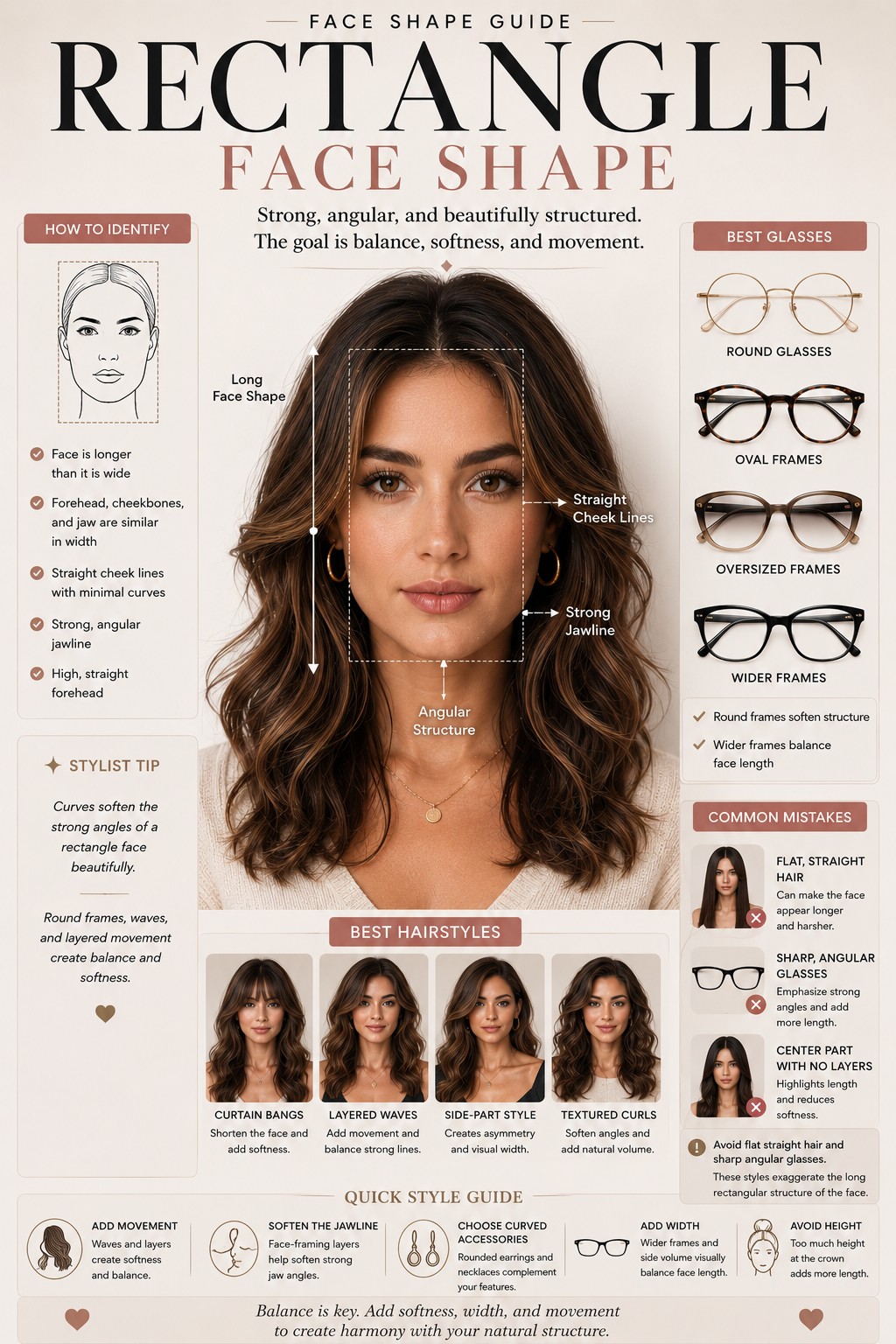
Rectangle Face Shape
Similar to oblong but with stronger, straighter sides and a more defined, angular jaw.
How to identify:
Your face is long with straight sides and a strong, clearly defined jaw. Forehead, cheekbones, and jaw are similar in width.
Common features:
- Face is noticeably long
- Strong, straight jawline
- Straight cheek lines
- Higher, often straight forehead
✓ Best glasses
- • Round and oval frames soften the structure
- • Wider frames break up the face length
- • Avoid narrow rectangular glasses
✓ Best hairstyles
- • Layered hairstyles with waves add softness
- • Bangs visually shorten the face
- • Side parts work better than center parts
Common mistake
Straight, long hair with no layers and sharp angular frames — both emphasize the rectangular look.
Stylist tip
Curves are your friend. Round frames, soft layers, and waves all balance the strong angles of a rectangle face shape.

Triangle Face Shape
Also called pear-shaped — the jawline is wider than the forehead, with a strong lower face.
How to identify:
Your jawline is the widest part of your face. Your forehead is narrower than your cheekbones and jaw. Often a strong, defined jaw.
Common features:
- Wider jawline
- Narrower forehead
- Defined jaw
- Cheekbones soft or moderate
✓ Best glasses
- • Browline frames add width at the top
- • Cat-eye frames balance the jaw
- • Top-heavy or decorative top-rim frames
✓ Best hairstyles
- • Volume near the temples and crown
- • Side-swept bangs widen the forehead
- • Pixie cuts and short layered styles
Common mistake
Long beards or hair tucked behind the ears — both emphasize the wider jaw.
Stylist tip
Add volume up top. Top-heavy frames, voluminous hair, statement earrings worn high, and structured shoulders all balance a triangle face.
Stop Guessing — Find Your Face Shape Now
Instead of guessing, use our free face shape calculator to find your face shape online and get better ideas for glasses, hairstyles, haircuts, and personal styling. You'll have an answer in less than a minute.
Frequently Asked Questions
How to find your face shape?
There are three reliable ways. First, take a clear front-facing photo and compare the widths of your forehead, cheekbones, and jawline. Second, measure those four points with a soft tape. Third, use a face shape calculator like the one on this page, which guides you through the same checks step by step.
How can I find my face shape online free?
Use the free face shape calculator at the top of this page. It works in any browser, on phone or desktop, with no download or sign-up required. Answer five quick questions or enter your measurements and you'll get your likely face shape in seconds.
Can I find my face shape by uploading a photo?
Photo upload tools exist, but selfies often distort proportions — wide-angle phone lenses make foreheads look wider, and tilted angles can change the apparent face length. A guided quiz or simple measurements usually gives a more reliable result than a single uploaded photo.
What is the best face shape detector?
The best face shape detector is one that uses multiple signals — face length, cheekbone width, jawline shape, and chin shape — instead of a single photo. Our calculator combines a quick quiz with optional measurements for a clearer estimate.
Is there a find your face shape filter?
Some apps offer AR filters that overlay face shape labels. They are fun, but they can be inaccurate because they rely on lighting and angle. A measurement or quiz-based tool is usually more reliable for choosing glasses or hairstyles.
How to find your face shape for glasses?
Look at the angularity of your jaw and the relative widths of your forehead, cheekbones, and jaw. Round and oval faces suit angular frames; square and rectangle faces suit round or oval frames; heart and diamond faces suit bottom-heavy or rimless frames; triangle faces suit browline or cat-eye frames.
How to find your face shape for a haircut?
For a haircut, the goal is balance. Round and square faces benefit from layers and vertical lines. Long faces (oblong, rectangle) benefit from bangs and waves that add width. Heart and diamond faces benefit from chin-length styles. Triangle faces benefit from volume near the temples.
How to find your face shape (men)?
Men can use the same calculator. The result helps you pick a beard style, haircut, and glasses. Square and rectangle face shapes look great with short, rounded beards. Heart and diamond shapes benefit from fuller beards. Round faces benefit from longer styles like a goatee.
How to find your face shape (female)?
Women use the same method — compare forehead, cheekbones, jaw, and face length. Once you know your shape, you can match it to flattering glasses, hairstyles, contouring, and earrings. Oval faces are the most versatile; round, heart, and oblong shapes benefit from specific style choices.
How to find your face shape without measurements?
Take a clear front-facing photo with hair pulled back. Look at three things: which part of your face is widest (forehead, cheekbones, or jaw), is your face longer than wide or about the same, and is your jaw sharp or soft. Those three answers point to your shape — exactly what our quiz uses.
How to find your face shape with measurements?
Measure four things with a soft tape: forehead width (across the widest part), cheekbone width (under the eyes), jawline width (just below the ear, around the curve to the chin), and face length (hairline to chin). Compare the numbers — the widest area and the length-to-width ratio decide your shape.
What is an oblong face shape?
An oblong face shape is one that is noticeably longer than it is wide, with forehead, cheekbones, and jaw at similar widths. The jawline is usually soft and the forehead is often high. It is similar to a rectangle but with softer, less angular features.
Is a face shape detector accurate?
A face shape detector gives a likely estimate, not a strict diagnosis. Many people have a mix of two shapes. Use the result as a starting point for styling decisions, not a fixed label. Trying a few hairstyles or frames will always be the final test.
Can my face shape be a mix of two shapes?
Yes — and most people are. You might be oval-with-square or heart-with-diamond. The calculator gives you the closest single match, but feel free to read the styling tips for your second-closest shape too.
What is the difference between oval and oblong face shape?
Both are longer than wide, but oval faces have cheekbones as the widest point and softer, balanced proportions. Oblong faces are noticeably longer with forehead, cheekbones, and jaw at roughly equal widths — they look more uniform vertically.
Ready to find your face shape?
Use the calculator at the top of this page to get your result in under a minute — free, no download, works on any device.
Start Face Shape Quiz →