
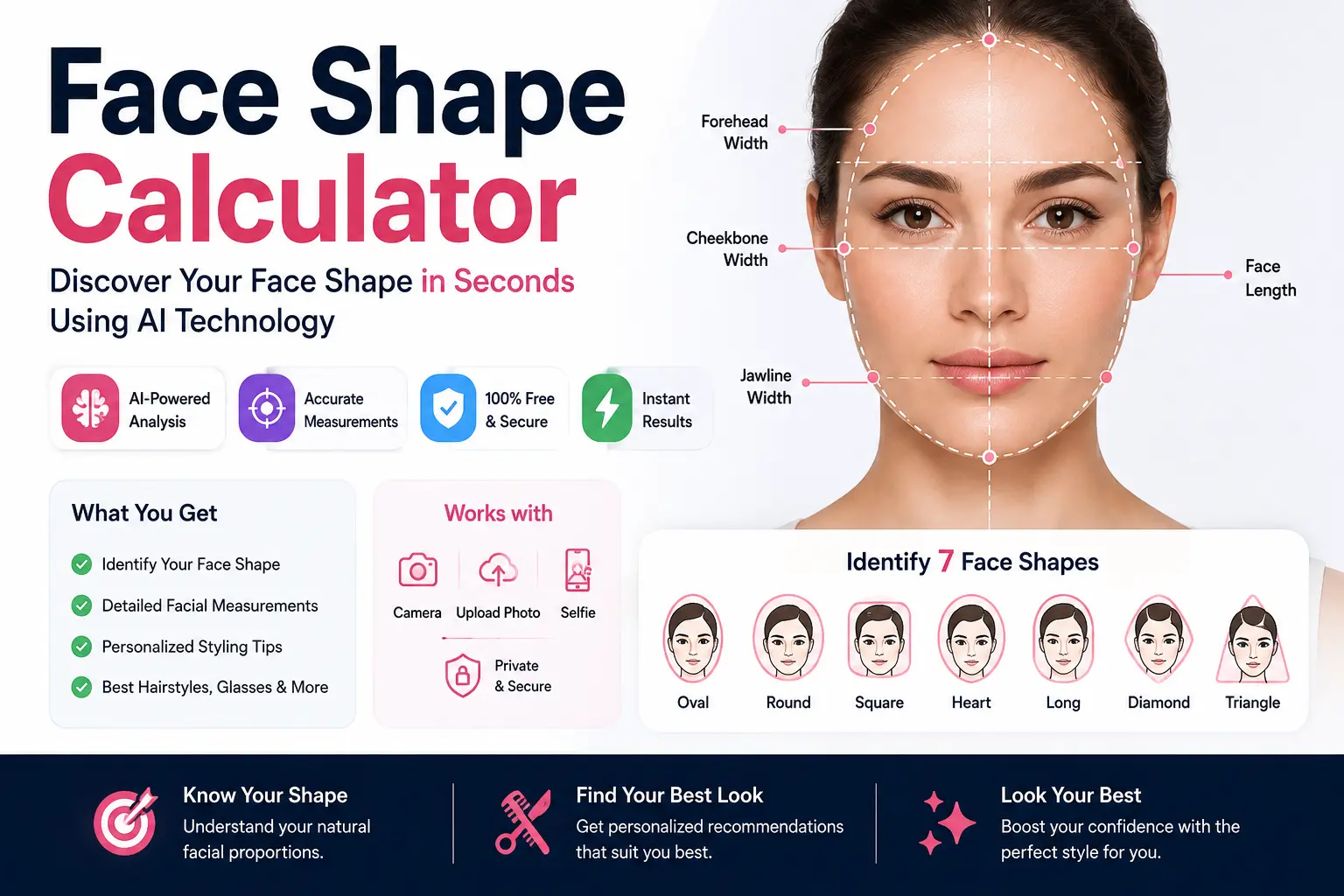
How to read your face-shape result
Your result is best read as a closest match. The most useful result is not just a label such as "Oval"; it is an explanation of which visible proportions pushed the match toward that category.
Example result explanation
Your closest match: Oval
Your face appears longer than it is wide, the cheekbone region is relatively prominent, and the jaw narrows gradually. Those characteristics are more consistent with an oval pattern than a round or square one.
What if I am between two face shapes?
That is normal. Human facial proportions vary continuously, so a face can show characteristics of two nearby categories—for example oval and oblong, round and square, or heart and diamond. If your proportions sit near a boundary, use both patterns as descriptive guides rather than forcing an exact label.
How does the Face Shape Calculator work?
Calqulate compares visible facial proportions rather than judging attractiveness. Photo mode estimates the facial boundaries needed for the calculation; manual mode lets you provide the measurements yourself.
1. Face length
The visible distance from the upper-face or hairline region to the bottom of the chin.
2. Forehead width
The relative width across the upper portion of the face.
3. Cheekbone width
The relative width across the cheekbone region.
4. Jaw width
The relative width and prominence of the lower face.
Two questions do most of the work
1. Is the face relatively long, balanced or wide?
A useful relationship is face length compared with cheekbone width. A relatively larger length-to-width relationship points toward longer patterns, while a smaller difference points toward shapes where visible length and width are closer. One ratio alone is not enough to classify the face.
2. Which part of the face is widest?
The calculator also compares the forehead, cheekbones and jaw. A relatively wider upper face can point toward heart; dominant cheekbone width can point toward diamond; and a relatively wider lower face can point toward triangle. Similar widths across the face require length and outline characteristics to separate patterns such as square, rectangle and oblong.
Methodology note: face-shape categories do not have one medically or scientifically mandated classification system. Calqulate uses relative facial measurements and proportion rules as practical matching criteria. Any numerical thresholds used by the calculator are Calqulate matching rules, not universal biological standards.
How to find your face shape from a photo
Photo quality can change the proportions visible to the detector. For a more repeatable result, use a simple photo rather than a heavily styled selfie.
- Face the camera directly and keep your head upright.
- Position the camera around eye level.
- Use even lighting without strong side shadows.
- Keep hair away from the forehead, cheeks and jaw.
- Use a relaxed, neutral expression.
- Avoid beauty filters and extreme wide-angle perspective.
Why can two photos give different results?
Camera distance, lens perspective, head tilt, hair, expression and lighting can change the apparent width or length of facial regions. If two photos return different matches, retake the photo under neutral conditions or compare the result with manual mode.
How to measure your face shape manually
If you do not want to use a photo, use a flexible measuring tape and record the four measurements below. Use the same unit for all four values—centimeters or inches both work.
- 1
Measure face length
Measure from the approximate center of the hairline or upper-face starting point to the bottom of the chin.
- 2
Measure forehead width
Measure across the widest visible part of the forehead without wrapping the tape around the head.
- 3
Measure cheekbone width
Measure across the widest visible part of the cheekbone region.
- 4
Measure jaw width
Measure the lower-face width consistently using the jaw points requested by the calculator.
Consistency matters more than trying to achieve millimeter-level precision. If your result seems unexpected, repeat the measurements once before changing the values.
Enter My Measurements ↑The 8 common face shapes
This calculator uses eight descriptive patterns. These categories are useful shortcuts for comparing proportions; they are not medical diagnoses or rigid identities.
Oval face shape
The face is moderately longer than it is wide, with cheekbones among the wider areas and a jaw that narrows gradually.
Often confused with: Oblong
Round face shape
Visible face length and width are relatively close, with fuller cheek width and a softer lower-face outline.
Often confused with: Square
Square face shape
The forehead, cheekbones and jaw are relatively similar in width, with a more defined or angular lower face.
Often confused with: Round or Rectangle
Oblong face shape
Face length is prominent while the forehead, cheekbones and jaw remain relatively similar in width, with a softer outline than rectangle.
Often confused with: Oval or Rectangle
Rectangle face shape
The face is clearly longer than it is wide, with relatively even widths through the upper, middle and lower face and a more angular jaw.
Often confused with: Oblong or Square
Heart face shape
The upper face is relatively wider and the lower face narrows toward the jaw and chin.
Often confused with: Diamond
Diamond face shape
The cheekbone region is the dominant width, while the forehead and lower face appear narrower.
Often confused with: Heart
Triangle face shape
The lower face or jaw is relatively wider than the forehead, making the lower portion visually more prominent.
Often confused with: Square
Face shape comparison chart
| Shape | Relative length | Dominant width | Lower-face outline |
|---|---|---|---|
| Oval | Moderately long | Cheekbones / balanced | Soft or tapered |
| Round | Close to width | Cheekbones | Rounded |
| Square | Close to width | Similar widths | More angular |
| Oblong | Long | Fairly even | Softer |
| Rectangle | Long | Fairly even | More angular |
| Heart | Moderate | Forehead / upper face | Narrower |
| Diamond | Moderate to long | Cheekbones | Narrow or tapered |
| Triangle | Moderate | Jaw / lower face | Wider |
Does the calculator work for women and men?
Yes. The basic comparison uses the same visible proportion relationships: face length and the relative widths of the forehead, cheekbones and jaw. A separate male or female face-shape classification system is not required for the core calculation.
Hairstyle, beard, makeup or accessory preferences can differ, but those styling choices are separate from the geometric comparison used to estimate face shape.
How accurate is a face shape calculator?
A face shape calculator provides an estimate, not an objective biological diagnosis. The result is designed to be a consistent comparison of visible proportions, but photo angle, lens distortion, head position, lighting, hair and expression can influence what the calculator sees.
My result does not look right. What should I do?
- 1. Retake the photo facing the camera directly.
- 2. Move hair away from the forehead and jaw.
- 3. Use neutral, even lighting.
- 4. Remove strong beauty filters.
- 5. Try manual measurement mode.
- 6. Consider whether your proportions sit between two categories.
Can face shape change over time?
The underlying facial structure is relatively stable in adulthood, but the visible outline can change. Weight changes, facial fat distribution, ageing, swelling, hairstyle and photography conditions can make a face appear closer to another descriptive pattern.
Is there a best or most attractive face shape?
No face-shape category is objectively the most attractive. Appearance preferences vary between people and cultures, and face shape is only one part of overall appearance. This calculator describes selected facial proportions; it does not rank beauty or attractiveness.
Use face shape as a styling starting point
Face shape can be one useful input when comparing hairstyles or glasses, but it should not be treated as a rule about what you can wear. Fit, personal preference and individual features matter too.
Hairstyles
Think about visual balance—adding height, width, softness or structure depending on the effect you prefer.
Explore haircut guidance →Glasses
Frame shape can create contrast with facial lines, but frame width, bridge fit and comfort are more important than a shape label alone.
What this calculator does—and does not do
The calculator compares selected visible facial proportions with eight common descriptive patterns. It does not use face shape to determine health, personality, intelligence, ethnicity, age or medical conditions, and it does not rank attractiveness.
Why Calqulate shows an estimate
There is no single universally accepted scientific threshold separating every oval face from every oblong face or every round face from every square face. Showing a closest-match estimate is more transparent than presenting a geometric label as an exact fact.
Photo privacy
The privacy statement shown beside the uploader should match the production implementation exactly. If photo analysis is fully local, state: “Your photo is processed locally in your browser and is not uploaded to Calqulate's servers.†Do not claim “100% secure,†and do not say an image is deleted after analysis if it was never uploaded or stored.
Advertisement
Related Calqulate tools
Frequently Asked Questions
Common questions and answers about this calculator.
How do I find my face shape?
Use a clear front-facing photo or measure your face length, forehead width, cheekbone width and jaw width. The calculator compares those visible proportions with common face-shape patterns and returns the closest match.
How do I find my face shape from a photo?
Use a straight-on photo taken around eye level with even lighting, a neutral expression and your forehead and jaw visible. The calculator estimates key facial proportions from the image and compares them with common face-shape patterns.
What are the eight face shapes used by this calculator?
This calculator uses eight descriptive categories: oval, round, square, oblong, rectangle, heart, diamond and triangle. Different guides may group or name categories differently because there is no single universally mandated face-shape taxonomy.
Can I find my face shape without uploading a photo?
Yes. Use manual mode and enter your face length, forehead width, cheekbone width and jaw width. Use the same unit for all four measurements.
Does the face shape calculator work for men and women?
Yes. The basic comparison uses visible facial proportions such as face length and the relative widths of the forehead, cheekbones and jaw. The calculator does not require separate male and female face-shape systems.
How accurate is a face shape calculator?
Treat the result as an estimate of your closest common face-shape pattern, not an exact biological classification. Photo angle, camera distance, lighting, hair, expression and proportions that sit between categories can affect the result.
What if my face looks like two different shapes?
That can happen because human facial proportions vary continuously. If your features sit near the boundary between two patterns, use both as descriptive guides rather than forcing an exact geometric label.
What is the rarest face shape?
There is no reliable universal population dataset that establishes one face shape as the rarest across all populations, so claims that one category is definitively the rarest should be treated cautiously.
Which face shape is most attractive?
There is no objectively most attractive face shape. Appearance preferences vary between people and cultures, and face shape is only one part of overall facial appearance.
Can my face shape change over time?
Your underlying facial structure is relatively stable in adulthood, but weight change, ageing, swelling, hairstyle and photography conditions can change the visible outline and affect a calculator result.
About the authors


Still not sure about your face shape?
Try another straight-on photo under neutral lighting, or switch to manual mode and compare your four measurements.