Best Haircut for Your Face Shape
Discover Which Hairstyles Complement Your Natural Proportions
Soft layers, precise parts, and customized length. Discover how professional hair stylists match geometry, volume, and texture to balance features, with interactive illustrations for both women and men.
calqulate.net - 2026 Haircut Guide
6
Face Shapes Covered
12+
Haircut Styles
2
Infographics
Free
Face Shape Tool
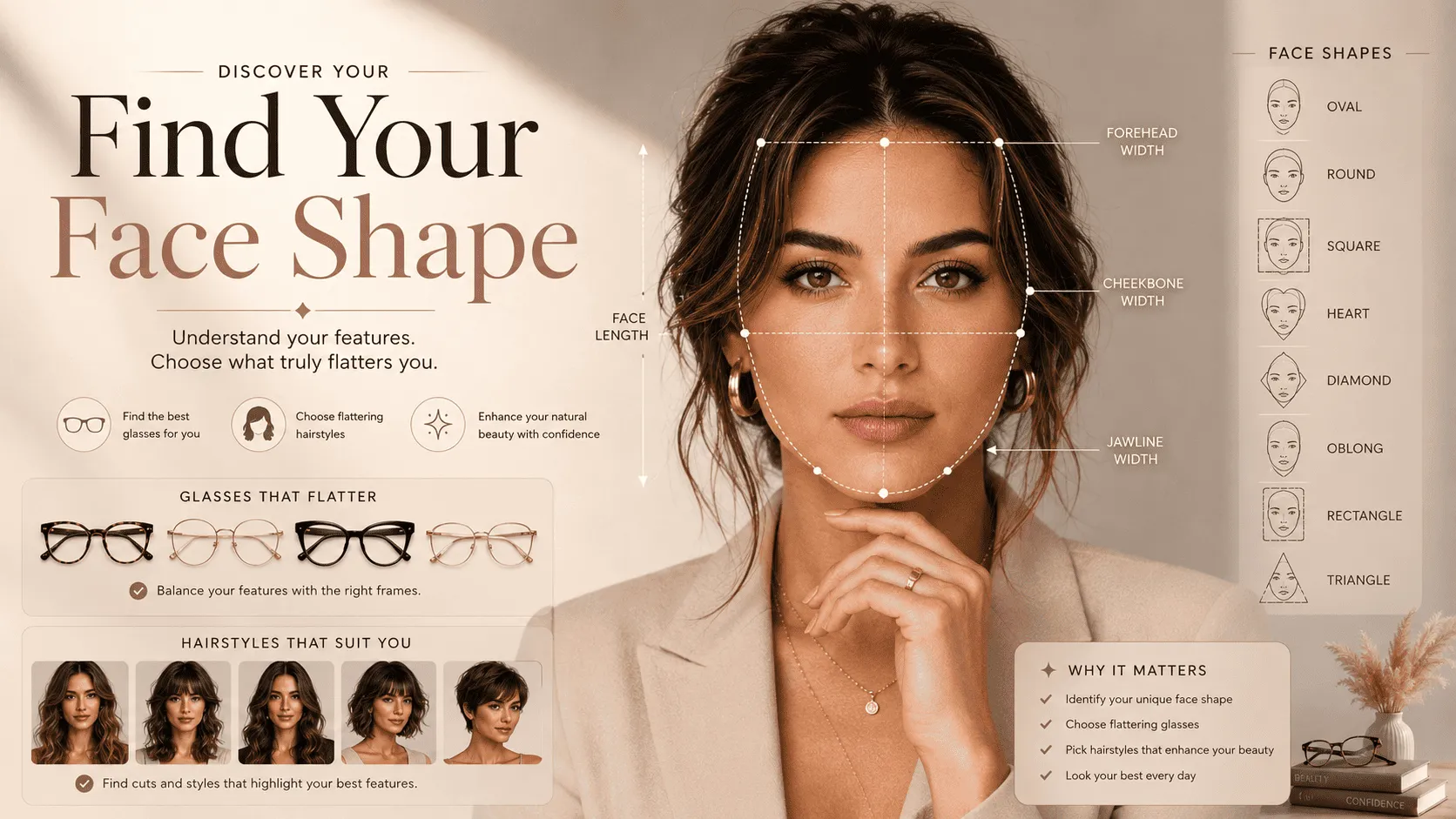
How to Find Your Face Shape (Quick Calibration)
To identify the right hairstyle profile, you must first accurately categorize your bone structure. Perform this quick three-step measurement ritual in front of a mirror:
Pull your hair back and use a mirror
Tie or clip all your hair away from your face so your full hairline, cheekbones, and jaw are visible. Use a well-lit mirror. If you wear glasses, remove them.
Identify the widest point
Look at three horizontal lines: your forehead (temple to temple), your cheekbones (widest point just below your eyes), and your jaw (just below the ears). Note which is widest - this is the single most useful data point.
Compare length to width and note your jaw
Is your face longer than it is wide, or roughly equal? Is your jaw angular and sharp, softly rounded, or pointed toward the chin? These two observations combined with step two will place you in one of the primary face shape categories.
Our interactive Face Shape Calculator uses relative face ratios (length, cheeks, forehead boundaries) to supply 100% objective feedback with personalized guides.
Best Haircut for Your Face Shape Female and Men : 6 face shapes Hairstyle Profiles That Instantly Improve Your Look
Click each face shape profile to discover the best hair alignments and haircut structure for your features.
Round Face Formula
Recommended Artworks (Infographics)
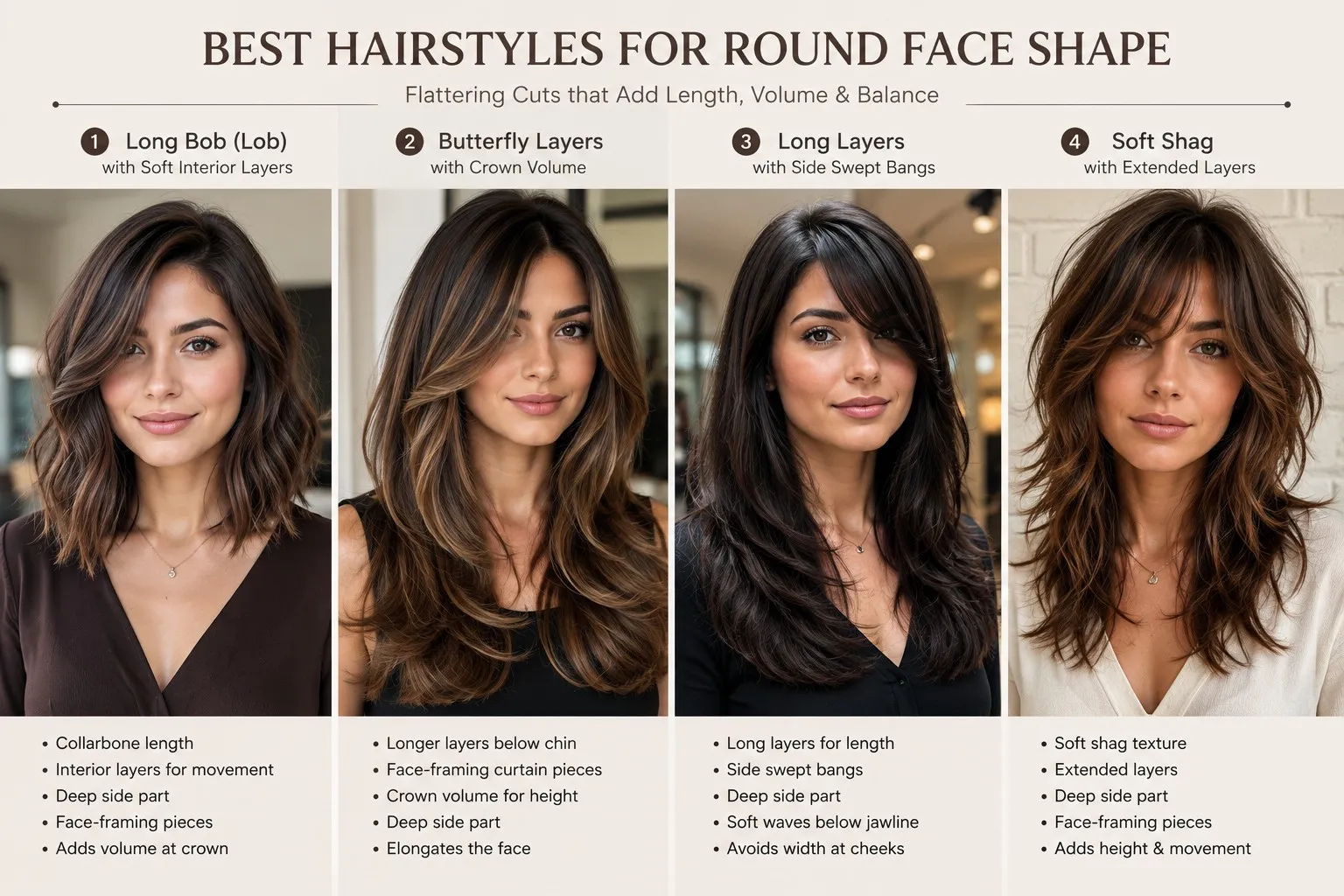
Long Bob (Lob) with Soft Interior Layers
The 2026 Long Bob sitting at collarbone length emphasizes interior layers rather than surface layers. Interior layering removes bulk from the middle of the hair without shortening the overall length, keeping the silhouette elongated. A deep side part breaks up symmetry by creating an asymmetrical line from the forehead downward, drawing the eye vertically rather than across the widest horizontal point. Avoid center parts - they can draw attention to the face's equal width-to-length ratio.
- •Collarbone-length or longer lob
- •Interior layers for movement
- •Deep side part (2 inches off center)
- •Face-framing pieces at the front
- •Slight wave or blow-dried volume at crown
- •Chin-length blunt bobs (adds width)
- •Center parts
- •Volume at cheek level
- •Tightly curled styles at jaw line
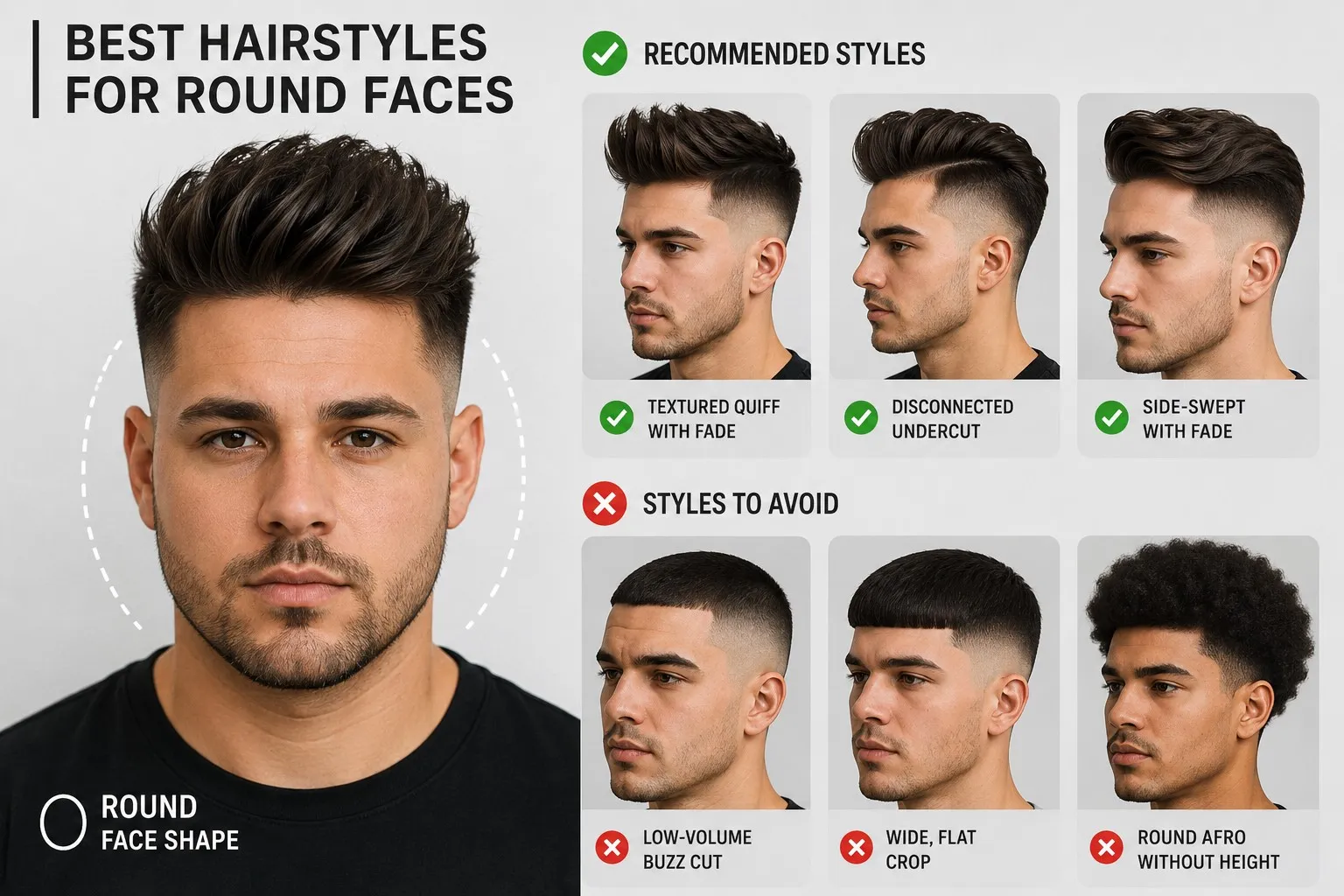
Modern Textured Quiff with High-Contrast Fade
The textured quiff is a strong 2026 choice for round-faced men. Tighter sides through a high-contrast fade combined with deliberate volume directed upward at the crown balances facial width by adding perceived height. The visual proportion shifts from circular to more elongated. The key word is textured - a flat, helmet-shaped quiff sits wide and low, producing the opposite effect. Ask your barber to disconnect the fade and leave enough length at the top to build vertical movement with a matte clay or paste.
- •Textured quiff with high-contrast fade
- •Disconnected undercut with crown volume
- •Side-swept styles with fade
- •Low-volume buzz cuts
- •Wide, flat crops
- •Round afro shapes without height
Introduce vertical visual interest - either through added height at the crown or through length that falls below the jaw.
Face length and width are nearly equal. Jaw is soft and curved. Cheeks are full with a wide, soft forehead and no sharp angles.
Recommended Artworks (Infographics)
Introduce vertical visual interest - either through added height at the crown or through length that falls below the jaw.
Face length and width are nearly equal. Jaw is soft and curved. Cheeks are full with a wide, soft forehead and no sharp angles.
Long Bob (Lob) with Soft Interior Layers
The 2026 Long Bob sitting at collarbone length emphasizes interior layers rather than surface layers. Interior layering removes bulk from the middle of the hair without shortening the overall length, keeping the silhouette elongated. A deep side part breaks up symmetry by creating an asymmetrical line from the forehead downward, drawing the eye vertically rather than across the widest horizontal point. Avoid center parts - they can draw attention to the face's equal width-to-length ratio.
- •Collarbone-length or longer lob
- •Interior layers for movement
- •Deep side part (2 inches off center)
- •Face-framing pieces at the front
- •Slight wave or blow-dried volume at crown
- •Chin-length blunt bobs (adds width)
- •Center parts
- •Volume at cheek level
- •Tightly curled styles at jaw line
Modern Textured Quiff with High-Contrast Fade
The textured quiff is a strong 2026 choice for round-faced men. Tighter sides through a high-contrast fade combined with deliberate volume directed upward at the crown balances facial width by adding perceived height. The visual proportion shifts from circular to more elongated. The key word is textured - a flat, helmet-shaped quiff sits wide and low, producing the opposite effect. Ask your barber to disconnect the fade and leave enough length at the top to build vertical movement with a matte clay or paste.
- •Textured quiff with high-contrast fade
- •Disconnected undercut with crown volume
- •Side-swept styles with fade
- •Low-volume buzz cuts
- •Wide, flat crops
- •Round afro shapes without height
Oval Face Formula
Recommended Artworks (Infographics)
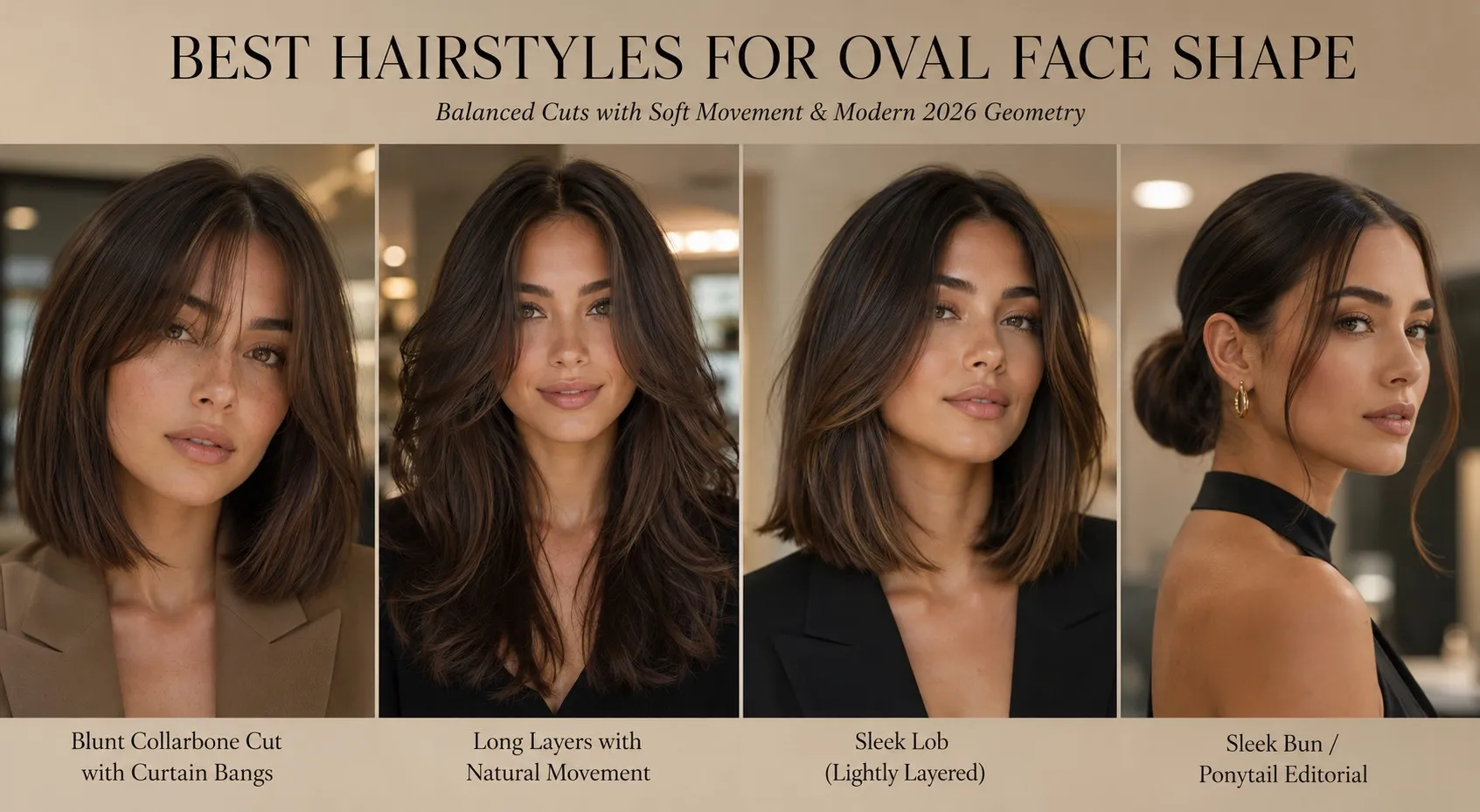
Blunt Collarbone Cut with Curtain Bangs
A blunt-edge cut at collarbone length with a clean, even line across the bottom creates a polished, modern look prominent in 2026 collections. Curtain bangs - soft, center-parted fringe that frames the face without covering the entire forehead - complement this cut well for oval faces because they add facial framing without disrupting the shape's natural balance. Very heavy layering or extreme volume at one area can throw off the natural equilibrium. The 2026 direction is clean lines with a hint of movement - not dramatic architectural haircuts.
- •Blunt collarbone-length cut
- •Curtain bangs with center part
- •Long layers with natural movement
- •Sleek buns or ponytails
- •Lobs - blunt or lightly layered
- •Oversized frames or shapes that hide balanced proportions
- •Very heavy top-of-head volume
- •Extreme architectural precision cuts
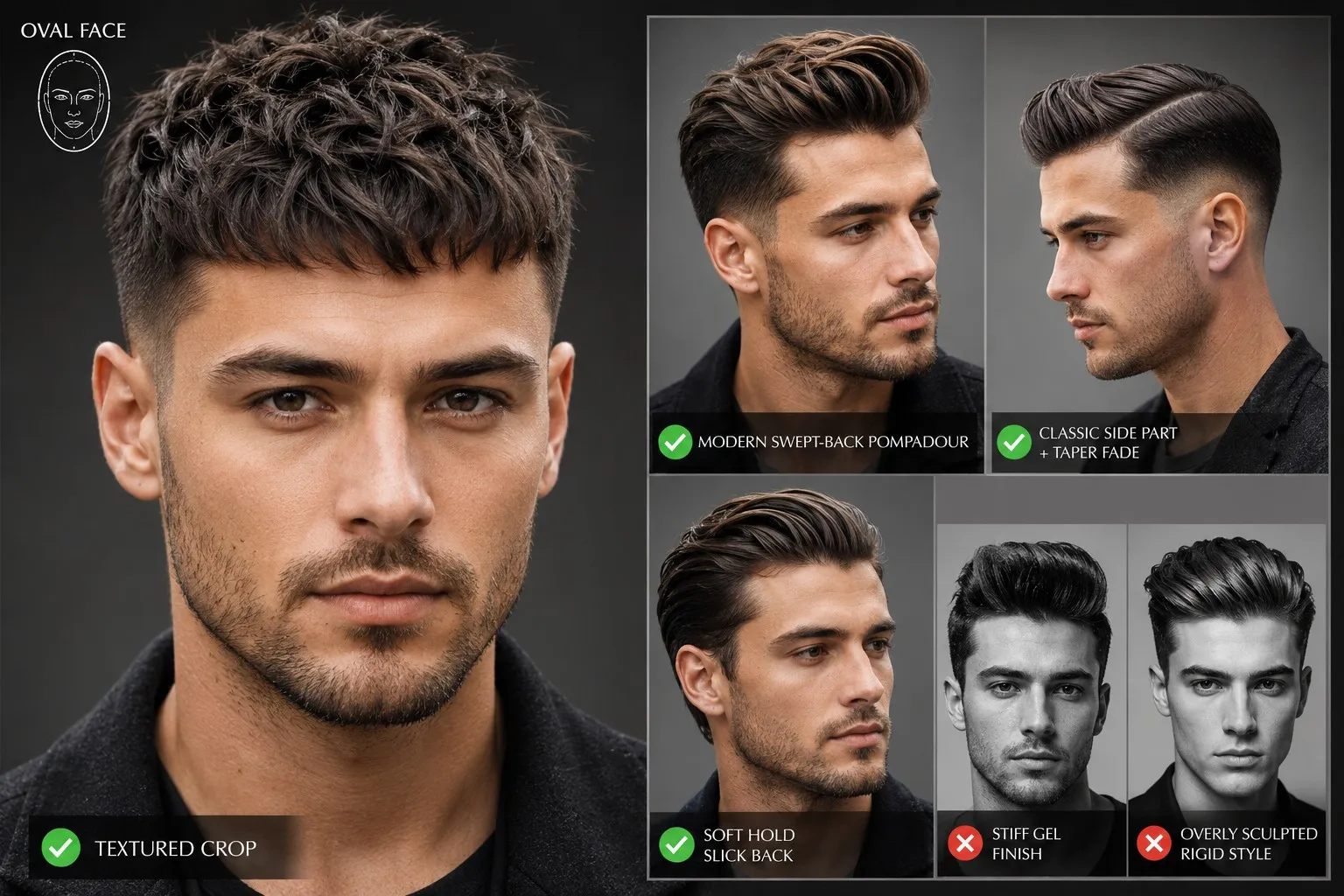
Textured Crop or Swept-Back Pompadour
The textured crop - a short cut with choppy, deliberately uneven ends on top - suits oval faces because it sits close to the head without needing to compensate for any imbalance. The swept-back pompadour (a modern, lower-profile version) adds a controlled degree of height while keeping the sides tight and clean. Avoid over-gelled or lacquered finishes. A light matte pomade or sea salt spray preserves the flexible, textured look that defines 2026 men's styling.
- •Textured crop with matte finish
- •Modern swept-back pompadour
- •Classic side part with taper fade
- •Slick back with soft hold product
- •Stiff gel or lacquered finishes
- •Overly sculpted, rigid styles
Maintain natural movement rather than forcing dramatic changes - oval faces respond well to a wide range of cuts.
Face length is about 1.5× the face width. Forehead is slightly wider than the jaw. Jawline is softly rounded, not sharp or pointed. Cheekbones are the widest point.
Recommended Artworks (Infographics)
Maintain natural movement rather than forcing dramatic changes - oval faces respond well to a wide range of cuts.
Face length is about 1.5× the face width. Forehead is slightly wider than the jaw. Jawline is softly rounded, not sharp or pointed. Cheekbones are the widest point.
Blunt Collarbone Cut with Curtain Bangs
A blunt-edge cut at collarbone length with a clean, even line across the bottom creates a polished, modern look prominent in 2026 collections. Curtain bangs - soft, center-parted fringe that frames the face without covering the entire forehead - complement this cut well for oval faces because they add facial framing without disrupting the shape's natural balance. Very heavy layering or extreme volume at one area can throw off the natural equilibrium. The 2026 direction is clean lines with a hint of movement - not dramatic architectural haircuts.
- •Blunt collarbone-length cut
- •Curtain bangs with center part
- •Long layers with natural movement
- •Sleek buns or ponytails
- •Lobs - blunt or lightly layered
- •Oversized frames or shapes that hide balanced proportions
- •Very heavy top-of-head volume
- •Extreme architectural precision cuts
Textured Crop or Swept-Back Pompadour
The textured crop - a short cut with choppy, deliberately uneven ends on top - suits oval faces because it sits close to the head without needing to compensate for any imbalance. The swept-back pompadour (a modern, lower-profile version) adds a controlled degree of height while keeping the sides tight and clean. Avoid over-gelled or lacquered finishes. A light matte pomade or sea salt spray preserves the flexible, textured look that defines 2026 men's styling.
- •Textured crop with matte finish
- •Modern swept-back pompadour
- •Classic side part with taper fade
- •Slick back with soft hold product
- •Stiff gel or lacquered finishes
- •Overly sculpted, rigid styles
Square Face Formula
Recommended Artworks (Infographics)
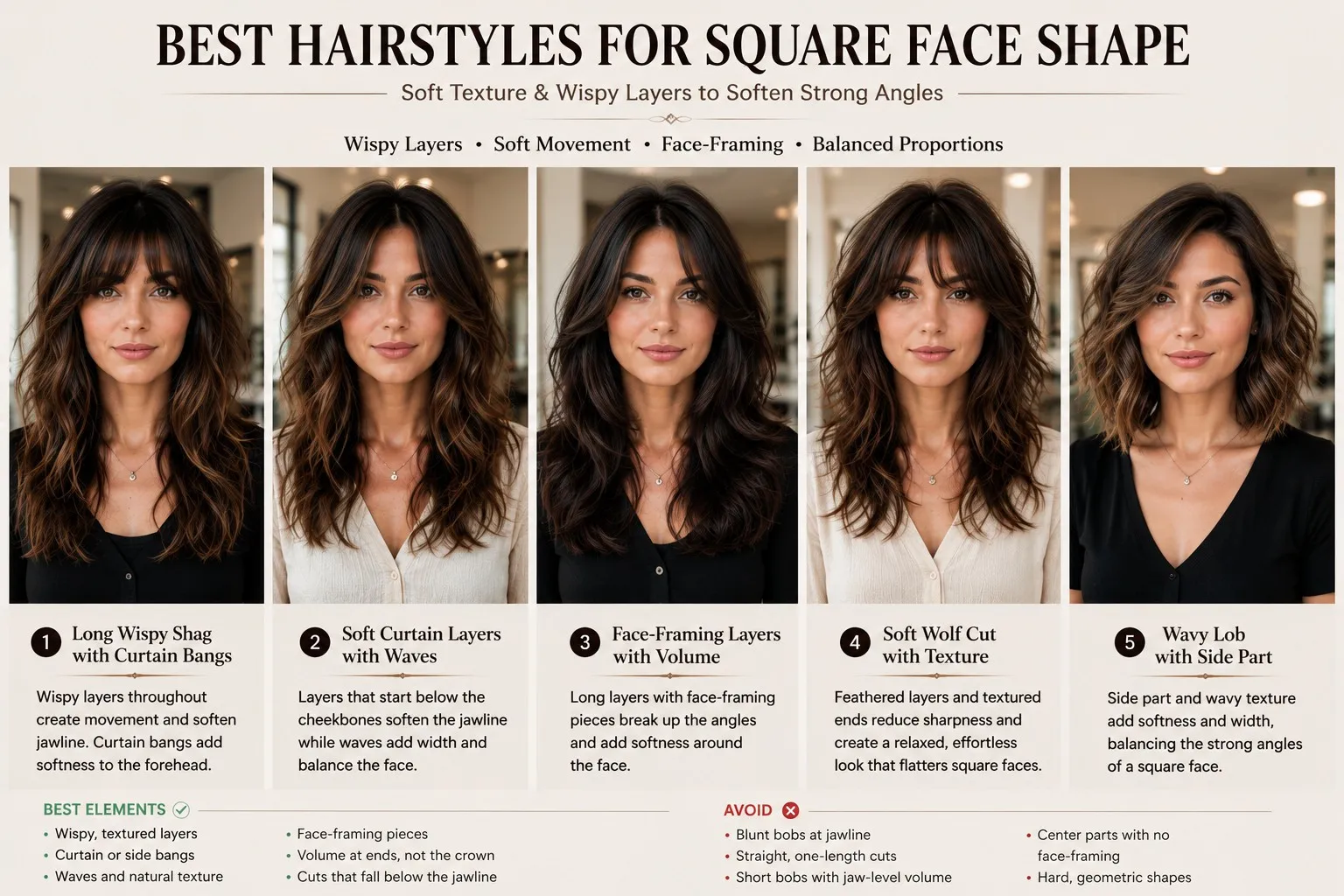
Long Wispy Shag with Soft Textured Layers
The 2026 shag - a layered cut with wispy, feathered ends - is among the best options for square face shapes. Its irregular, organic texture reduces the visual rigidity of a strong jaw by surrounding the face with movement and softness. Unlike a blunt bob that ends exactly at the jaw (framing the jaw's width), a shag that falls below the jaw draws the eye downward. Layers should be cut with a point-cutting or razored technique rather than blunt scissors to ensure the ends remain airy rather than solid.
- •Long wispy shag below the jaw
- •Soft, point-cut layers throughout
- •Curtain bangs or wispy fringe
- •Long waves and loose texture
- •Face-framing pieces at front
- •Blunt-cut bobs ending exactly at the jaw
- •Cuts with a straight, hard perimeter
- •Short bobs with extra jaw-level volume
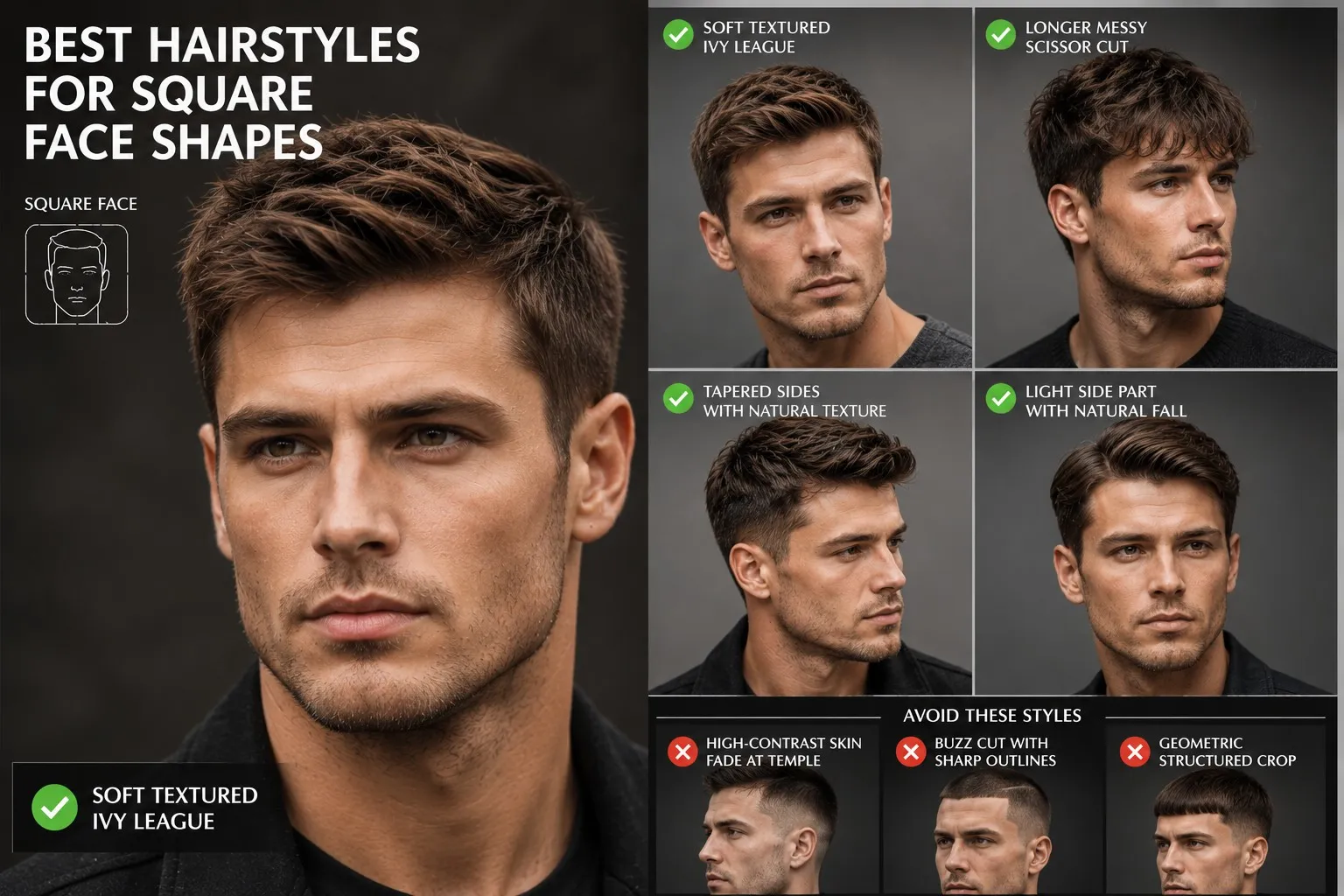
Soft Textured Ivy League or Classic Scissor Cut
The 2026 direction for square-faced men is away from sharp, rigid fades and toward softer, scissor-cut styles. A textured ivy league - a slightly longer version of the crew cut with a gentle side part and enough length to show texture - reduces the visual contrast that a skin fade creates against a strong jaw. A longer, messier classic scissor cut that reaches the temples without being overly styled is the alternative. Avoid high-contrast skin fades that go up to the temples - the abrupt transition from bare skin to hair can sharpen the impression of an already angular jaw.
- •Soft textured ivy league
- •Longer messy scissor cut
- •Tapered (not faded) sides
- •Light side part with natural fall
- •High-contrast skin fades at temple
- •Buzz cuts with sharp outlines
- •Very structured, geometric crops
Soften the visual sharpness of angular jaw lines through wispy, organic texture rather than blunt geometric cuts.
Forehead, cheekbones, and jawline are all roughly similar in width. Jaw is strong, angular, and well-defined. Face length and width are similar.
Recommended Artworks (Infographics)
Soften the visual sharpness of angular jaw lines through wispy, organic texture rather than blunt geometric cuts.
Forehead, cheekbones, and jawline are all roughly similar in width. Jaw is strong, angular, and well-defined. Face length and width are similar.
Long Wispy Shag with Soft Textured Layers
The 2026 shag - a layered cut with wispy, feathered ends - is among the best options for square face shapes. Its irregular, organic texture reduces the visual rigidity of a strong jaw by surrounding the face with movement and softness. Unlike a blunt bob that ends exactly at the jaw (framing the jaw's width), a shag that falls below the jaw draws the eye downward. Layers should be cut with a point-cutting or razored technique rather than blunt scissors to ensure the ends remain airy rather than solid.
- •Long wispy shag below the jaw
- •Soft, point-cut layers throughout
- •Curtain bangs or wispy fringe
- •Long waves and loose texture
- •Face-framing pieces at front
- •Blunt-cut bobs ending exactly at the jaw
- •Cuts with a straight, hard perimeter
- •Short bobs with extra jaw-level volume
Soft Textured Ivy League or Classic Scissor Cut
The 2026 direction for square-faced men is away from sharp, rigid fades and toward softer, scissor-cut styles. A textured ivy league - a slightly longer version of the crew cut with a gentle side part and enough length to show texture - reduces the visual contrast that a skin fade creates against a strong jaw. A longer, messier classic scissor cut that reaches the temples without being overly styled is the alternative. Avoid high-contrast skin fades that go up to the temples - the abrupt transition from bare skin to hair can sharpen the impression of an already angular jaw.
- •Soft textured ivy league
- •Longer messy scissor cut
- •Tapered (not faded) sides
- •Light side part with natural fall
- •High-contrast skin fades at temple
- •Buzz cuts with sharp outlines
- •Very structured, geometric crops
Heart Face Formula
Recommended Artworks (Infographics)
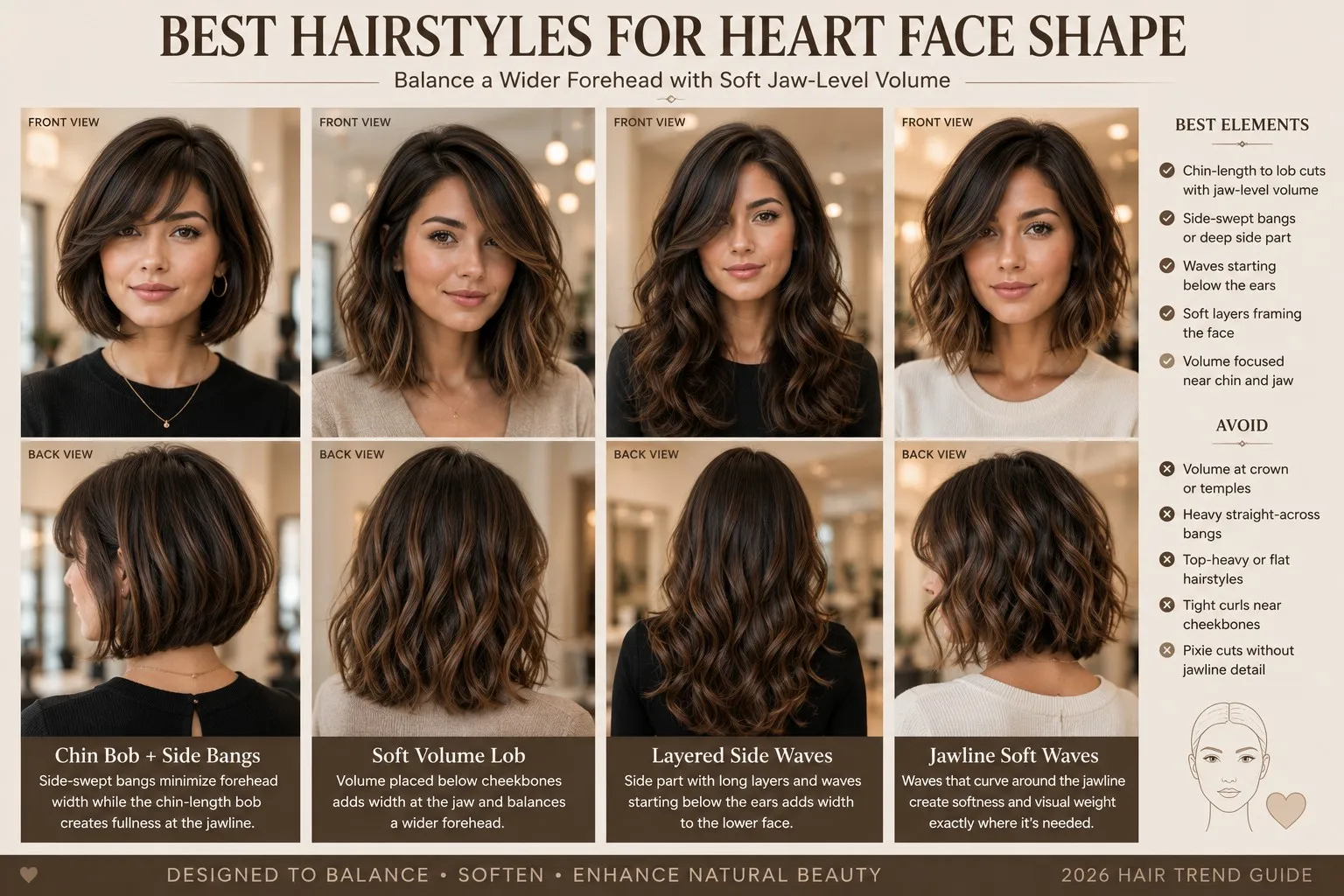
Chin-Length Bob with Side-Swept Bangs
A chin-length bob adds width and volume exactly where a heart face needs it - at the jaw. When the ends of the bob sit at or just below chin level, they create a visual bracket around the lower third of the face, drawing attention downward from a wider forehead. Side-swept bangs complement this cut by breaking up the forehead's width on one side rather than covering it entirely. A full, heavy fringe sitting across a wide forehead can emphasize its proportions - side-swept bangs redirect the eye instead.
- •Chin-length bob with volume at ends
- •Side-swept bangs
- •Lob with soft volume below cheekbone
- •Side-parted long hair with mid-length layers
- •Waves starting below the ear
- •Volume at the crown and temples
- •Heavy straight-across fringe
- •Pixie cuts without jaw-level detail
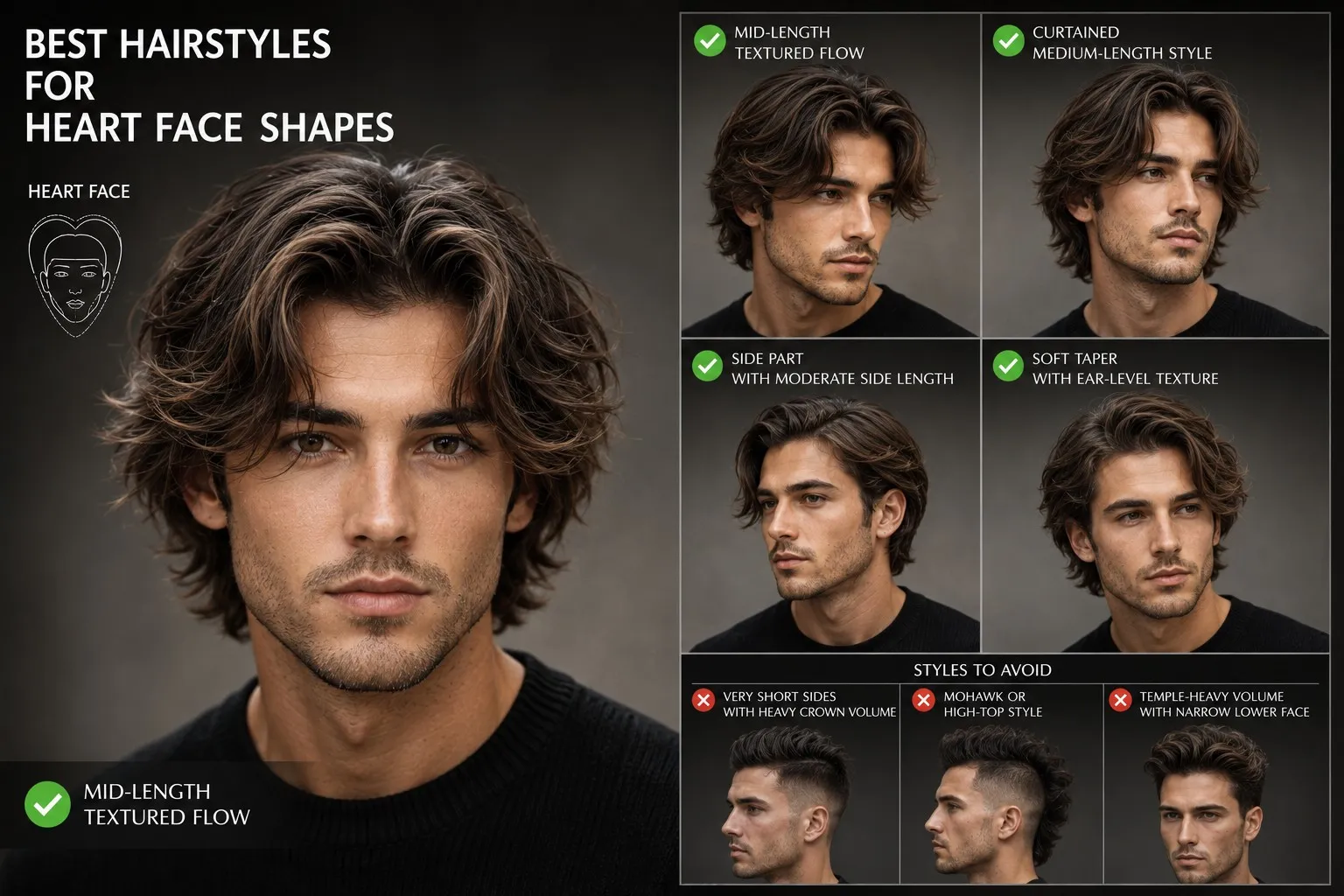
Mid-Length Textured Flow or Side Part with Moderate Length
Mid-length textured cuts that reach the jaw area - sometimes referred to as a flow style - work well for heart-faced men because they add softness and coverage around the narrower lower face. The extra length at the sides and bottom adds the visual width the lower face lacks, creating a more balanced overall silhouette. A classic side part with moderate length on the sides (avoiding a tight skin fade) is a more structured alternative. The key is keeping enough length through the mid-section to prevent the lower face from looking bare or narrow against a fuller upper face.
- •Mid-length flow / curtained style
- •Side part with moderate side length
- •Soft taper (not aggressive fade)
- •Textured medium cut at ear level
- •Very short sides with heavy crown
- •Mohawk or high-top styles
- •Styles that add volume at the temples only
Add visual weight near the jaw to create a more proportional balance between the upper and lower face.
Forehead is the widest part. Chin is noticeably narrower than forehead. Jaw tapers to a soft or pointed chin. Cheekbones are high and prominent.
Recommended Artworks (Infographics)
Add visual weight near the jaw to create a more proportional balance between the upper and lower face.
Forehead is the widest part. Chin is noticeably narrower than forehead. Jaw tapers to a soft or pointed chin. Cheekbones are high and prominent.
Chin-Length Bob with Side-Swept Bangs
A chin-length bob adds width and volume exactly where a heart face needs it - at the jaw. When the ends of the bob sit at or just below chin level, they create a visual bracket around the lower third of the face, drawing attention downward from a wider forehead. Side-swept bangs complement this cut by breaking up the forehead's width on one side rather than covering it entirely. A full, heavy fringe sitting across a wide forehead can emphasize its proportions - side-swept bangs redirect the eye instead.
- •Chin-length bob with volume at ends
- •Side-swept bangs
- •Lob with soft volume below cheekbone
- •Side-parted long hair with mid-length layers
- •Waves starting below the ear
- •Volume at the crown and temples
- •Heavy straight-across fringe
- •Pixie cuts without jaw-level detail
Mid-Length Textured Flow or Side Part with Moderate Length
Mid-length textured cuts that reach the jaw area - sometimes referred to as a flow style - work well for heart-faced men because they add softness and coverage around the narrower lower face. The extra length at the sides and bottom adds the visual width the lower face lacks, creating a more balanced overall silhouette. A classic side part with moderate length on the sides (avoiding a tight skin fade) is a more structured alternative. The key is keeping enough length through the mid-section to prevent the lower face from looking bare or narrow against a fuller upper face.
- •Mid-length flow / curtained style
- •Side part with moderate side length
- •Soft taper (not aggressive fade)
- •Textured medium cut at ear level
- •Very short sides with heavy crown
- •Mohawk or high-top styles
- •Styles that add volume at the temples only
Diamond Face Formula
Recommended Artworks (Infographics)
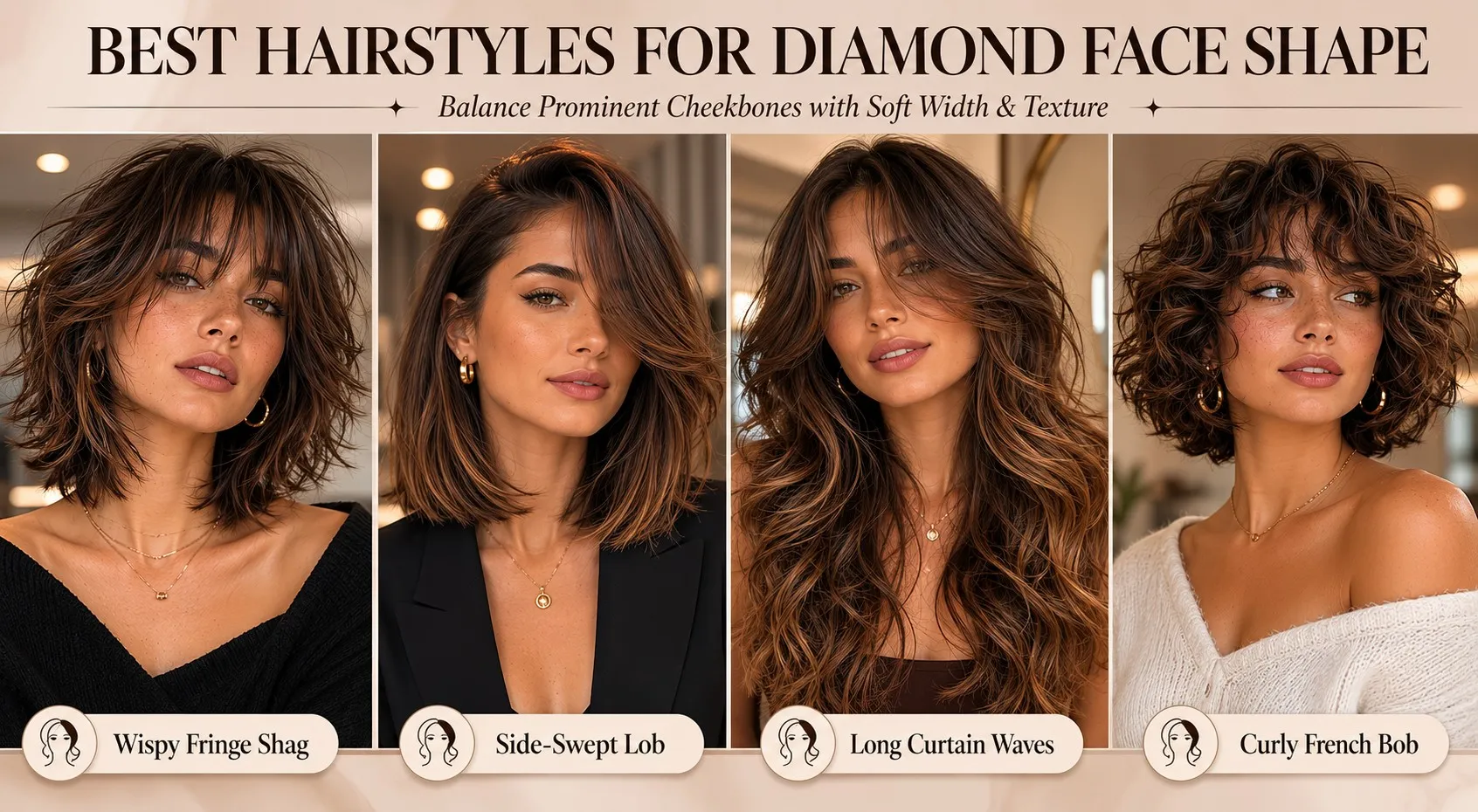
Textured Fringe or Chin-Length Shag
Textured fringe - wispy rather than blunt - adds width at the forehead, which balances the prominent cheekbone width of a diamond face. A chin-length shag or lob with layers that fan outward at cheekbone level draws attention to the broadest part of the face in a flattering way. Avoid very sleek, center-parted styles that emphasize the narrowness of the forehead and chin.
- •Textured fringe (wispy, not blunt)
- •Chin-length shag or lob
- •Side-swept bangs over narrow forehead
- •Layers that widen at cheekbone level
- •Sleek center parts with no fringe
- •Volume only at cheekbones
- •Very narrow, column-like styles
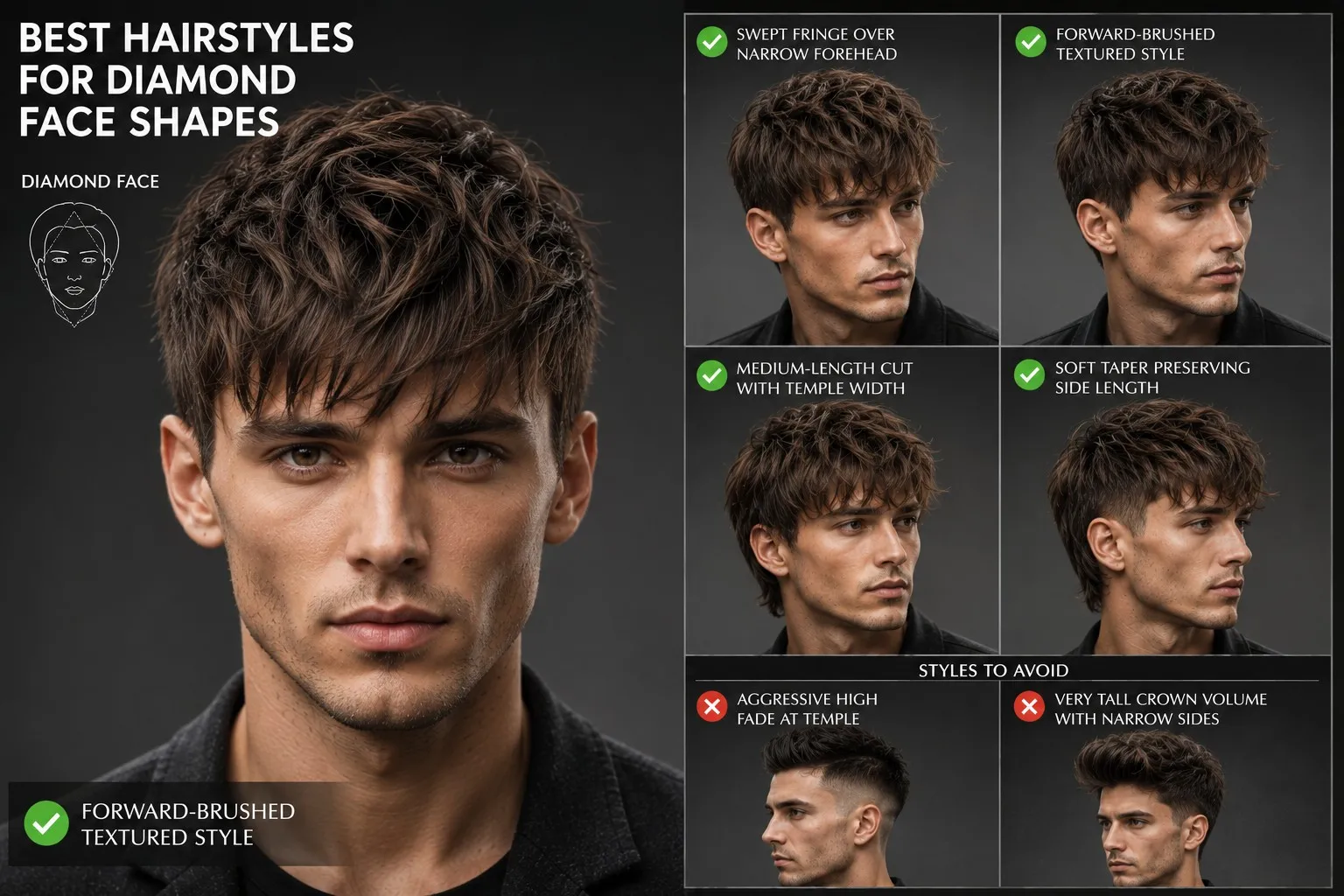
Forward-Brushed Textured Style with Temple Width
Men with diamond faces benefit from medium-length cuts that maintain width at the temples and sides rather than tapering aggressively. A swept fringe or forward-brushed style that reaches the forehead adds horizontal weight at the top of the face. Keeping the sides longer with a soft taper prevents additional length from being added through a very high or voluminous crown style.
- •Swept fringe over narrow forehead
- •Forward-brushed textured style
- •Medium length with temple width
- •Soft taper preserving side length
- •Aggressive high fades at temple
- •Very tall crown volume with narrow sides
Create width at the forehead and jaw to balance prominent, wide cheekbones.
Cheekbones are the widest point. Forehead and jaw are both narrower than cheekbones. Chin is often pointed or sharp. Face is longer than wide.
Recommended Artworks (Infographics)
Create width at the forehead and jaw to balance prominent, wide cheekbones.
Cheekbones are the widest point. Forehead and jaw are both narrower than cheekbones. Chin is often pointed or sharp. Face is longer than wide.
Textured Fringe or Chin-Length Shag
Textured fringe - wispy rather than blunt - adds width at the forehead, which balances the prominent cheekbone width of a diamond face. A chin-length shag or lob with layers that fan outward at cheekbone level draws attention to the broadest part of the face in a flattering way. Avoid very sleek, center-parted styles that emphasize the narrowness of the forehead and chin.
- •Textured fringe (wispy, not blunt)
- •Chin-length shag or lob
- •Side-swept bangs over narrow forehead
- •Layers that widen at cheekbone level
- •Sleek center parts with no fringe
- •Volume only at cheekbones
- •Very narrow, column-like styles
Forward-Brushed Textured Style with Temple Width
Men with diamond faces benefit from medium-length cuts that maintain width at the temples and sides rather than tapering aggressively. A swept fringe or forward-brushed style that reaches the forehead adds horizontal weight at the top of the face. Keeping the sides longer with a soft taper prevents additional length from being added through a very high or voluminous crown style.
- •Swept fringe over narrow forehead
- •Forward-brushed textured style
- •Medium length with temple width
- •Soft taper preserving side length
- •Aggressive high fades at temple
- •Very tall crown volume with narrow sides
Oblong / Rectangle Face Formula
Recommended Artworks (Infographics)
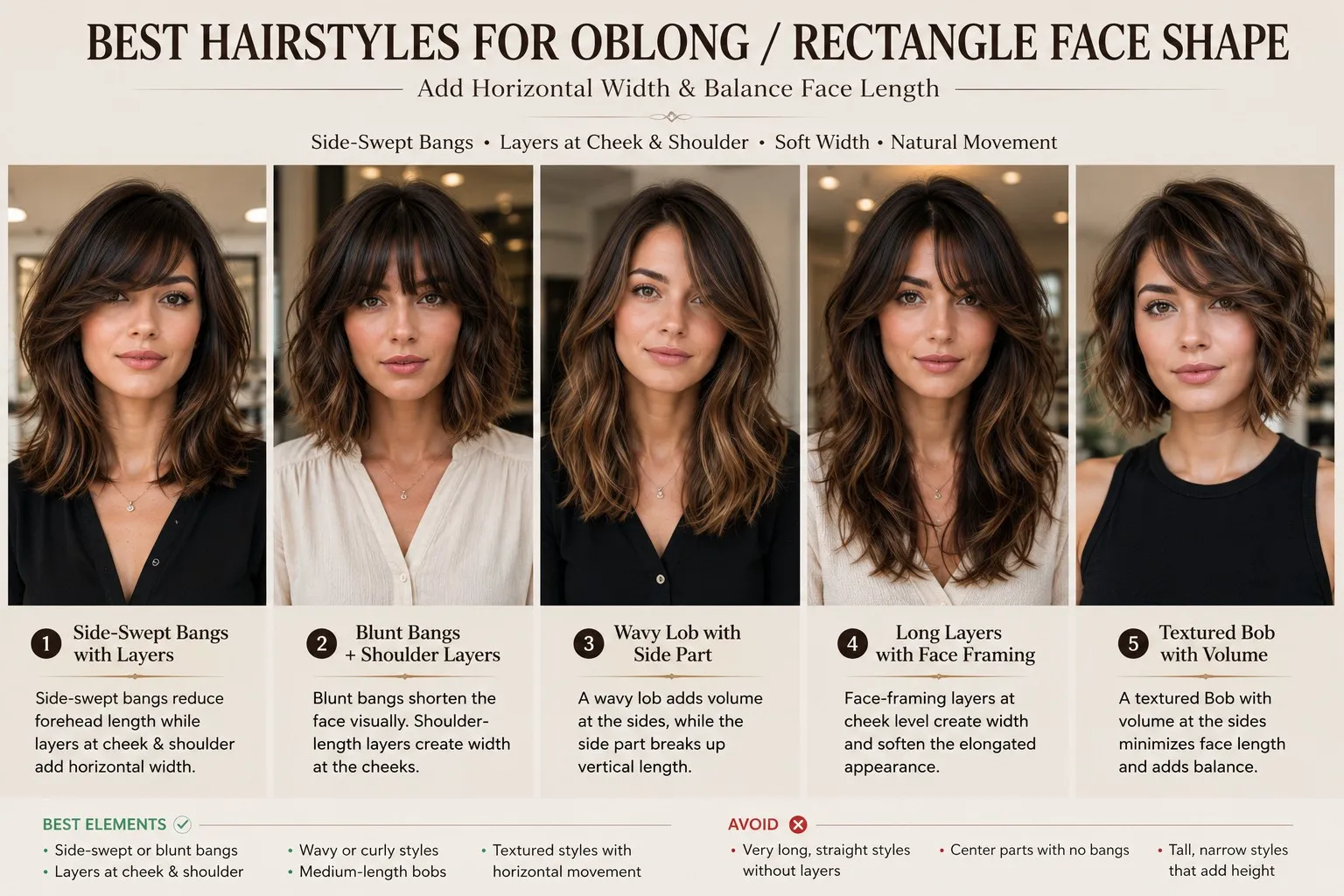
Side-Swept Bangs with Layers at Cheek and Shoulder
Oblong faces benefit from cuts with horizontal emphasis. Side-swept or blunt-cut bangs reduce the visible forehead length - which is the primary driver of face elongation. Layers that add width at the cheeks and temples and styles that do not add excessive length at the top of the head all help. Avoid very long, straight styles without layers, as they can further elongate an already long face.
- •Side-swept or blunt bangs
- •Layers at cheek and shoulder level
- •Wavy or curly styles with width
- •Medium-length bobs with volume at sides
- •Textured styles with horizontal movement
- •Very long, straight styles without layers
- •Center parts with no bangs
- •Tall, narrow styles that add vertical height
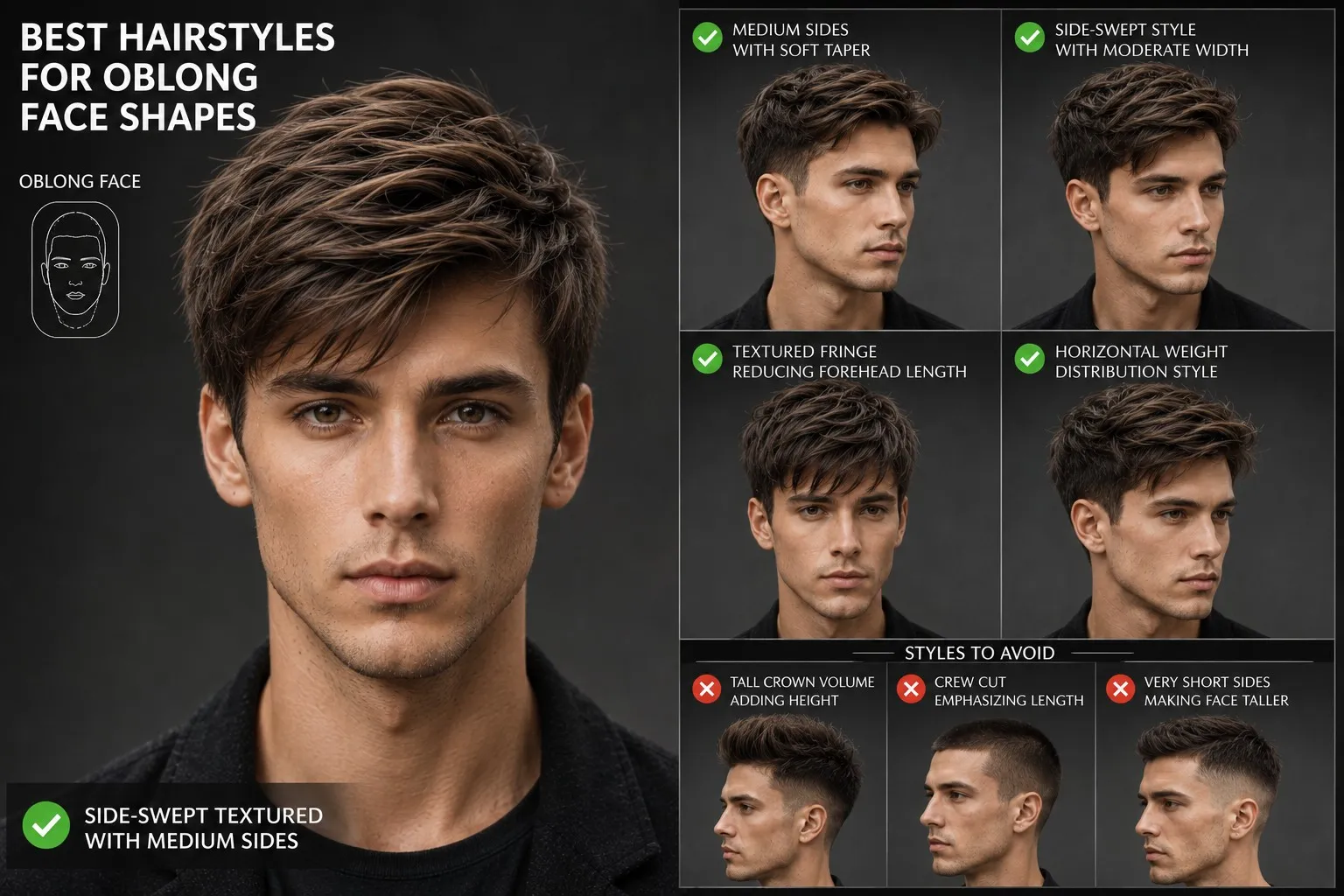
Medium Sides with Soft Taper
For oblong-faced men, keeping the sides longer with a soft taper prevents additional length from being added through a very high or voluminous crown style. A side-swept style with moderate volume distributed across the width of the top - rather than concentrated at the very crown - helps reduce the apparent face length. Avoid crew cuts or flat tops that add visible height.
- •Medium sides with soft taper
- •Side-swept with moderate width
- •Textured fringe to reduce forehead length
- •Styles with horizontal weight distribution
- •Tall styles at crown adding height
- •Crew cuts emphasizing length
- •Very short sides making face look taller
Introduce horizontal width through layering, bangs, and styles that reduce the apparent length of the face.
Face length is significantly greater than width. Forehead, cheekbones, and jaw are all roughly similar in width. Jawline may be slightly angular (rectangle) or soft (oblong).
Recommended Artworks (Infographics)
Introduce horizontal width through layering, bangs, and styles that reduce the apparent length of the face.
Face length is significantly greater than width. Forehead, cheekbones, and jaw are all roughly similar in width. Jawline may be slightly angular (rectangle) or soft (oblong).
Side-Swept Bangs with Layers at Cheek and Shoulder
Oblong faces benefit from cuts with horizontal emphasis. Side-swept or blunt-cut bangs reduce the visible forehead length - which is the primary driver of face elongation. Layers that add width at the cheeks and temples and styles that do not add excessive length at the top of the head all help. Avoid very long, straight styles without layers, as they can further elongate an already long face.
- •Side-swept or blunt bangs
- •Layers at cheek and shoulder level
- •Wavy or curly styles with width
- •Medium-length bobs with volume at sides
- •Textured styles with horizontal movement
- •Very long, straight styles without layers
- •Center parts with no bangs
- •Tall, narrow styles that add vertical height
Medium Sides with Soft Taper
For oblong-faced men, keeping the sides longer with a soft taper prevents additional length from being added through a very high or voluminous crown style. A side-swept style with moderate volume distributed across the width of the top - rather than concentrated at the very crown - helps reduce the apparent face length. Avoid crew cuts or flat tops that add visible height.
- •Medium sides with soft taper
- •Side-swept with moderate width
- •Textured fringe to reduce forehead length
- •Styles with horizontal weight distribution
- •Tall styles at crown adding height
- •Crew cuts emphasizing length
- •Very short sides making face look taller
Not certain about your shape profile yet?
Our fully automated face geometry analysis calculator measures proportions of your facial markers via simple sliders to map you into the corresponding lookbook shape category.
Quick Reference: 2026 Haircuts Index
A simple proportional grid comparing main styles. Perfect for showing reference to your stylist at your next appointment.
| Face Shape Outline | Women's Pick | Men's Pick | Stylist's Key Rule |
|---|---|---|---|
| Round Face | Soft lob · Interior layers · Side part | Textured quiff · High-contrast fade | Add vertical height |
| Oval Face | Blunt collarbone cut · Curtain bangs | Textured crop · Swept pompadour | Maintain natural movement |
| Square Face | Wispy shag · Point-cut layers | Soft ivy league · Scissor cut | Soften angles with texture |
| Heart Face | Chin bob · Side-swept bangs | Mid-length flow · Moderate side length | Add width near the jaw |
| Diamond Face | Textured fringe · Chin shag | Forward-brushed fringe · Medium sides | Widen forehead and jaw |
| Oblong / Rectangle Face | Side-swept bangs · Wavy layers | Medium sides · Soft taper | Add horizontal width |
Personal Haircut Lookbook Generator
Need a printout for the barbershop or salon appointment?
Our Lookbook generator constructs an A4-formatted, print-ready document containing the styled schematic guides, dos and don'ts list, and personalized instructions based on the six primary face shapes.
References & Styling Resources
Original Haircut Context Suite
Where the full context of these structural geometry rules, trends reports, and hair calculation metrics are maintained.
Find original context on Calqulate.net →Interactive Face Shape Calculator
Measure your relative horizontal proportions to map your head structure objectively.
Open Precision Calculator →Illustrated Measurement Guide
Step-by-step math rules to discover and map facial geometry proportions like an expert.
Read step-by-step guide →Salon Lookbook PDF
Generate and download a high-contrast binary lookbook document to carry to your stylist.
Jump to Lookbook Generator →Advertisement