
Ovulation Calculator
Knowing when you ovulate is one of the most powerful things you can do when trying to conceive. Enter your last period date and average cycle length below to estimate your ovulation date, fertile window, and the best days to try.
Calqulate.net predicts your fertile window and ovulation day from your cycle, accurate for regular and irregular/PCOS cycles. You get your peak conception days on a clear calendar.
Fertile
Window
Free
Price
No
Sign-up
Instant
Results
Private
In-browser
Why ask for Luteal Phase? Standard calculators assume a generic 14-day luteal phase. If yours is 12 days, standard apps will miscalculate ovulation by 2 whole days! Adjusting this ensures exact cycle personalization.
Ready to Calculate
Enter your last cycle details on the left to generate your personalized cycle dashboard and exact fertile window [3].
How Does This Ovulation Calculator Work?
This fertility calculator uses the standard fertility awareness method. It treats the first day of your last menstrual period (LMP) as Cycle Day 1, then uses your average cycle length to estimate key dates.
The math behind it is simple but reliable for regular cycles. Ovulation typically happens about 14 days before your next period — not 14 days after your last one. That distinction matters, especially if your cycle is shorter or longer than 28 days.
Next Period Date:
LMP + Average Cycle Length
Estimated Ovulation:
Next Period Date − 14 Days
Fertile Window:
5 Days Before Ovulation + Ovulation Day
Cycle Length Examples:
What Is the Fertile Window?
Your fertile window is the stretch of days in each cycle when pregnancy is biologically possible. It usually covers 6 days total — the 5 days leading up to ovulation and ovulation day itself.
Here is why those days before ovulation matter so much: sperm can survive inside the reproductive tract for up to 5 days. The egg, however, only stays viable for around 12 to 24 hours after it is released. So having sperm already present when ovulation occurs dramatically increases your chances of fertilization.
Most fertility experts recommend having intercourse every day or every other day during this window. Many couples focus specifically on the 2 to 3 days just before ovulation as the peak opportunity period.
Days Before Ovulation
5 Days
Sperm waits for the egg
Ovulation Day
Day 0
Egg is released — peak fertility
After Ovulation
12–24 hrs
Egg viability window closes
How the Menstrual Cycle Works
Your menstrual cycle starts on the first day of your period and ends the day before your next period begins. Most cycles fall between 21 and 35 days. Understanding the four phases helps you see where ovulation fits in — and why it does not always happen exactly at the midpoint.
| Phase | Timing | What Is Happening |
|---|---|---|
| Menstrual Phase | Days 1–5 | Uterine lining sheds — this is your period |
| Follicular Phase | Days 1–13 | Follicles develop in the ovary; estrogen rises |
| Ovulation | ~Day 14 (28-day cycle) | LH surge triggers egg release — peak fertility |
| Luteal Phase | Days 15–28 | Progesterone rises; uterus prepares for implantation |
The luteal phase is relatively fixed at around 14 days. It is the follicular phase that varies most between women.
Signs and Symptoms of Ovulation
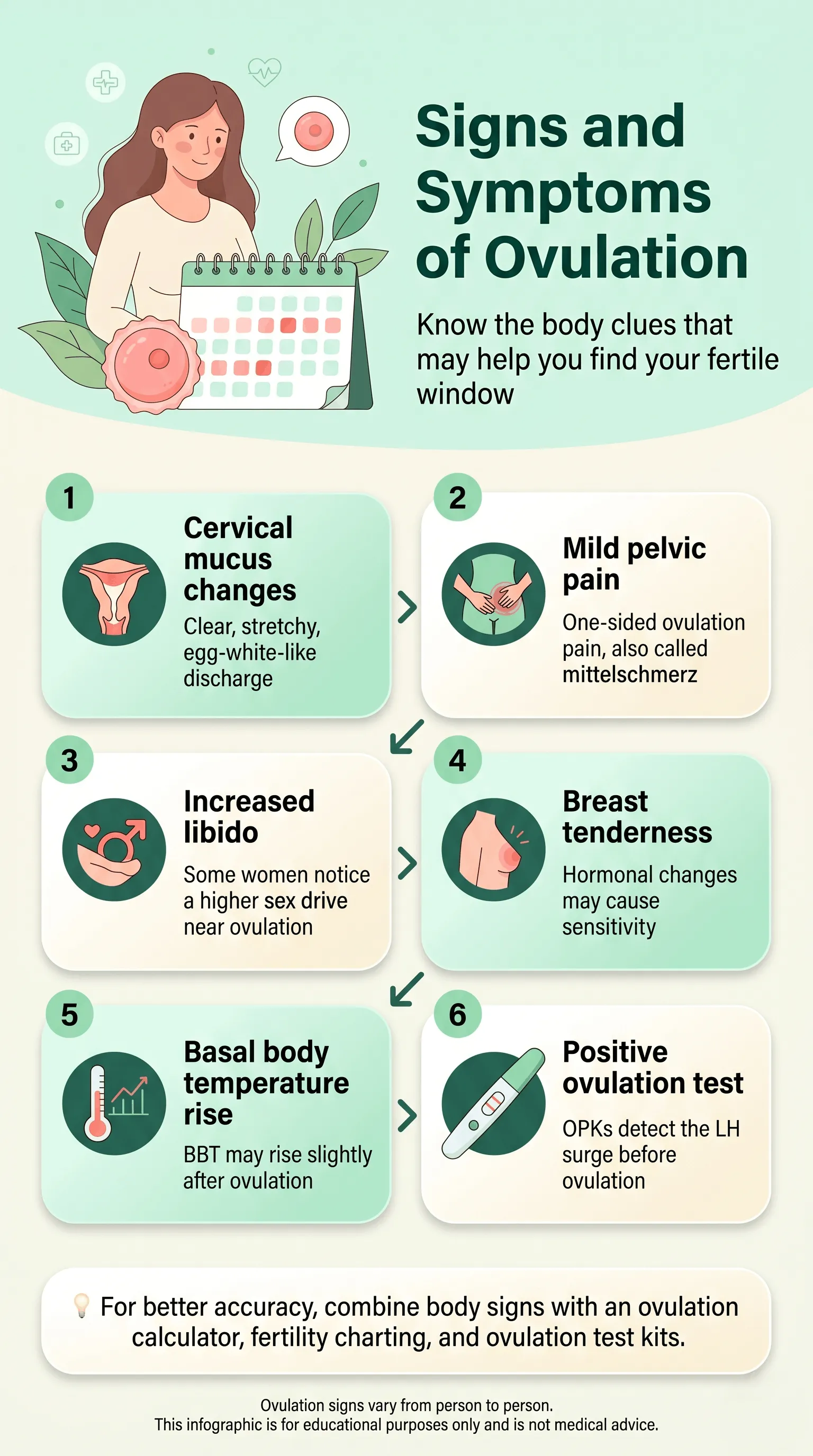
Many women notice physical changes around ovulation. Learning to recognize these signals helps you confirm what the ovulation calculator predicts and gives you even more confidence about your timing.
💧 Cervical Mucus Changes
Discharge becomes clear, slippery, and stretchy — similar to raw egg whites. This is one of the most reliable signs of approaching ovulation.
🌡️ Basal Body Temperature Rise
BBT rises slightly (0.2–0.5°C) after ovulation due to progesterone. Tracking BBT daily confirms ovulation has occurred but not before it happens.
⚡ Ovulation Pain (Mittelschmerz)
Some women feel a mild, one-sided pelvic ache or twinge during ovulation. It typically lasts from a few minutes to a couple of hours.
✅ Positive OPK Result
Ovulation predictor kits detect the LH surge that happens 24–36 hours before ovulation. A positive OPK is a strong signal that ovulation is imminent.
❤️ Increased Libido
Many women notice a natural increase in sex drive around ovulation — this is a biological signal that your body is at peak fertility.
🎯 Breast Tenderness
Mild breast sensitivity can appear around ovulation due to hormone fluctuations, particularly rising estrogen and progesterone levels.
Pro tip: Combining an ovulation calculator with OPK testing and BBT charting gives you the most complete fertility picture. No single method is perfect on its own — but together they significantly improve accuracy.
Using This Calculator for Irregular Periods and PCOS
This ovulation calculator works best when your cycles are consistent. If you have irregular periods, PCOS, a thyroid condition, or if you are breastfeeding or recently came off hormonal birth control, your ovulation timing may not follow a predictable pattern.
For longer or unpredictable cycles — common with PCOS — ovulation may happen much later in the cycle or not at all in some months. An ovulation calculator can still give you a rough estimate, but it should be treated as a starting point rather than a definitive answer.
If your cycles are irregular, try these alongside the calculator:
- Use ovulation predictor kits (OPKs) from Day 10 onward to catch the LH surge when it comes
- Track basal body temperature (BBT) daily to confirm ovulation after it happens
- Observe cervical mucus changes throughout your cycle
- Use a fertility charting app to log signs over several months and spot patterns
- Speak with a healthcare provider if cycles are very irregular, absent, or unpredictable
When Is the Best Time to Conceive?
The highest probability of conception comes from timing intercourse well within your fertile window. Research consistently shows that the two days before ovulation and ovulation day itself offer the best odds. Here is a practical breakdown:
Highest Probability Days
- 2 days before ovulation (peak sperm meets egg timing)
- 1 day before ovulation
- Ovulation day itself
Good Supporting Days
- 3–5 days before ovulation (sperm will survive to wait)
- 1 day after ovulation (lower chance, egg still briefly viable)
Recommended Frequency
- Every day or every other day during the fertile window
- Daily intercourse is fine and does not reduce sperm quality in healthy men
Track Multiple Signs
- Use OPK tests alongside this fertility date calculator
- Watch for egg-white cervical mucus as a natural signal
When to Speak with a Healthcare Provider
A fertility calculator is a useful starting point — but it is not a substitute for professional guidance. Reach out to a doctor or reproductive specialist if:
How Many Cycles Does It Typically Take to Conceive?
Conception does not always happen immediately, even with perfect timing. Here is a realistic picture of what research shows for couples actively trying:
~30%
Conceive in the first cycle
~75%
Conceive within 6 months
~90%
Conceive within 12 months
These figures apply to couples under 35 with no fertility issues. Age, health, and timing all play a role.
Limitations of This Ovulation Calculator
This fertility calculator provides helpful estimates — but it cannot confirm whether ovulation has actually occurred, or guarantee pregnancy. Actual ovulation can shift from cycle to cycle even in women with generally regular periods. Stress, illness, travel, or sudden changes in weight or exercise can all delay or advance ovulation.
This tool is not appropriate as a birth control method. If you are trying to avoid pregnancy, please use a proven contraceptive and speak with a healthcare provider about your options.
For any of the situations above, estimates from this ovulation date calculator may be less accurate. Combine with physical tracking and professional guidance when needed.
Use this calculator as a guide — not a guarantee.
This ovulation calculator is for educational and informational purposes only. It is not a substitute for professional medical advice, diagnosis, or treatment. Ovulation dates and fertile windows are estimates that can vary from cycle to cycle. Always consult a qualified healthcare provider for personalized fertility guidance.
Related Women's Health Calculators
Explore the rest of our women's health tools — each one adds a different piece of the picture.
Frequently Asked Questions
Common questions and answers about this calculator.
How accurate is an ovulation calculator?
Ovulation calculators are a helpful starting point but not 100% accurate. They estimate your fertile window based on average cycle patterns. For the most reliable results, combine the calculator with ovulation predictor kits (OPKs), basal body temperature (BBT) tracking, and cervical mucus observation.
Can I use an ovulation calculator for irregular periods?
Ovulation calculators work best with regular cycles. If your periods are irregular — due to PCOS, thyroid conditions, stress, or recent hormonal changes — the estimates will be less reliable. Ovulation predictor kits and tracking physical signs are better tools for irregular cycles.
What is the fertile window and how many days does it last?
The fertile window typically spans 6 days: the 5 days before ovulation plus the day of ovulation itself. Sperm can survive in the reproductive tract for up to 5 days, while the egg remains viable for less than 24 hours after ovulation. This is why the days leading up to ovulation are just as important as ovulation day itself.
Can I use this ovulation calculator to avoid pregnancy?
No. This calculator is designed to help people trying to conceive — not to prevent pregnancy. Ovulation timing can vary even in regular cycles, making this tool unreliable as a contraceptive method. Always use proven birth control methods if you wish to avoid pregnancy.
What are the signs that ovulation is happening?
Common ovulation signs include clear, stretchy cervical mucus (similar to egg whites), mild pelvic cramping (mittelschmerz), a slight rise in basal body temperature, increased libido, and a positive reading on an ovulation predictor kit due to the LH surge. Not everyone experiences all of these signs.
How does an ovulation calculator work for a 28-day cycle?
For a standard 28-day cycle, ovulation typically occurs around Day 14. The calculator subtracts 14 days (the average luteal phase length) from your next expected period date to estimate ovulation. Your fertile window would then fall roughly between Days 9 and 14 of your cycle.
What should I do if the ovulation calculator shows no fertile window?
If the calculator results seem off or your cycles are very short or very long, speak with a healthcare provider. Conditions like PCOS, thyroid imbalances, or hormonal issues can affect ovulation timing and may require medical evaluation.
Tool Information
August 2026
Dr. Jaydeep Sanghani
Meet Akabari

Dr. Jaydeep Sanghani
MBBS, MD, DNB(Anaesth.), PDCC(CCM), DrNB(CCM)
AIIMS Bhubaneswar · AIIMS Rishikesh
Critical care specialist and anesthesiologist with advanced training from AIIMS. Reviews health calculators at Calqulate to ensure medical accuracy and evidence-based standards.
About the authors