BMR vs TDEE: What’s the Difference?
BMR is the calories you burn at rest. TDEE is your total daily burn. See the difference, how to turn one into the other, the activity multipliers, and a free BMR + TDEE calculator.
~65%
BMR Share of TDEE
5
Activity Levels
3
Formulas
Free
Calculator
The Short Answer
Basal Metabolic Rate
Your body at complete rest
The calories your body burns just to keep you alive — heart, lungs, brain, kidneys, cells. It is your metabolic floor: the minimum energy required to exist. For most adults this lands between 1,200 and 2,000 calories a day.
Total Daily Energy Expenditure
Your real-world burn
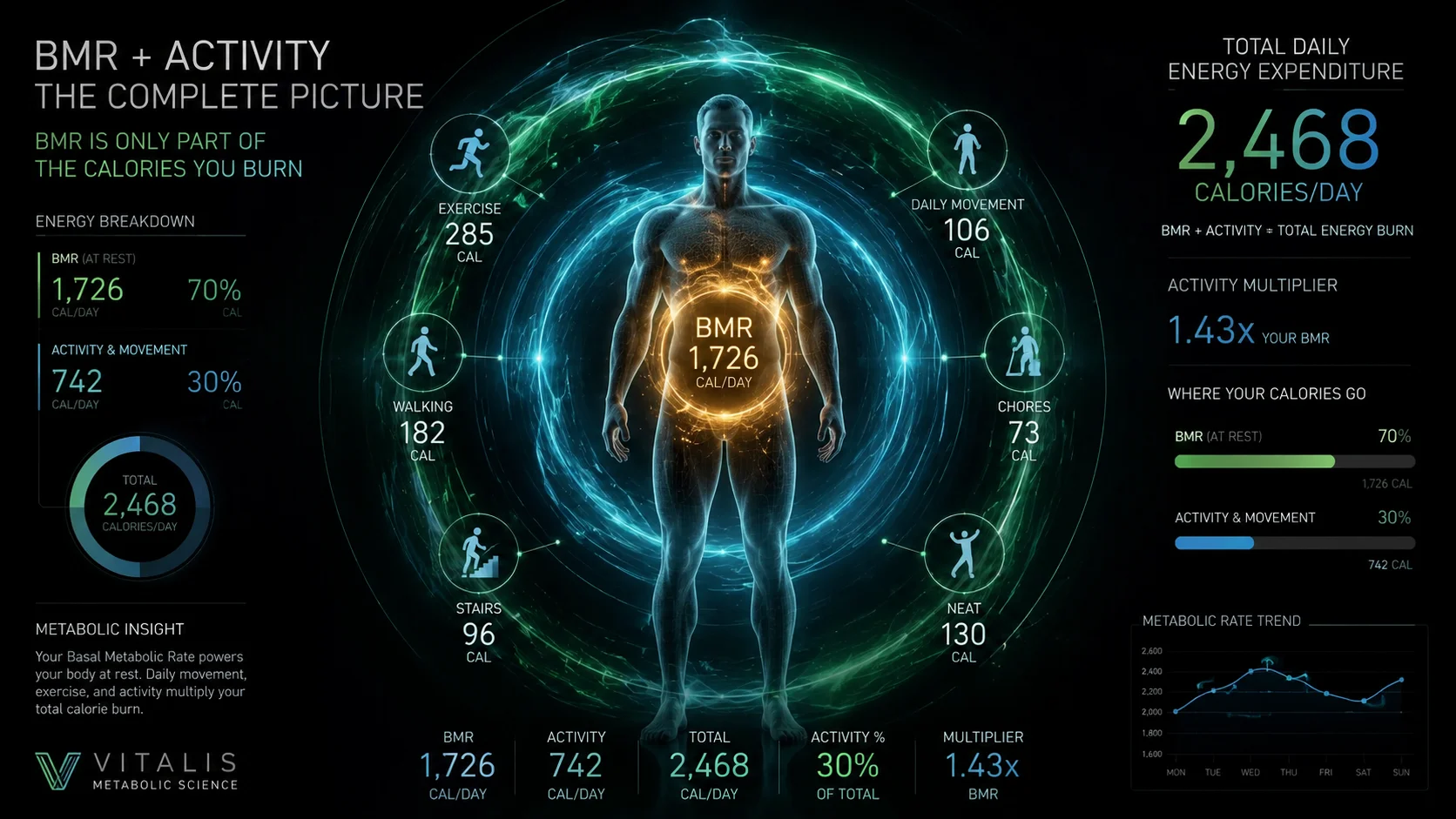
BMR plus walking, workouts, chores, fidgeting, and the energy spent digesting food. It is your true daily target: 20% to 90% higher than BMR depending on how active you are.
Mix the two up and a diet either stalls or starts eating your muscle. The free BMR calculator returns both figures at once, so you do not have to do the math by hand.
BMR vs TDEE at a Glance
Same body, two different questions. One asks what you burn doing nothing, the other asks what you burn living your day.
| Factor | BMR | TDEE |
|---|---|---|
| What it measures | Calories burned at complete rest | Total calories burned across a full day |
| Includes activity | No | Yes, all of it |
| Includes digestion | No | Yes (TEF) |
| Typical size | Your metabolic floor | 20% to 90% higher than BMR |
| How to use it | Never eat below this | Base your daily calorie target on this |
| Changes when | Weight, muscle, age change | Activity, sleep, and stress also change it |
How BMR Becomes TDEE
Your BMR is the dark floor and stays the same all day. Activity stacks the green calories on top. The full bar is your TDEE.
Numbers on top of each bar are your TDEE at that activity level. Defaults to a sample BMR of 1,500 kcal. Multipliers are 1.2, 1.375, 1.55, 1.725, and 1.9. Estimates carry about a 10% margin, so treat them as a starting point.
Get Both Numbers in One Step
Enter your age, sex, height, weight, and activity level. The calculator returns your BMR and your TDEE together, using the Mifflin-St Jeor equation dietitians rely on.
What BMR Measures
Brain
Your brain burns a fifth of your resting calories just thinking and regulating.
Heart & Lungs
Constant pumping and breathing — the biggest non-brain organ demand.
Liver & Kidneys
Filtration, detox, and processing — these organs never rest.
Cells & Repair
Cell maintenance, ion pumps, protein turnover — the silent majority.
At Complete Rest
Picture your body parked in bed, awake but not moving, not digesting, not cold. The calories it still burns to run your heart, lungs, brain, and kidneys are your basal metabolic rate. Your brain alone takes about a fifth of it. For most adults BMR lands somewhere between 1,200 and 2,000 calories a day.
Changes Slowly
BMR is the part of your burn you cannot change overnight. It moves slowly, with weight, muscle mass, and age. It drops by roughly 50 calories per decade as muscle naturally declines, which is why a 45 year old needs fewer calories than at 25 at the same weight.
Read our full RMR guide →Where Your Daily Calories Go
TDEE is made of four parts. BMR is the largest by far, which is why your resting burn matters more than any single workout.
BMR Basal metabolic rate
Calories your body burns at complete rest to keep you alive. The biggest slice of TDEE and the one you cannot change quickly.
NEAT Non-exercise activity
Walking, chores, fidgeting, standing. The most flexible piece, and the one that quietly drops when you diet or sit more.
EAT Exercise activity
Planned workouts. Smaller than most people assume, which is why exercise alone rarely outruns a poor diet.
TEF Thermic effect of food
Energy spent digesting meals. Protein costs the most to process (20–30%), which is one reason high-protein diets help.
Shares are representative for an average person. Athletes and highly active people carry a larger activity slice.
Turning BMR Into TDEE: The Activity Multiplier
TDEE is just your BMR multiplied by an activity factor. Pick the row that matches your real week, not your best week. Most people overrate their activity, which inflates the target and stalls fat loss.
| Activity level | Multiplier | Who it fits | TDEE (BMR 1,500) |
|---|---|---|---|
| Sedentary | ×1.2 | Desk job, little or no exercise | 1800 kcal |
| Lightly active | ×1.375 | Light exercise 1–3 days a week | 2063 kcal |
| Moderately active | ×1.55 | Exercise 3–5 days a week | 2325 kcal |
| Very active | ×1.725 | Hard training 6–7 days a week | 2588 kcal |
| Extra active | ×1.9 | Physical job plus daily intense training | 2850 kcal |
Prefer a tool that asks for your activity directly? The TDEE calculator builds the multiplier in for you.
A Worked Example, Start to Finish
Take a 30 year old woman, 65 kg, 165 cm, who trains a few times a week. Here is how her BMR turns into a fat-loss target.
- 1
Find BMR (Mifflin-St Jeor)
(10 × 65) + (6.25 × 165) − (5 × 30) − 161 = 1,370 kcal/day.
- 2
Find TDEE (moderate × 1.55)
1,370 × 1.55 = about 2,124 kcal/day. That is her real daily burn.
- 3
Apply a 500 kcal deficit
2,124 − 500 = 1,624 kcal/day, which targets roughly 0.5 kg of fat loss a week.
- 4
Stay above BMR
1,624 sits well above her 1,370 floor, so the plan protects muscle and her metabolism.
Set Your Target From TDEE, Not BMR
Once you know your TDEE, your goal decides the adjustment. Think in zones rather than one exact number, which leaves room for the normal day-to-day swing in how much you burn.
Maintain weight
TDEE ± 100Eat at your TDEE to hold steady. Useful as a baseline before any cut or bulk.
Slow fat loss
TDEE − 250A gentle deficit, easy to sustain and kind to muscle. Around 0.25 kg a week.
Steady fat loss
TDEE − 500The classic deficit. Roughly 0.5 kg of fat a week without crashing.
Lean muscle gain
TDEE + 250A small surplus paired with training adds muscle while limiting fat gain.
The Formulas Behind BMR
TDEE depends on getting BMR right first. Three formulas do the job. Mifflin-St Jeor is the default for most people.
Mifflin-St Jeor
Men
(10 × kg) + (6.25 × cm) − (5 × age) + 5
Women
(10 × kg) + (6.25 × cm) − (5 × age) − 161
The current standard. The Academy of Nutrition and Dietetics rates it the most accurate for modern adults, and it is what Calqulate's BMR calculator uses by default.
Harris-Benedict (revised)
Men
(13.397 × kg) + (4.799 × cm) − (5.677 × age) + 88.362
Women
(9.247 × kg) + (3.098 × cm) − (4.330 × age) + 447.593
The older clinical standard. Still common, but it tends to read about 5% high for today's populations.
Katch-McArdle
Men
370 + (21.6 × lean body mass in kg)
Built on lean body mass, so it needs your body-fat percentage. The most accurate option for lean, muscular people once that number is known.
A Note on These Numbers
BMR and TDEE formulas are estimates with about a 10% margin. They are a strong starting point, not a lab measurement. Conditions like thyroid disorders, PCOS, pregnancy, and some medications shift your real burn beyond what any formula predicts. Track your weight for two to three weeks, then adjust your target based on what the scale shows. If you have a medical condition or are in recovery from disordered eating, work with a doctor or registered dietitian.
Take the cheat sheet with you
Download a free, printable BMR and TDEE guide. Formulas, activity multipliers, and calorie zones in one PDF.
Frequently Asked Questions
What is the difference between BMR and TDEE?+
BMR is the calories your body burns at complete rest just to stay alive. TDEE is your total burn across a full day, which adds movement, exercise, and the energy spent digesting food. TDEE is always higher than BMR, usually 20% to 90% higher depending on how active you are. You plan meals around TDEE, not BMR.
Should I eat my BMR or my TDEE?+
Eat around your TDEE, then adjust for your goal. Your BMR is a floor, not a target. Eating at or below BMR for long stretches triggers muscle loss and slows your metabolism, which makes fat loss harder later. Find your TDEE first, then subtract 250 to 500 calories for fat loss.
How do I calculate TDEE from BMR?+
Multiply your BMR by an activity multiplier: 1.2 if sedentary, 1.375 lightly active, 1.55 moderately active, 1.725 very active, and 1.9 extra active. For example, a BMR of 1,500 at moderate activity gives a TDEE of about 2,325 calories. Calqulate's BMR calculator does both steps for you.
Why is my TDEE so much higher than my BMR?+
Because TDEE counts everything BMR leaves out. Walking, workouts, chores, fidgeting, and digestion all stack on top of your resting burn. Even a sedentary day adds about 20% over BMR, and an active day can add 70% or more.
Does BMR change with age?+
Yes, slowly. BMR tends to drop by roughly 50 calories per decade as muscle mass declines with age. That is one reason recalculating every few months, and protecting muscle with resistance training, matters as you get older.
Which BMR formula is most accurate?+
Mifflin-St Jeor is the current standard for most adults and is about 5% more accurate than the older Harris-Benedict formula. If you know your body-fat percentage and carry a lot of muscle, Katch-McArdle is more accurate because it works from lean body mass instead of total weight.
Is RMR the same as BMR?+
Close enough for planning. RMR (resting metabolic rate) is measured under slightly looser conditions than BMR and reads a little higher, but the two are used interchangeably for nutrition. Both describe the calories you burn at rest.
The Bottom Line
BMR is what you burn at rest. TDEE is what you burn in real life. Find your BMR, multiply by your honest activity level to get TDEE, then adjust from there for fat loss or muscle gain. Keep your daily intake above your BMR, recheck the numbers every couple of months, and let real-world results fine-tune the rest.
Calculate Your BMR & TDEE →