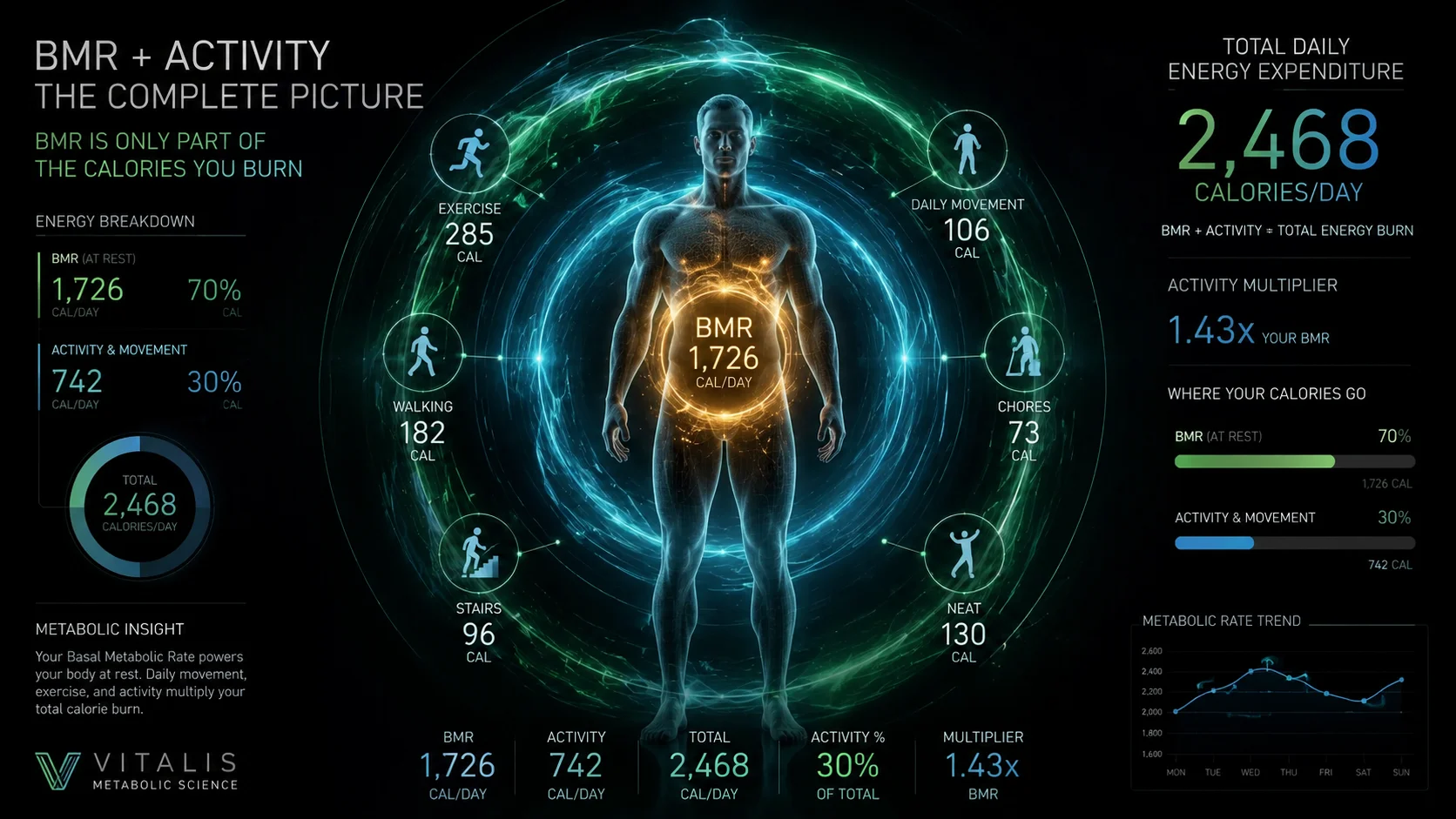
How to Calculate Your Resting Metabolic Rate (RMR)
Your RMR is the single number that determines whether your calorie target is realistic or completely off. This guide explains what it is, how the formulas work, and how to turn your result into an actual eating plan.

4
RMR Equations
5
Activity Levels
8
Factors Covered
Free
Calculator
What Is Resting Metabolic Rate (RMR)?
Your resting metabolic rate is the number of calories your body burns while doing absolutely nothing. Breathing, circulating blood, repairing cells, keeping your organs running — that all costs energy, and RMR is the bill your body pays every single day before you even get out of bed.
For most adults, RMR accounts for 60% to 75% of total daily calorie burn. That makes it the most important number in any weight management plan. If your calorie target is built on a wrong RMR estimate, every number downstream is wrong too.
The good news is you don’t need lab equipment to get a useful estimate. With four inputs — age, sex, height, and weight — a validated formula will land within roughly 10% of your true RMR. That’s close enough for practical meal planning. Below, you’ll find the formulas that actually hold up under research scrutiny, a free calculator, and a step-by-step breakdown of how to use your result.
RMR vs. BMR: What’s the Actual Difference?
People use these terms interchangeably, and for everyday purposes, that’s fine. But technically they measure slightly different things.
BMR (Basal Metabolic Rate) is measured under strict lab conditions: 12 hours of fasting, a full night of sleep, complete physical stillness, and a controlled room temperature. It captures the absolute minimum your body needs to survive.
RMR (Resting Metabolic Rate) is measured under more relaxed conditions. You’ve rested for a few hours, but the setting isn’t as tightly controlled. Because of that, RMR tends to run about 10 to 20% higher than BMR.
The predictive formulas you’ll see below — Mifflin-St. Jeor, Harris-Benedict, and others — were originally validated against BMR measurements, but fitness tools and BMR calculators commonly apply them to estimate RMR too. The difference rarely matters unless you’re in a clinical setting.
The 4 RMR Equations That Actually Work
Researchers have spent decades refining prediction formulas. Most are built on the same four inputs — age, sex, height, and weight — but they were tested on different populations and produce meaningfully different results. Here’s what each one does, and which one to use.
1. Mifflin-St. Jeor Equation (Best Choice for Most People)
Published in 1990, this is the most accurate formula for the average adult and is the one recommended by the Academy of Nutrition and Dietetics. A 2005 comparison study in the Journal of the American Dietetic Association found it outperformed the Harris-Benedict revision for predicting measured resting energy expenditure across a wide population[1].
If you pick one formula to trust, this is it.
Mifflin-St. Jeor Formula
Men: (10 × weight in kg) + (6.25 × height in cm) − (5 × age) + 5
Women: (10 × weight in kg) + (6.25 × height in cm) − (5 × age) − 161
Worked example
A 32-year-old woman, 65 kg, 165 cm tall:
(10 × 65) + (6.25 × 165) − (5 × 32) − 161 = 650 + 1,031.25 − 160 − 161 = 1,360 kcal/day
2. Harris-Benedict Equation (The Classic Formula)
This is the original metabolic formula, first published in 1919 and revised in 1984 by Roza and Shizgal. It held the standard for most of the 20th century and you’ll still find it used in a lot of nutrition textbooks.
The catch: it tends to overestimate RMR by about 5 to 8% in people who are sedentary or carry more body fat. For a 150-pound person, that drift can add up to 100+ phantom calories a day. Use Mifflin-St. Jeor unless you have a specific reason to use this one.
Harris-Benedict Formula (Revised)
Men: 88.362 + (13.397 × wt kg) + (4.799 × ht cm) − (5.677 × age)
Women: 447.593 + (9.247 × wt kg) + (3.098 × ht cm) − (4.330 × age)
3. Katch-McArdle Equation (Best for Athletes and Lean Individuals)
This formula skips the weight-and-height approach entirely. Instead, it uses lean body mass — your total weight minus your fat mass. Muscle tissue burns roughly three times more calories at rest than fat tissue, so this equation is significantly more accurate if you know your body-fat percentage and you’re on the leaner side.
Two people can both weigh 80 kg. If one has 20% body fat and the other has 30%, their RMRs will differ by roughly 150 to 200 calories per day. Mifflin-St. Jeor can’t capture that gap. Katch-McArdle can.
Katch-McArdle Formula
Both sexes: 370 + (21.6 × lean body mass in kg)
Calculate lean body mass: Total weight kg × (1 − body fat fraction). If you weigh 75 kg and have 22% body fat: 75 × (1 − 0.22) = 58.5 kg lean mass. RMR = 370 + (21.6 × 58.5) = 1,633 kcal/day.
4. Cunningham Equation (For Elite and Highly Trained Athletes)
The Cunningham equation is structurally similar to Katch-McArdle but produces higher estimates. It was developed specifically for elite athletes and tends to overestimate RMR for anyone who isn’t in serious competitive training. Most people don’t need this one. If you’re a recreational gym-goer using Cunningham, you’ll likely overestimate your burn by 100 to 200 calories a day.
Three Real-World Examples
Numbers without context are hard to use. Here’s what the Mifflin-St. Jeor formula produces for three different people, and what it means practically.
- Priya, 28, woman, 60 kg, 162 cm, lightly active. RMR = 1,326 kcal. Multiply by 1.375 for light activity = TDEE of about 1,823 kcal/day. A realistic fat loss target: 1,450 to 1,550 kcal.
- Rohan, 35, man, 78 kg, 178 cm, moderately active. RMR = 1,733 kcal. Multiply by 1.55 = TDEE of about 2,686 kcal/day. Maintenance eating sits around 2,650 to 2,700 kcal.
- Susan, 52, woman, 70 kg, 165 cm, sedentary. RMR = 1,360 kcal. Multiply by 1.2 = TDEE of about 1,632 kcal/day. A 250-calorie daily deficit produces steady fat loss without crashing energy levels.
Even when two people are similar in weight, their RMRs can differ significantly once age and sex enter the equation. A generic 2,000-calorie target underfeeds some people and overfeeds others — and now you can see exactly why.
When a Formula Isn’t Enough
For most people, a predictive formula is a solid starting point. But if precision matters — for athletic performance, medical nutrition therapy, or post-surgical recovery — the gold standard is indirect calorimetry. You breathe into a measurement hood for 10 to 20 minutes, and the machine calculates your actual oxygen-to-carbon-dioxide exchange. It costs $100 to $300 at a sports lab or metabolic clinic, but it removes the guesswork entirely.
How Accurate Is Each RMR Equation?
Accuracy score (0–100) measured against gold-standard indirect calorimetry.
Methodology: each equation's predicted RMR is compared against indirect calorimetry across mixed-population studies; closer agreement = higher score.
Calculate Your RMR and TDEE
Enter your age, sex, height, and weight. The calculator runs all four formulas and shows you your TDEE at every activity level in seconds.
From RMR to TDEE: Your Real Daily Calorie Number
RMR tells you how many calories your body burns at rest. But you don’t spend your whole day at rest. Total Daily Energy Expenditure (TDEE) accounts for everything: walking, working, working out, and even the energy cost of digesting food.
The formula is: TDEE = RMR × Activity Multiplier.
Once you have your TDEE, setting a calorie target becomes straightforward:
- Fat loss: eat 10 to 20% below TDEE. A 500-calorie daily deficit produces about 0.5 kg of fat loss per week in most people.
- Maintenance: eat at TDEE.
- Muscle gain: eat 10 to 15% above TDEE with adequate protein.
Quick example: your RMR is 1,500 kcal, and you train three times a week. Use the moderately active multiplier of 1.55. Your TDEE is 2,325 kcal. For fat loss, target 1,850 to 1,950 kcal. For lean muscle gain, target 2,550 to 2,700 kcal. Every popular diet plan you’ve seen is just this calculation with a different deficit or surplus number attached.
| Activity Level | Multiplier | Who It Fits |
|---|---|---|
| Sedentary | ×1.2 | Desk job, little or no exercise. |
| Lightly Active | ×1.375 | Light exercise or sport 1–3 days a week. |
| Moderately Active | ×1.55 | Moderate exercise 3–5 days a week. |
| Very Active | ×1.725 | Hard exercise 6–7 days a week. |
| Extra Active | ×1.9 | Very hard exercise plus a physical job or training twice a day. |
What Affects Your Resting Metabolic Rate
Two people at the same height and weight can have RMRs that differ by 300 to 500 calories a day. That’s not a small gap — it’s the difference between a diet that works and one that stalls. These are the main factors driving that variance.
Lean Muscle Mass high impact
Muscle tissue burns roughly three times more calories at rest than fat tissue. The single biggest lever you control.
Age high impact
RMR drops about 1–2% per decade after age 20, largely because of natural muscle loss (sarcopenia).
Sex medium impact
Men typically have 5–10% higher RMR than women of the same size because of greater average muscle mass.
Body Size & Composition high impact
Taller and heavier bodies have more cells to maintain, so they burn more calories at complete rest.
Thyroid Hormone high impact
An underactive thyroid (hypothyroidism) can cut RMR by 15–40%. Overactive thyroid does the opposite.
Genetics medium impact
Two people with identical age, weight, and body fat can have RMRs that differ by up to 200 kcal per day.
Climate & Body Temperature low impact
Cold environments and a slight fever both raise RMR — your body burns energy to maintain core temperature.
Pregnancy & Lactation medium impact
RMR rises 15–25% in late pregnancy and stays elevated through breastfeeding.
Common Question
Does metabolism really slow down with age?
Less than most people assume. A 2021 study published in Science tracking over 6,400 people found that RMR stays remarkably stable from age 20 to 60. The slowdown most people experience in their 30s and 40s comes mainly from losing muscle mass and moving less, not from some fundamental change in metabolism itself. [2] Resistance training two to three times a week preserves muscle and keeps your RMR from dropping.
Can You Actually Raise Your RMR?
Yes, and the research is fairly clear on how. Building lean muscle through resistance training is the most reliable method. Each pound of muscle added burns roughly 6 to 10 extra calories per day at rest. That sounds small, but six months of consistent lifting can add enough muscle to raise your daily burn by 50 to 100 calories — meaningful over time.
Below are the habits that help and the ones that quietly work against you.
Resistance training 3×/week
Adds lean muscle, the most powerful long-term RMR booster.
Adequate protein (1.6–2.2 g/kg)
Higher thermic effect than carbs or fat, preserves muscle in a deficit.
Consistent sleep (7–9 hrs)
Poor sleep lowers RMR and increases hunger hormones the next day.
Steady hydration
Even mild dehydration can suppress metabolic rate by 2–3%.
Crash dieting (<1000 kcal)
Triggers metabolic adaptation — RMR can drop 20%+ within weeks.
Chronic under-sleeping
Less than 6 hours regularly slows RMR and disrupts hunger signals.
Skipping all carbs long-term
Can lower thyroid T3 levels, which directly reduces RMR.
Protein Matters More Than People Think
Protein has a thermic effect of about 20 to 30% — meaning your body burns roughly a quarter of protein calories just to digest it. Fat and carbohydrates are closer to 5 to 10%. Eating 150g of protein per day instead of 75g can add 75 to 100 calories of daily calorie burn just through digestion, without changing anything else.
Sleep Deprivation Lowers RMR
A 2012 study in the American Journal of Clinical Nutrition found that sleeping just 5.5 hours instead of 8.5 hours reduced RMR by about 5% and also increased appetite hormones. [3] Poor sleep doesn’t just make you tired. It directly reduces the calories your body burns at rest.
5 Metabolism Myths That Keep Getting Repeated
A lot of advice about metabolism sounds credible because it gets repeated confidently. Most of it doesn’t hold up under research. Here are the ones worth ignoring.
- ✕Eating small meals every 2 hours speeds up your metabolism (it doesn't).
- ✕Green tea or 'fat-burner' pills meaningfully raise RMR (effect is under 4%).
- ✕Skipping breakfast permanently slows your metabolism (only crash dieting does).
- ✕Cardio is the best way to boost long-term RMR (resistance training wins).
- ✕Your metabolism is 'broken' if you can't lose weight (almost always wrong).
How to Get Your RMR Tested Professionally
If you want a precise measurement rather than an estimate, a few options are available.
Indirect Calorimetry
$100–$300
Sports labs, metabolic clinics, some hospitals
Gold standard. You breathe into a sealed hood or mask for 15–20 minutes. Accuracy is within 1–2% of true RMR.
DEXA Scan + Katch-McArdle
$50–$150 for DEXA
Imaging centers, university labs
DEXA measures your exact body-fat percentage. Feed that into Katch-McArdle and you get a highly accurate RMR estimate without indirect calorimetry.
Predictive Formula
Free
This page
Accurate within 10% for healthy adults. Good enough for meal planning and weight management decisions for most people.
Important Disclaimer
The calculator and content on this page are for general informational purposes only. They do not constitute and are not intended as medical advice, diagnosis, or treatment. All predictive RMR formulas carry an inherent margin of error of approximately ±10%. Certain health conditions — including hypothyroidism, PCOS, type 2 diabetes, chronic kidney disease, and recovery from surgery or illness — can alter your actual resting metabolic rate significantly. Before making substantial changes to your diet or calorie intake, speak with a registered dietitian (RD) or your primary care physician. This is especially important if you have an existing health condition or are taking prescription medications that affect metabolism or appetite.
References
Scientific sources used in this article.
- [1]Frankenfield D, Roth-Yousey L, Compher C. Comparison of predictive equations for resting metabolic rate in healthy nonobese and obese adults: a systematic review. Journal of the American Dietetic Association. 2005;105(5):775-789. PubMed: 15883556
- [2]Pontzer H, et al. Daily energy expenditure through the human life course. Science. 2021;373(6556):808-812. PubMed: 34385400
- [3]Nedeltcheva AV, Kilkus JM, Imperial J, et al. Insufficient sleep undermines dietary efforts to reduce adiposity. Annals of Internal Medicine. 2010;153(7):435-441. PubMed: 20921542
- [4]Mifflin MD, St Jeor ST, Hill LA, et al. A new predictive equation for resting energy expenditure in healthy individuals. American Journal of Clinical Nutrition. 1990;51(2):241-247. PubMed: 2305711
- [5]Academy of Nutrition and Dietetics. Evidence-Based Nutrition Practice Guidelines. eatrightpro.org
- [6]Roza AM, Shizgal HM. The Harris Benedict equation reevaluated: resting energy requirements and the body cell mass. American Journal of Clinical Nutrition. 1984;40(1):168-182. PubMed: 6741850
Save this for later
Download a free printable reference guide with every formula, activity multiplier, and factor on one page.
Frequently Asked Questions
Questions pulled from Reddit, Quora, and Google searches around RMR and BMR. These are the ones that actually come up most often.
What is the difference between BMR and RMR?+
BMR is measured under strict lab conditions after fasting and complete rest — it captures the absolute minimum calories your body needs to function. RMR is measured under slightly relaxed conditions and typically runs 10 to 20% higher. For practical purposes like setting a calorie target, the difference doesn't matter. Both numbers get used interchangeably in most fitness calculators.
Which formula is the most accurate for calculating RMR?+
For most adults who don't know their body-fat percentage, the Mifflin-St. Jeor equation is the most accurate option. It's endorsed by the Academy of Nutrition and Dietetics and outperformed other formulas in a large systematic review. If you're lean and know your body-fat percentage, use Katch-McArdle instead — it accounts for the muscle-to-fat ratio that Mifflin-St. Jeor ignores.
What is a normal RMR?+
There's no universal 'normal' — it depends on your age, sex, height, weight, and muscle mass. As a rough reference: most adult women fall between 1,200 and 1,600 kcal/day, and most adult men fall between 1,500 and 1,900 kcal/day. Athletes or taller individuals can be above 2,000 kcal/day. Use the calculator on this page to get your personal number.
How do I calculate TDEE from my RMR?+
Multiply your RMR by an activity factor: 1.2 for sedentary (desk job, little exercise), 1.375 for lightly active (light exercise 1 to 3 days per week), 1.55 for moderately active (moderate exercise 3 to 5 days), 1.725 for very active (hard training 6 to 7 days), and 1.9 for extremely active (physical job plus daily training). The result is your TDEE.
Why is my RMR so low?+
The most common reasons are having lower muscle mass, being older, being shorter, being female, or having dieted aggressively in the past. Crash dieting — eating well below your RMR for extended periods — can suppress metabolic rate through a process called adaptive thermogenesis. Building muscle and eating at or near maintenance for a period helps restore it over time.
Can I increase my resting metabolic rate?+
Yes, mostly by building lean muscle through resistance training. Muscle tissue is metabolically active and burns more calories at rest than fat tissue. Eating adequate protein, sleeping 7 to 9 hours, and avoiding very low-calorie diets all protect your existing RMR. Supplements marketed as metabolism boosters have minimal long-term effect based on current evidence.
How accurate is an online RMR calculator?+
Predictive formulas are typically accurate within 10% for healthy adults with no major medical conditions. That margin is small enough to build a workable calorie target from. For precision — in athletic performance, clinical settings, or when medical conditions affect metabolism — indirect calorimetry at a sports lab or clinic gives a direct measurement.
Does eating small meals frequently boost metabolism?+
No. Meal frequency has no meaningful impact on RMR or total daily calorie burn. What matters is your total daily intake and the composition of your diet. Eating six small meals versus three larger ones produces the same metabolic outcome when total calories and protein are matched. Choose the eating pattern that fits your schedule and keeps you satisfied.
Get your number and build a plan around it
The calculator above gives you RMR, BMR, and TDEE across every activity level. Use those numbers to set a calorie target that’s grounded in your actual biology, not a generic estimate.