Ideal Weight by Height & Age (Chart)
Ideal weight chart by height and age for women and men, 4'10" to 6'6", in both lbs and kg. See the healthy BMI range and Devine target for every height, and why the number shifts through your 20s, 40s and 60s.
21
Heights Charted
4
IBW Formulas
3
Age Bands
Free
Calculator
What Counts as an Ideal Weight for Your Height?
Most people want one number. The honest answer is a small range.
Your ideal weight is set mostly by your height and sex, with age and body type fine-tuning where you land inside it. A 5'6" woman and a 5'6" man do not share a target, and neither should be compared to a friend who is three inches taller.
Healthy Weight Range
Built from BMI, this gives the lowest and highest weight that is generally healthy for your height. Think of it as your allowed zone — the floor and ceiling where most adults can maintain good health.
Ideal Body Weight
A single target doctors calculate with the Devine formula for drug dosing and clinical assessment. It is your bullseye — a precise number to aim for inside the healthy range.
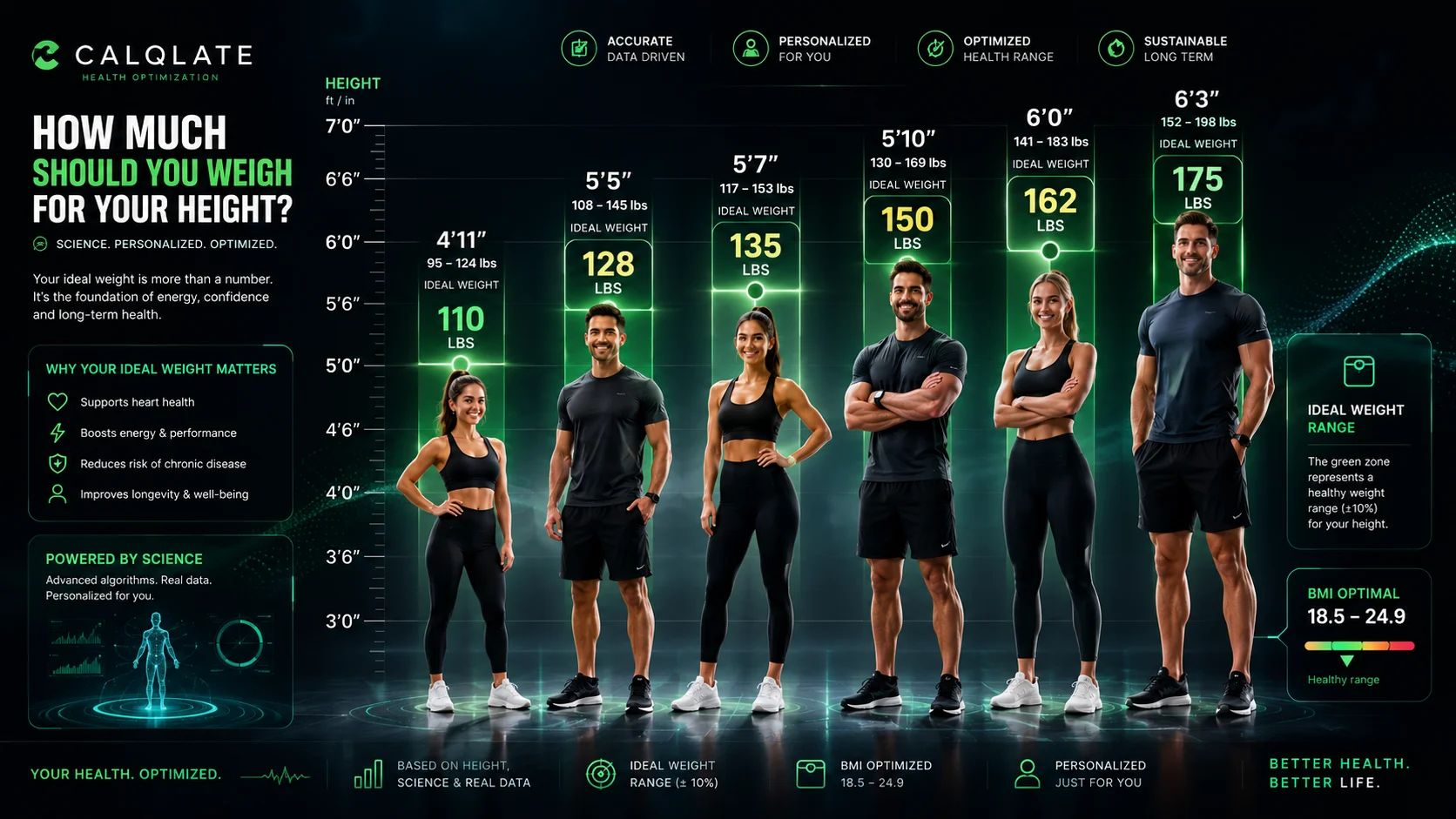
The chart below gives you both for every height from 4'10" to 6'6", and the ideal body weight calculator runs the math for your exact height in seconds.
Ideal Weight Chart by Height (Women & Men)
Ideal target uses the Devine formula. The healthy range uses the CDC BMI window of 18.5 to 24.9. Pounds are listed first for a US reader, with kilograms in parentheses.
| Height | Women ideal | Men ideal | Healthy range |
|---|---|---|---|
| 4'10" (147 cm) | 90 lb (40.9 kg) | 100 lb (45.4 kg) | 89–119 lb |
| 4'11" (150 cm) | 95 lb (43.2 kg) | 105 lb (47.7 kg) | 92–123 lb |
| 5'0" (152 cm) | 100 lb (45.5 kg) | 110 lb (50 kg) | 95–127 lb |
| 5'1" (155 cm) | 105 lb (47.8 kg) | 115 lb (52.3 kg) | 98–132 lb |
| 5'2" (157 cm) | 110 lb (50.1 kg) | 120 lb (54.6 kg) | 101–136 lb |
| 5'3" (160 cm) | 116 lb (52.4 kg) | 125 lb (56.9 kg) | 104–141 lb |
| 5'4" (163 cm) | 121 lb (54.7 kg) | 131 lb (59.2 kg) | 108–145 lb |
| 5'5" (165 cm) | 126 lb (57 kg) | 136 lb (61.5 kg) | 111–150 lb |
| 5'6" (168 cm) | 131 lb (59.3 kg) | 141 lb (63.8 kg) | 115–154 lb |
| 5'7" (170 cm) | 136 lb (61.6 kg) | 146 lb (66.1 kg) | 118–159 lb |
| 5'8" (173 cm) | 141 lb (63.9 kg) | 151 lb (68.4 kg) | 122–164 lb |
| 5'9" (175 cm) | 146 lb (66.2 kg) | 156 lb (70.7 kg) | 125–169 lb |
| 5'10" (178 cm) | 151 lb (68.5 kg) | 161 lb (73 kg) | 129–174 lb |
| 5'11" (180 cm) | 156 lb (70.8 kg) | 166 lb (75.3 kg) | 133–179 lb |
| 6'0" (183 cm) | 161 lb (73.1 kg) | 171 lb (77.6 kg) | 136–184 lb |
| 6'1" (185 cm) | 166 lb (75.4 kg) | 176 lb (79.9 kg) | 140–189 lb |
| 6'2" (188 cm) | 171 lb (77.7 kg) | 181 lb (82.2 kg) | 144–194 lb |
| 6'3" (190 cm) | 176 lb (80 kg) | 186 lb (84.5 kg) | 148–199 lb |
| 6'4" (193 cm) | 181 lb (82.3 kg) | 191 lb (86.8 kg) | 152–205 lb |
| 6'5" (196 cm) | 187 lb (84.6 kg) | 196 lb (89.1 kg) | 156–210 lb |
| 6'6" (198 cm) | 192 lb (86.9 kg) | 202 lb (91.4 kg) | 160–215 lb |
Scroll the table sideways on mobile. Values are rounded. Your own healthy number depends on frame size, muscle, and age, covered further down.
Ideal Weight by Height (Visual Chart)
The green band is the healthy weight range for each height. The two lines are the Devine ideal target for women and men.
Healthy range uses the CDC BMI window (18.5–24.9) for adults 20–64. Ideal target lines use the Devine formula. Both are screening guides, not a diagnosis. Frame size, muscle, and age move where you fit inside the band.
Skip the Chart. Get Your Exact Number
Enter your height, sex, and age. The calculator returns your ideal body weight in pounds and kilograms, plus a healthy range, using the same formulas doctors rely on.
Two Worked Examples
The chart is faster than math, but it helps to see how a single target is built. The Devine formula starts at a base weight for 5'0" and adds 2.3 kg for every inch above that.
Example 1
5'6" woman
Six inches over 5 ft. Start at 45.5 kg, add 6 × 2.3 = 13.8 kg. Ideal weight comes to 59.3 kg, about 131 lbs. The healthy range for that height is roughly 115 to 154 lbs.
Example 2
6'0" man
Twelve inches over 5 ft. Start at 50 kg, add 12 × 2.3 = 27.6 kg. Ideal weight comes to 77.6 kg, about 171 lbs. The healthy range for that height is roughly 136 to 184 lbs.
The Four Formulas Doctors Use
There is no single agreed formula, so clinicians compare a few and read the spread as a range. Devine is the most common. Here is how each one works and where it gets used.
Devine Formula
- Men
- 50 kg + 2.3 kg per inch over 5 ft
- Women
- 45.5 kg + 2.3 kg per inch over 5 ft
The most widely used formula in hospitals for drug dosing and ventilation. Calqulate's calculator uses this as its primary result.
Robinson Formula
- Men
- 52 kg + 1.9 kg per inch over 5 ft
- Women
- 49 kg + 1.7 kg per inch over 5 ft
A refinement of Devine, common in dietetics and nutrition assessment. Lands close to Devine for most heights.
Miller Formula
- Men
- 56.2 kg + 1.41 kg per inch over 5 ft
- Women
- 53.1 kg + 1.36 kg per inch over 5 ft
Adds less weight per inch, so it gives lower targets for tall people. Often cited in general fitness contexts.
Hamwi Formula
- Men
- 48 kg + 2.7 kg per inch over 5 ft
- Women
- 45.5 kg + 2.2 kg per inch over 5 ft
The original 1964 method, still used as a quick bedside estimate. Adds the most weight per inch for men.
Does Your Ideal Weight Change With Age?
The formula itself does not. A 25 and a 65 year old at the same height get the same Devine number. What changes is body composition and the healthy band that research links to the best outcomes. The biggest shift comes after 60.
Peak muscle years
Your body builds and holds lean mass most easily here. The ideal weight target is a fair benchmark, but a lifter can sit above it and still be lean. Judge the mirror and tape, not only the scale.
Healthy BMI 18.5–24.9
Muscle slowly declines
Adults lose roughly 3–8% of muscle per decade after 30 (sarcopenia). The scale may hold steady while fat replaces muscle. Protecting muscle with protein and resistance training matters more than chasing a lower number.
Healthy BMI 18.5–24.9
A little extra can help
Several large studies link a slightly higher BMI, roughly 23–30, to longer life and a buffer against illness in older adults. Being underweight carries more risk here than being mildly above the standard range. This is the one age group where the textbook IBW often needs adjusting upward.
Healthy BMI ~23–30
Ideal Weight vs BMI: Which Number Do You Need?
They answer different questions. Ideal body weight gives you a target to aim for and is adjusted for sex. BMI sorts your current weight into a category and is not. Most people benefit from running both.
Underweight
BMI Below 18.5May signal under-nutrition or muscle loss. Worth a check-in.
Healthy weight
BMI 18.5 – 24.9The standard target range for most adults 20–64.
Overweight
BMI 25 – 29.9Raised risk for some conditions, but frame and muscle matter.
Obesity
BMI 30 and aboveHigher risk for heart disease, diabetes, and joint strain.
Want your BMI category alongside your target weight? The ideal body weight calculator shows your healthy range, and you can pair it with the BMI tool for the full picture.
Four Things That Move Your Healthy Number
A chart cannot see your body. These four factors explain why two people at the same height can both be healthy 15 lbs apart.
Frame size
Wrist circumference is a quick proxy. A larger frame carries more healthy weight, a smaller frame less. Two people at the same height can sit 10–15 lbs apart and both be healthy.
Muscle mass
Muscle is denser than fat. A trained body can read 'overweight' on a height chart while carrying low body fat. Tape and body-fat readings tell the real story.
Sex
Women carry more essential fat (about 12–15% vs 2–5% for men) and have a lower ideal-weight baseline at every height. Gender-blind charts overestimate a woman's target.
Age
Composition shifts over the decades. The healthy band drifts slightly upward after 60. A single number for a 25 and a 65 year old hides that.
A Note on Using These Numbers
An ideal weight chart is a screening guide, not a diagnosis. It does not account for athletes carrying heavy muscle, pregnancy, growing teens, or chronic conditions and the medications that come with them. If you are planning a major change in your weight, or you fall into one of those groups, treat the chart as a starting point and confirm your target with a doctor or registered dietitian.
Take the chart with you
Download a free, printable ideal weight chart. Height and weight for women and men, the formulas, and the healthy ranges in one PDF.
Frequently Asked Questions
How much should I weigh for my height and age?+
Start with the healthy BMI range for your height, which is 18.5 to 24.9. For example, at 5'6" that is about 115 to 154 lbs. The ideal-weight formulas give a single target inside that band, lower for women, higher for men. Age shifts the read mainly after 60, where a BMI up to about 30 is linked to better outcomes. The chart above gives both figures for every height from 4'10" to 6'6".
Does ideal body weight change with age?+
The Devine formula doctors use does not change with age. What changes is body composition and the healthy band. Adults 20 to 64 share the 18.5 to 24.9 BMI target. For adults 65 and older, research links a slightly higher BMI, around 23 to 30, to longer life, so the textbook target is usually nudged upward for seniors.
What is the ideal weight for a 5'6" woman?+
Using the Devine formula, a 5'6" woman has an ideal target near 131 lbs (59 kg). The full healthy range for that height, based on BMI, runs roughly 115 to 154 lbs. Where you sit inside that band depends on frame size, muscle, and activity.
What is the ideal weight for a 6-foot man?+
A 6'0" man has a Devine ideal weight of about 171 lbs (77.6 kg). The healthy BMI range for that height is roughly 136 to 184 lbs. A man carrying real muscle can sit at the top of that range, or just above, and still be lean.
Is ideal body weight the same as BMI?+
No. Ideal body weight gives you a target number to aim for and is gender-adjusted. BMI classifies your current weight against your height into ranges and is not gender-adjusted. IBW answers 'what should I weigh,' BMI answers 'where do I stand right now.' The two work best together.
Why do the formulas give different numbers?+
Each formula was built from a different population and purpose. Devine and Robinson land close together, Miller gives lower targets for tall people, and Hamwi adds the most per inch for men. The differences are usually within a few pounds, which is why clinicians look at a range rather than one figure.
How accurate is an ideal weight chart?+
A chart is a screening guide, not a diagnosis. It does not see your frame size, muscle, or medical history, so athletes, pregnant women, seniors, and people with chronic conditions should treat it as a starting point and pair it with clinical advice.
The Bottom Line
Your ideal weight is a short range set by height and sex, with age and body type deciding where you sit inside it. Use the chart to find your window, the calculator to get your exact target, and your own common sense about frame and muscle to read it well. A healthy number is one you can hold without fighting your body.
Open the Ideal Body Weight Calculator →