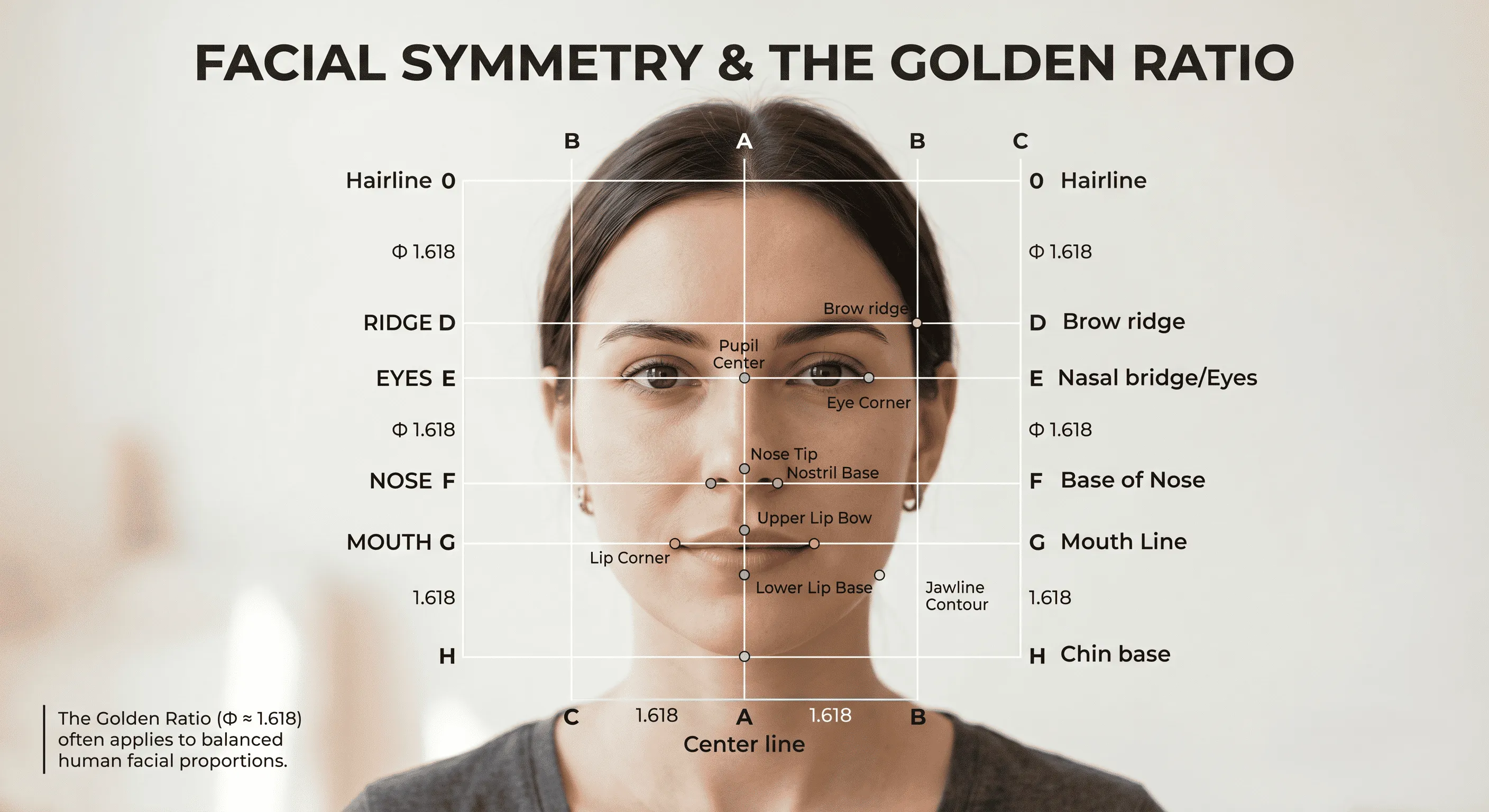
What Your Golden Ratio Face Result Includes
Instead of showing only one unexplained number, the calculator breaks the result into the facial relationships it measures so you can see what contributed to your score.
Face length to width
Compares visible vertical facial length with facial width.
Eye spacing
Compares the distance between the eyes with visible eye width.
Nose and mouth
Compares selected nose-width and mouth-width relationships.
Facial thirds
Compares the balance of the upper, middle and lower visible face.
Left-right symmetry
Compares corresponding visible landmarks on both sides of the face.
Jaw and cheek balance
Compares visible lower-face and mid-face width relationships.
Your score describes how closely the measurements used by this calculator match its mathematical reference proportions. It is not an objective attractiveness rating.
How the Golden Ratio Face Calculator Works
The analyzer detects visible facial landmarks, measures selected distances, converts them into ratios and compares those ratios with the mathematical references used by the calculator.
- 1
Upload a clear photo
Choose one front-facing face with even lighting, a neutral expression and no beauty filter.
- 2
Detect facial landmarks
The analyzer estimates visible points around the eyes, nose, mouth, jaw, cheeks and chin.
- 3
Calculate facial ratios
Selected distances are converted into ratios and compared with the calculator's mathematical references.
- 4
Review your breakdown
See the overall result together with the individual measurements that contributed to it.
What Is the Golden Ratio of a Face?
The golden ratio is a mathematical relationship represented by phi (φ), approximately 1.618. In facial proportion analysis, selected distances may be compared with phi or other classical reference relationships.
That does not mean every facial measurement should equal 1.618. Human faces contain many different proportions, so the golden ratio is best treated as one mathematical reference for exploring facial geometry rather than a universal formula for beauty.
Common relationships explored in face-ratio analysis include:
- • Face length compared with face width
- • Eye spacing compared with eye width
- • Nose width compared with mouth width
- • Upper, middle and lower facial thirds
- • Left-to-right landmark symmetry
- • Jaw and cheek width relationships
What Are Facial Thirds?
Facial thirds divide the visible face vertically into three regions. They are commonly used as a simple way to compare vertical facial balance.
Upper third
The upper visible region of the face, typically considered from the hairline area toward the brow region.
Middle third
The central region running from the brow area toward the base of the nose.
Lower third
The lower region running from the base of the nose toward the chin.
The calculator uses visible facial landmarks to compare these regions. Hair, head angle and landmark visibility can affect the estimate, so use the same photo conditions if you compare results over time.
What Does a Golden Ratio Face Score Mean?
A golden ratio face score is a summary of how closely the selected measurements in your photo match the reference proportions used by this calculator.
A higher score means the measured ratios are closer to those mathematical references. A lower score means more of the measured relationships differ from them. The useful part of the result is the breakdown: it shows which measurements were closer and which differed more.
Use the score as a proportion-matching result, not as a grade of attractiveness. There is no scientifically established universal "perfect face score."
How to Take a Photo for a More Consistent Result
Photo conditions can change the visible geometry and landmark positions. Follow the same setup when comparing two results.
- Look directly at the camera without turning or tilting your head.
- Use soft, even light and avoid strong shadows across one side of the face.
- Keep a neutral expression because smiling can change visible facial measurements.
- Keep your eyes, eyebrows, cheeks, jawline and chin clearly visible.
- Remove sunglasses and avoid beauty filters or extreme wide-angle camera settings.
- Use one face only and enough image resolution for the landmarks to be detected clearly.
Why Can Your Face Ratio Score Change Between Photos?
Your face can be unchanged while the calculated result moves because the calculator measures what is visible in a two-dimensional image.
For a meaningful comparison, use similar lighting, camera distance, expression and head position. Small changes between two scores should not automatically be treated as physical changes in your face.
How Accurate Is a Golden Ratio Face Calculator?
A photo-based calculator can estimate two-dimensional facial landmark relationships from a clear, front-facing image. It cannot perfectly measure three-dimensional facial structure from a single photograph.
Accuracy depends on both photo quality and landmark detection. Camera perspective, head position, expression and partially hidden features can all affect the measurements.
If the detected landmark overlay looks incorrectly positioned, use a clearer photo instead of relying on that result.
Golden Ratio and Facial Attractiveness: Important Context
Research does not establish the golden ratio as a universal rule for facial attractiveness. A systematic review found no significant association between golden-ratio conformity and facial evaluation scores across ethnicities.
Symmetry, averageness, facial proportions, expression, culture and many other factors can influence how faces are perceived. This calculator measures selected geometric relationships only.
Research and Methodology Context
These sources provide context about facial proportions and the limits of treating the golden ratio as a universal beauty rule.
- Assessment of the golden proportion in natural facial esthetics: A systematic review
- The golden ratio: dispelling the myth
- New golden ratios for facial beauty
- Does three-dimensional facial attractiveness relate to golden ratio measurements?
Last reviewed: August 27, 2026
Continue with Your Face Shape
Golden-ratio analysis describes selected facial proportions. Face-shape analysis focuses on the visible relationship between the forehead, cheekbones, jaw and overall facial length.
Discover Your Face Shape