
Calqulate GLP-1 Hub
GLP-1 Weight Loss & Treatment Guide
One place for the calculators, tools and guides Calqulate publishes for GLP-1 weight-loss and treatment. Pick the section that matches what you need to understand today — dosing, side effects, cost, body composition, or the medication itself.
Medically reviewed by Dr. Jaydeep Sanghani, MBBSLast reviewed August 2026
On this page
- 1. What GLP-1s are
- 2. What to track
- 3. Weight-loss progress
- 4. Body composition
- 5. Muscle preservation
- 6. Side effects
- 7. Nutrition
- 8. Medication guides
- 9. Dosing
- 10. Getting started
- 11. Cost & access
- 12. Stopping & maintenance
- 13. Calqulate tools
- 14. When to contact a clinician
- 15. Sources
- 16. Medical review
- 17. FAQ
- 18. Related resources
What GLP-1 medications are
GLP-1 receptor agonists are a class of injected (and, in one case, oral) medications that mimic glucagon-like peptide-1 — a hormone your gut releases after eating. They act in three main places: they slow how quickly the stomach empties, they improve the insulin response to a meal, and they blunt the appetite signal from the brain. The result, at the doses used for weight management, is that you feel full sooner, feel full for longer, and typically eat less.
The medications approved in the U.S. today are semaglutide (Ozempic, Wegovy, Rybelsus), tirzepatide (Mounjaro, Zepbound — which additionally activates the GIP receptor), liraglutide (Saxenda, Victoza) and dulaglutide (Trulicity). Compounded semaglutide and tirzepatide from state-licensed 503A pharmacies are also in wide use, with a different regulatory profile from the brand products.
None of these medications are magic. They are one lever — a strong one — inside a larger plan that still includes food, protein, movement and, when things stall, a conversation with your prescriber.
What people on GLP-1s commonly track
The things worth measuring on a GLP-1 aren't the same things a scale-only diet asks for. Calqulate's tools are shaped by what actually matters over months and years on these medications:
- Weight, on the same day of the week, at the same time.
- Waist circumference — often falls even when the scale doesn't.
- Weekly average, not day-to-day noise.
- Injection day and dose — miss patterns show up here first.
- Protein grams per day, especially during the fastest weight-loss weeks.
- Resistance-training sessions per week (lean-mass protection).
- Side-effect severity — a rising trend is the earliest signal to talk to a prescriber.
Weight-loss progress
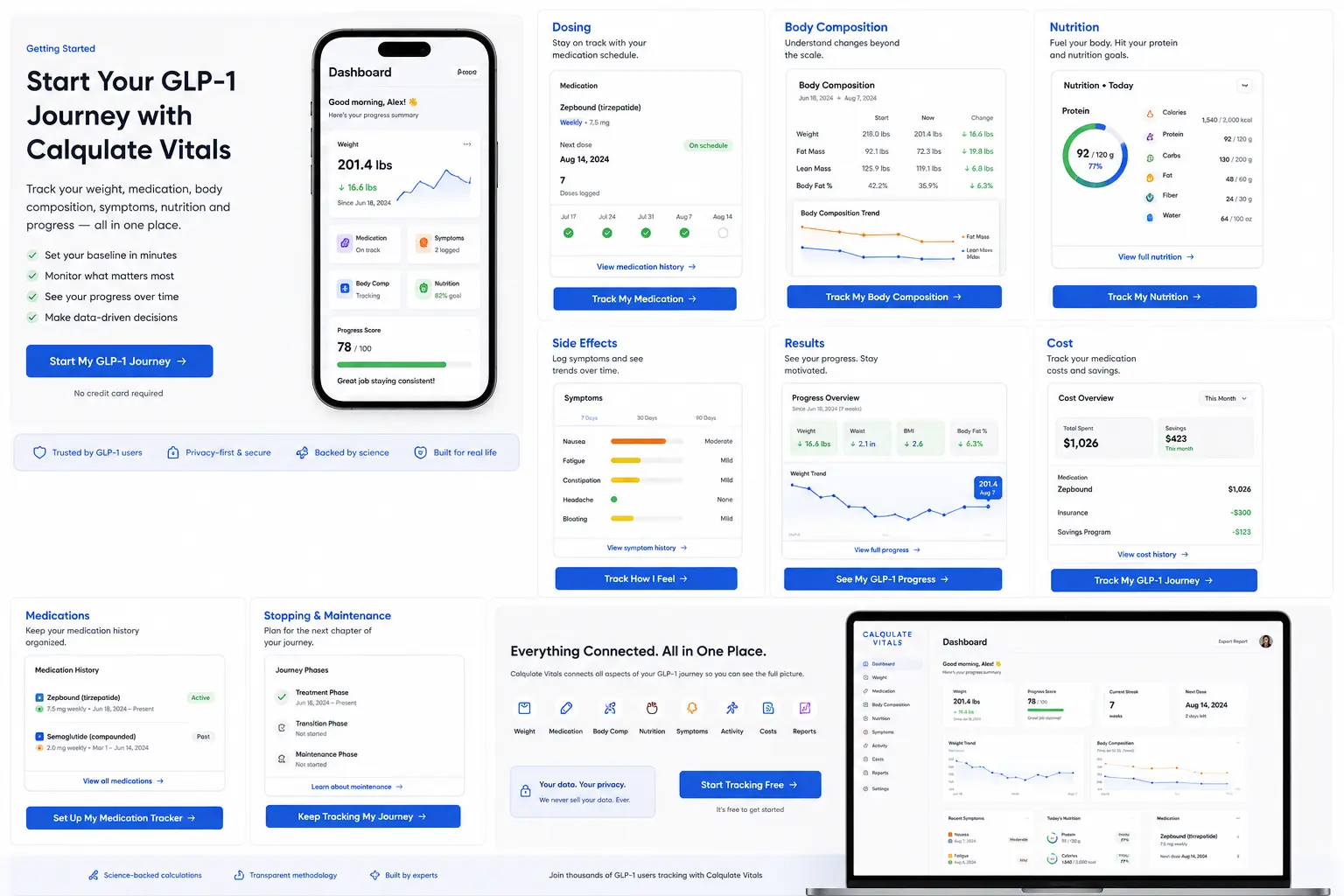
Most people want the same two answers: how fast am I likely to lose, and is my week's loss actually on trend? Calqulate's weight-loss tools are built to answer both. The Weight-Loss Timeline projects a curve from your starting weight and target dose. The Weight-Loss Calculator estimates a 68-week outcome from the trial averages that match your medication. The Progress Plotter charts every entry against a goal line so a plateau shows up in a chart, not after four missed weeks.
Body composition
The scale is the loudest metric on a GLP-1 and often the least useful. A pound of fat and a pound of muscle weigh the same, but only one of them keeps your resting metabolism where you want it. That is why our body-composition tools track lean mass, waist and fat percentage as their own series — so a “good week” on the scale doesn't hide muscle loss underneath.
Muscle preservation
Any large calorie deficit — GLP-1 or otherwise — costs some lean mass. The published estimates are wide (roughly a quarter to a third of the weight you lose can come from lean tissue if nothing is done about it), and the two levers that reliably narrow that band are protein intake and resistance training. Neither is unique to GLP-1s, but the medication makes it easy to eat too little of both by accident because appetite is suppressed across the board.
Practical starting points most clinicians and dietitians recommend are: hit a daily protein floor set by your body weight and activity level, and lift something heavy against gravity two to three times a week. Neither Calqulate nor its tools prescribe those specifics — they belong in a conversation with your dietitian or prescriber — but the tracker and body-composition tools are designed to make the underlying trend visible.
Side effects
The most common side effects across GLP-1s are gastrointestinal — nausea, reduced appetite, constipation, occasional diarrhea and reflux. They cluster in the first few weeks of a new dose and typically settle as the body adjusts. Serious but rare events (severe pancreatitis, gallbladder disease, allergic reactions and, in specific populations, thyroid-related risks) are documented on the FDA prescribing information linked in the Sources section below and warrant same-day contact with a clinician if they occur.
Nutrition on a GLP-1
When appetite falls, the food you do eat has to work harder. That usually means front-loading protein at the meal you feel most hungry at (often breakfast), keeping fiber and water up so the slower stomach emptying doesn't become constipation, and treating alcohol carefully — it hits harder on a smaller plate. Calqulate's nutrition guides are practical rather than prescriptive.
Medication-specific guides
Individual medication pages cover the FDA label, the dose ladder, the pivotal trials, the most common questions and the head-to-head comparisons — one place per medication so you don't have to hunt.
Read the Medications cluster hub
Head-to-head comparisons
Dosing
Every GLP-1 uses a titration schedule — small doses at the start, increased at fixed intervals — because starting high causes more nausea and quitting. The dosing tools on Calqulate look up your standard step for the week you're on, plus the arithmetic behind mg → units on a pen or U-100 syringe. They are references, not prescriptions.
Getting started
The first month is the hardest — the dose is the lowest, the side effects are the most surprising, and the scale hasn't moved much yet. The Getting Started hub walks through the questions to expect from a prescriber, the eligibility criteria most insurance plans use, what to have in the fridge and cabinet before your first injection, and what changes to expect week by week.
Cost and access
GLP-1 pricing depends on the medication, the plan, the state, the pharmacy, and whether you use a brand savings program or a compounded route. The cost tools model the trade-offs so you can go into a coverage call with real numbers.
Stopping and maintenance
Coming off a GLP-1 is a real decision. The published evidence shows appetite and weight rebound is common after discontinuation, especially without a maintenance plan for protein, resistance training and cost of replacement. The Stopping hub covers taper strategies people discuss with their clinicians, what maintenance dosing looks like, and how to keep the muscle you protected on the way down.
Every Calqulate GLP-1 tool
The full library, one description per tool. All are free, no sign-up required.
When to contact a clinician
Same-day care if any of these happen:
- Severe, persistent abdominal pain — especially if it radiates to the back.
- Uncontrolled vomiting or dehydration.
- Signs of a serious allergic reaction (swelling of the face, throat or tongue; trouble breathing).
- Symptoms of low blood sugar (especially if you also take insulin or a sulfonylurea).
- Yellowing of the skin or eyes, or dark urine.
- A neck lump, hoarseness or difficulty swallowing that is new.
Non-emergency changes worth an appointment with your prescriber include: side effects that are worsening rather than settling after a dose increase, a plateau that has lasted more than 8–12 weeks with no change in protein or training, or any new medication that could interact with your GLP-1.
Primary sources
Every medical claim on this hub traces back to one of the sources below. Every URL resolves to the regulator or the publisher directly — no press releases, no aggregators.
- Wegovy (semaglutide) prescribing information — U.S. FDA
- Ozempic (semaglutide) prescribing information — U.S. FDA
- Zepbound (tirzepatide) prescribing information — U.S. FDA
- Mounjaro (tirzepatide) prescribing information — U.S. FDA
- STEP 1 — once-weekly semaglutide in adults with overweight or obesity — NEJM 2021
- SURMOUNT-1 — tirzepatide once weekly for the treatment of obesity — NEJM 2022
- SURMOUNT-5 — tirzepatide vs. semaglutide, head-to-head — NEJM 2025
Tool Information
August 2026
Dr. Jaydeep Sanghani
Meet Akabari

Dr. Jaydeep Sanghani
MBBS, MD, DNB(Anaesth.), PDCC(CCM), DrNB(CCM)
AIIMS Bhubaneswar · AIIMS Rishikesh
Critical care specialist and anesthesiologist with advanced training from AIIMS. Reviews health calculators at Calqulate to ensure medical accuracy and evidence-based standards.
Frequently asked questions
Frequently Asked Questions
Common questions and answers about this calculator.
What is a GLP-1?
GLP-1 receptor agonists are a class of medications that mimic the natural hormone glucagon-like peptide-1. They slow gastric emptying, improve insulin release after meals and reduce appetite. Semaglutide (Ozempic, Wegovy), tirzepatide (Mounjaro, Zepbound), liraglutide (Saxenda, Victoza) and compounded formulations are the most common. They are prescribed for type 2 diabetes and, at higher doses, for chronic weight management.
How much weight do people lose on GLP-1 medications?
In pivotal trials, adults on semaglutide 2.4 mg (Wegovy) lost about 15% of baseline body weight over 68 weeks in STEP-1, and adults on tirzepatide 15 mg (Zepbound) lost about 21% over 72 weeks in SURMOUNT-1. In the SURMOUNT-5 head-to-head trial, tirzepatide led to about 20% mean weight loss vs. about 14% for semaglutide over 72 weeks. Individual results vary and depend on dose adherence, nutrition, protein intake and resistance training.
Which GLP-1 is right for me?
That is a decision between you and your prescriber, based on your indication (diabetes vs. weight management), insurance coverage, side-effect tolerance and cost. Tirzepatide has shown greater average weight loss than semaglutide in the SURMOUNT-5 head-to-head trial. Semaglutide has the longest safety and cardiovascular outcomes evidence. Compounded versions can be lower cost but come with different regulatory oversight. The medication comparisons on this hub walk through the trade-offs.
Is Calqulate a prescription service?
No. Calqulate does not prescribe, sell or ship medications. Every calculator and guide here is educational, and none of it replaces guidance from your prescriber or pharmacist.
How is my progress tracker data used?
The GLP-1 progress tracker is designed for private, personal use. Weight entries, injection logs, side-effect journals and photos are yours. We use aggregated, de-identified trends to improve the product, but no individual can be identified from those aggregates. Full details are in the privacy policy.
Educational only. Everything on this hub is written to help you understand your medication, not to prescribe it. Medical content is reviewed by Dr. Jaydeep Sanghani. Always confirm your dose, injection schedule and side-effect concerns with your own prescriber and pharmacist.